Support

Temple of Olympian Zeus

About

The Temple of Olympian Zeus, also known as the Olympieion, is one of the most magnificent and historically significant landmarks in Athens. Located in the heart of the capital of Greece, this ancient temple was once the largest in the country and a majestic example of ancient architecture. Its construction spanned several centuries and was only completed during the reign of the Roman Emperor Hadrian.

Even today, its ruins leave an indelible impression. Of the once colossal structure that featured 104 giant columns, only a few remain today. These monumental Corinthian columns, which locals and tourists poetically call the "bones and joints of the ancient city," speak eloquently of the temple's former greatness.
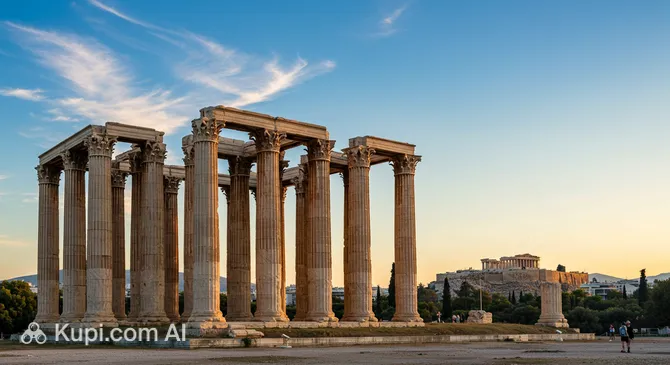
Temple of Olympian Zeus. Illustration.
Source: Kupi.com AI

Traveler photos:

According to ancient legend, the temple was built on the site of an even older sanctuary dedicated to Deucalion—the mythical forefather of the Greek people. This connection to mythology gives the site a special aura, immersing visitors in the atmosphere of ancient legends and allowing them to touch the origins of Hellenic civilization.

Visiting the Temple of Olympian Zeus is a must for any traveler. Despite only a small part of the original structure surviving to this day, it remains one of the country's most impressive architectural monuments and allows one to fully sense the scale and majesty of the ancient world.

Contacts

To plan your visit to the Temple of Olympian Zeus and check the latest information, such as opening hours or ticket prices, it is recommended to use the official contact details. As the temple is a significant archaeological site, all necessary information for tourists is available through official channels.

How to contactContact
AddressAthens 105 57, Greece
Phone number+30 21 0922 6330
Websiteodysseus.culture.gr

What to Do

Visiting the Temple of Olympian Zeus is an opportunity to literally touch centuries of history and feel the former majesty of the ancient world. The main draw for travelers is, of course, the surviving giant Corinthian columns. Walking through the archaeological site, you can get a close look at these monumental structures standing about 17 meters tall and appreciate the scale of what was once the largest temple in Greece. Even in ruins, the Olympieion radiates power and allows you to imagine how grand it was during its heyday.

The area around the temple is a true open-air museum, where you can see not only the remains of the sanctuary itself but also other historical artifacts. This place creates a unique contrast between antiquity and modernity, as the majestic ruins are located in the heart of bustling Athens. A walk here is not just sightseeing, but a total immersion in an atmosphere where eras intersect. Additionally, the temple grounds offer a magnificent view of the Acropolis, making it even more attractive to visitors.

The Temple of Olympian Zeus is an ideal place for those interested in photography. Many tourists and photographers recommend coming here at sunset, when the rays of the setting sun paint the marble columns in warm golden tones, creating a truly magical scene. This is a time to take especially impressive photos against the blue or sunset sky. For a more comfortable visit, it's better to choose morning or evening hours when there are fewer tourists and it's not as hot.

Getting There

The Temple of Olympian Zeus is located in the very heart of Athens, making it easily accessible for travelers. Thanks to its central position, this majestic landmark can be reached in several convenient ways, seamlessly fitting into any tourist itinerary through the Greek capital.

The easiest and fastest way to reach the temple is by metro. The nearest station, "Acropolis" (Red Line 2), is just an 8-15 minute walk away. You can also take the metro to "Syntagma" station (Lines 2 and 3), from where the walk to the Olympieion takes about 15-20 minutes. Additionally, several bus and trolleybus routes pass near the temple, stopping at Amalias Avenue or Vasilissis Olgas Street, providing another convenient alternative.

Given that the temple is within walking distance of the city's key historical sites, many tourists prefer to get there on foot. It is located just 500 meters from the Acropolis and 700 meters from Syntagma Square, next to the famous Plaka district. This allows you to easily include a visit to the ruins of the Temple of Zeus in a walking tour of the historic center of Athens while enjoying views of the ancient city along the way.

Nearest city: Athens

History & Facts

The history of the Temple of Olympian Zeus is a true saga of a long-term construction project that spanned centuries. Its construction began in the 6th century BC, specifically in 515 BC, during the reign of the tyrant Peisistratus. Originally intended to be the greatest temple in Greece, the project faced political changes. After the establishment of democracy in Athens, interest in the massive project waned, and it was abandoned for centuries. Furthermore, some of its parts were even used by the statesman Themistocles to build a defensive wall connecting the city with Piraeus.

A new chapter in the temple's history began in 175-164 BC thanks to the Hellenistic Syrian King Antiochus IV Epiphanes, who resumed construction and decided to build it in the luxurious Corinthian order. However, the Olympieion's adventures didn't end there. In 84 BC, the Roman dictator Sulla, having captured Athens, couldn't resist the temple's beauty: he removed several carved capitals from the columns and sent them to Rome to decorate the Temple of Jupiter Capitolinus. Despite this, even in its unfinished state, the structure made a colossal impression—the Roman historian Titus Livy called it "the only one in the world worthy of this deity" a century later.

Construction was finally completed only in 129-132 AD during the reign of the Roman Emperor Hadrian, a great admirer of Greek culture. Thus, more than 650 years passed from the laying of the first stone to the completion of the work—a unique case even for ancient architecture. It was thanks to Hadrian that the temple appeared in all its splendor, becoming one of the most magnificent structures of the ancient world and the center of the imperial cult in Athens.

Time Needed

To fully enjoy a visit to the Temple of Olympian Zeus, it is worth setting aside about 1-2 hours. This time is usually sufficient to leisurely walk around the entire archaeological complex, carefully examine the surviving majestic columns, read the information on the stands, and, of course, take several memorable photos against the backdrop of the ancient ruins. For those very short on time, a quicker visit of 15 to 30 minutes is possible to get a general impression of the structure's grandeur.

When planning your day, keep in mind that the Olympieion is located in the heart of Athens' historic center. If you want to dive deeper into Greek history and culture, a visit to the temple can easily be combined with other iconic sights nearby, such as the Acropolis. In this case, it's worth allowing half a day or even a full day for the entire route, allowing you to explore the treasures of the ancient city without rushing.

Working Hours

The Temple of Olympian Zeus is open for visits year-round, but its opening hours vary significantly depending on the season. During the summer period, which lasts from April to October, the archaeological complex is usually open to tourists daily from 8:00 AM to 8:00 PM. In the winter months, from November to March, the hours are shorter—you can visit the attraction from 8:30 AM to 3:00 PM. Keep in mind that schedules may change on public holidays, so it is highly recommended to check current information on the official website of the Ministry of Culture of Greece or at tourist centers in Athens before your visit.

Generally, advance booking is not required to visit the temple, and tickets can be purchased on-site. However, to avoid queues, especially during the peak tourist season, you can buy tickets online. Additionally, for those planning to visit several of the city's key landmarks, there is a cost-effective combined ticket. It is valid for several days and includes access not only to the Temple of Olympian Zeus but also to the Acropolis, the Ancient Agora, and other iconic historical sites, allowing you to save significant time and money.

Nearby

The location of the Temple of Olympian Zeus in the heart of Athens makes it an ideal starting point for exploring the city's other treasures. A walk around the temple's surroundings allows you not just to see individual sights, but to form a comprehensive picture of the grandeur of ancient Greece, as many iconic sites are literally just a few steps from each other.

Exploring nearby historical and cultural monuments will enrich your trip and allow you to make the most efficient use of your time. In just a few minutes, you can move from the grand ruins of the Olympieion to other equally impressive places, each with its own unique history. Below is a list of attractions located in the immediate vicinity.

NameDistance
Acropolis Museum0.4 km
National Garden of Athens0.5 km
Theatre of Dionysus0.5 km
Parthenon0.6 km
Acropolis of Athens0.7 km
Syntagma Square0.7 km
Tomb of the Unknown Soldier0.7 km

Have you reached the end of the page?

So the route has been studied inside and out