Support

Acropolis Museum

About

The Acropolis Museum is one of the most significant and modern museums not only in Greece but in the entire world. It is located in the heart of Athens, at the foot of the legendary Acropolis hill, making it the starting point for immersion into the history of ancient civilization. This museum has become a must-visit destination for anyone interested in the art and archaeology of Ancient Greece.

The museum building, which opened to visitors in 2009, is an architectural masterpiece in its own right. Designed by Swiss architect Bernard Tschumi, it combines glass and concrete to create a bright and spacious exhibition space. One of the unique features is the glass floor on the first level, through which visitors can see the ruins of an ancient city quarter discovered during construction. The museum's extensive collection includes over 3,000 artifacts found on the Acropolis and its slopes, including priceless sculptures and fragments of ancient temples.

The museum's exhibition is logically structured across several levels. The middle level features galleries covering periods from the Archaic to the Roman Empire. The building is crowned by the "Parthenon Gallery"—a hall where surviving fragments of the Parthenon frieze are displayed, and panoramic windows offer breathtaking views of the temple itself. Other treasures in the collection include the famous Caryatid statues from the porch of the Erechtheion and the "Moschophoros" (Calf-Bearer) statue.
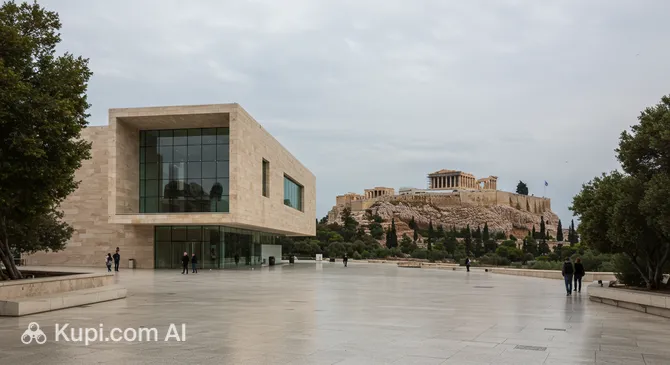
Acropolis Museum. Illustration.
Source: Kupi.com AI

Traveler photos:

A visit to the Acropolis Museum is not just a tour of exhibits, but a real journey through time, allowing for a deeper understanding of the culture and daily life of the ancient Athenians. Modern facilities, including ramps and elevators, make the museum accessible to all categories of visitors, offering them a comfortable and educational adventure in the world of antiquity.

Contacts

For the most accurate and up-to-date information regarding opening hours, ticket prices, and current exhibitions at the Acropolis Museum, it is recommended to visit its official website. You can also consult staff at the information desk directly in the museum or contact the administration using the contact details provided below.

How to contactContact
AddressDionysiou Areopagitou 15, Athina 117 42, Greece
Phone number+30 21 0900 0900
Websitewww.theacropolismuseum.gr

What to Do

A visit to the Acropolis Museum offers visitors a rich cultural experience and full immersion into the history and art of ancient Athens. You can spend several hours here exploring the exhibitions that tell the story of the city's life in different eras. The halls display famous statues and reliefs, including priceless fragments of the Parthenon, allowing you to appreciate the skill of ancient sculptors. This is a must-see for anyone interested in Ancient Greek civilization who wants to see firsthand the artifacts that shaped Western culture.

For the convenience of guests, the museum provides all necessary facilities. Cloakrooms are located on the first floor, where you can leave personal belongings and large bags before starting your tour. It is worth noting that all items brought inside undergo a security check at the entrance. The museum cares about the accessibility of its exhibits for everyone: for visually impaired visitors, a brief guide in Braille is available and can be obtained at the information desk. This makes exploring the great heritage of Greece comfortable and educational for every guest.

Getting There

The Acropolis Museum is located in the very heart of Athens, at 15 Dionysiou Areopagitou St., at the foot of the southeastern slope of the Acropolis, making it easily accessible for travelers. The most convenient and fastest way to reach the museum is by public transport. The nearest metro station, "Akropoli", is located on the Red Line (M2) and is just a few minutes' walk from the museum entrance. This option allows you to avoid city traffic and save time.

In addition to the metro, the museum can be reached by bus and trolleybus. For example, bus route No. 230 stops right next to the museum. Also, the "Makrygianni" and "Chatzichristou" stops, which serve numerous city routes, are within a 5-minute walk. For tourists who prefer to see the city in comfort, Hop-on Hop-off tourist buses are a convenient solution, as they also have a stop near the Acropolis Museum.

If you prefer to travel by taxi or rental car, reaching the museum is straightforward; however, keep in mind that parking in central Athens is limited. Due to its central location, the museum is also a pleasant walk from nearby historical districts such as Plaka or Monastiraki. A stroll along the pedestrianized Dionysiou Areopagitou Street will not only lead you to your destination but also allow you to enjoy views of the ancient monuments.

Nearest city: Athens

History & Facts

The history of the modern Acropolis Museum began long before its opening in 2009. The first museum was built as early as 1865 right on the Acropolis hill, southeast of the Parthenon. However, as archaeological excavations that began in 1886 brought more and more priceless finds to light, it became obvious that the small building could not house the entire collection. For many years, this fact served as one of the main arguments against returning the Parthenon Marbles, which were removed by Lord Elgin and are kept in the British Museum, to Greece.

The idea of creating a new, more spacious, and modern museum space was the answer to this challenge. The project was designed by Swiss architect Bernard Tschumi in collaboration with Greek colleague Michael Photiadis. Construction faced an unexpected difficulty: ruins of an ancient city quarter were discovered beneath the foundation. The architects had to adjust the plan, and eventually, the entire building was erected on columns, elegantly hovering over the archaeological site, which is now visible to visitors through glass floors. The head of the organization for the museum's creation was archeology professor Dimitrios Pandermalis, and on June 20, 2009, the new Acropolis Museum officially opened its doors.

The opening of the museum was not only a cultural but also a symbolic event. It marked a new stage in Greece's struggle to reunite all surviving fragments of the Parthenon. During the opening ceremony, a significant act took place: the Vatican Museums returned a fragment of one of the Parthenon metopes to Athens. This gesture highlighted the main mission of the new museum—to become a home for all the sculptures of the great temple, gathered together in their historical homeland, within direct sight of the Acropolis itself.

Time Needed

When planning a visit to the Acropolis Museum, it is worth setting aside enough time to enjoy its rich collection without rushing. For a general overview of the main exhibits, it is recommended to allocate at least two to three hours. This time will be enough to see the famous "Parthenon Gallery," view the original Caryatid statues, and get a general impression of the museum's main treasures.

If you want to dive deeper into history and study the artifacts in detail, it is better to set aside 3 to 4 hours, or even half a day. This approach will allow you not only to carefully examine masterpieces of the Archaic period and Roman-era exhibits but also to study the ruins of the ancient city quarter, visible through the glass floor on the first level. Depending on your interest, the time spent in the museum can vary, but on average, visitors spend between 2 and 4 hours here.

Working Hours

The Acropolis Museum is open to visitors year-round, but its operating hours change depending on the season. During the summer period (roughly from April 1 to October 31), the museum usually stays open later, while in the winter (from November 1 to March 31), it closes earlier. The museum opens at 9:00 AM, and closing times vary. It is closed on major public holidays: January 1, March 25, Orthodox Easter Sunday, May 1, as well as December 25 and 26. Since the schedule is subject to change, it is highly recommended to check the current opening hours on the official museum website before planning your visit.

To avoid long queues, especially during the height of the tourist season, it is strongly recommended to buy tickets online in advance. This will not only save you time but also guarantee entry to the museum, as tickets can sell out during peak periods. You can purchase tickets on the museum's official website as well as through third-party services, which often offer combined tours.

DayOpening hours
Monday9:00 – 17:00
Tuesday9:00 – 20:00
Wednesday9:00 – 20:00
Thursday9:00 – 20:00
Friday9:00 – 22:00
Saturday9:00 – 20:00
Sunday9:00 – 20:00

Nearby

A visit to the Acropolis Museum is just the starting point for exploring the ancient heritage of Athens. Thanks to its location at the foot of the sacred hill, you find yourself at the epicenter of historical events. A walk through the surrounding area will allow you to see firsthand the very places where the artifacts you just studied in the museum halls came from, and to feel the scale of the ancient city.

Exploring nearby attractions will enrich your experience, creating a complete picture of the greatness of Ancient Greece. Many iconic monuments are within walking distance, making it easy to plan a walking route and continue your journey through time. Below is a list of interesting places located near the museum.

NameDistance
Theatre of Dionysus0.2 km
Acropolis of Athens0.4 km
Temple of Olympian Zeus0.4 km
Parthenon0.4 km
Odeon of Herodes Atticus0.4 km
Areopagus Hill0.6 km
Roman Agora0.7 km

Have you reached the end of the page?

So the route has been studied inside and out