Support

Temple of Hephaestus

About

The Temple of Hephaestus, also known as the Hephaisteion, is one of the most impressive and well-preserved ancient Greek sanctuaries, standing proudly on the Kolonos Agoraios hill in the heart of Athens, the capital of Greece. This outstanding monument of the Periclean era still amazes visitors with its integrity and craftsmanship, being the most intact building within the grounds of the ancient Athenian Agora.
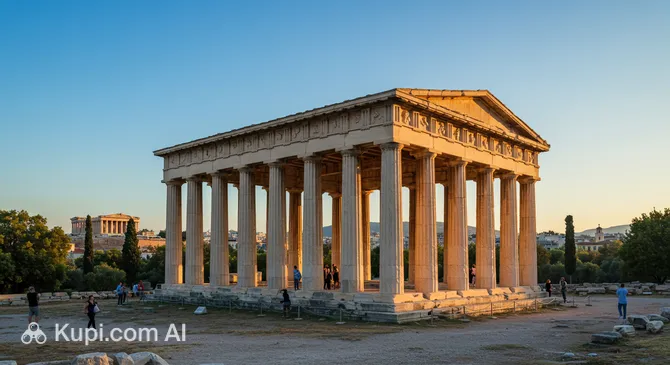
Temple of Hephaestus. Illustration.
Source: Kupi.com AI

Traveler photos:

Initially, the temple was mistakenly named the Theseion, based on the belief that the remains of the legendary hero Theseus were laid to rest here. However, later archaeological research convincingly proved that this magnificent structure was dedicated to the god of fire, blacksmithing, and crafts—Hephaestus, as well as Athena Ergane, the patroness of craftsmen. The temple is a vivid testimony to the religious and cultural life of ancient Athens.

Built entirely of Pentelic marble, the Temple of Hephaestus is designed in the strict and majestic Doric order. Its dimensions at the stylobate (the top step of the base) are 13.72 by 31.77 meters, and its structure is framed by a colonnade of 6 columns on the short sides and 13 on the long sides. This type of temple, surrounded by columns on all sides, is called a peripteros. The internal space, or cella, included a pronaos (front porch), a naos (main sanctuary), and an opisthodomos (rear porch). The temple was once richly decorated with sculptural compositions, fragments of which have partially survived and tell of mythological feats and deities.

Visiting the Temple of Hephaestus is a unique opportunity to touch history, feel the atmosphere of antiquity, and admire one of the most significant architectural masterpieces of Ancient Greece. Its monumentality and excellent state of preservation make it a must-see for any traveler interested in ancient culture and history.

Contacts

Since the Temple of Hephaestus is an ancient historical monument, it does not have traditional contact details such as a phone number or email address. To visit this outstanding landmark in Athens, you need to head to the grounds of the Ancient Agora, specifically to the Kolonos Agoraios hill, where the temple is located. Current information regarding opening hours and ticket prices can usually be found on the official website of the Athenian Agora or at the city's tourist information centers.

How to contactContact
AddressAthens 105 55, Greece
Phone number+30 21 0321 0185
Websiteodysseus.culture.gr

What to Do

Visiting the Temple of Hephaestus is a true immersion into the history and culture of Ancient Greece. Once here, you can examine in detail the wonderfully preserved architecture of this ancient sanctuary. Note the strict lines of the Doric style and appreciate the skill of the ancient Greek architects who created this masterpiece. This is a unique opportunity to see one of the most complete temples of antiquity firsthand and imagine what life was like in Athens thousands of years ago.

The main activity here is a leisurely walk around the temple itself and through the territory of the Athenian Agora, where it is located. You can take impressive photos against the backdrop of majestic columns and ancient stones. Climb the Kolonos Agoraios hill where the temple stands to enjoy panoramic views of the surrounding Agora—the ancient center of Athens' public life. Although rituals in honor of the god Hephaestus are no longer held here today, the site itself retains an atmosphere of antiquity and allows you to feel the connection between eras.

As you explore the temple, you can pay attention to its structural features: the friezes and metopes that were once decorated with reliefs depicting scenes from myths. Imagine what this place looked like in its heyday, when it served not only as a religious center but also as a symbol of the power and culture of ancient Athens. This is a great opportunity for history and archaeology enthusiasts to delve into the details and feel the spirit of antiquity.

Getting There

Getting to the Temple of Hephaestus in Athens is quite simple, as it is located in the very heart of the city within the grounds of the Ancient Agora. This is a popular tourist destination, and many routes—both public transport and pedestrian—lead to it.

The most convenient way to reach the Temple of Hephaestus is to use the Athens Metro. The nearest stations are "Thissio" on the Green Line (Line 1) and "Monastiraki", where the Green (Line 1) and Blue (Line 3) lines intersect. From both stations, the entrance to the Ancient Agora, where the temple is located, is just a few minutes' walk away. The area around the Agora is also served by city buses, but the metro is usually a faster and more predictable option due to potential traffic.

If you prefer comfort or are traveling with luggage, you can take a taxi. A trip from the central districts of Athens to the Ancient Agora will be short and relatively inexpensive. Just tell the driver "Ancient Agora" or "Hephaisteion." Additionally, since the temple is in the historic center, it is easily reachable on foot from other key attractions such as the Acropolis or the Plaka district, allowing you to enjoy a walk through the ancient city.

Nearest city: Athens

History & Facts

The construction of the Temple of Hephaestus took place during the Golden Age of Athens, during the reign of Pericles, and is dated between 460 and 420 BC. Although the name of the architect who created this masterpiece remains a mystery to history, there is a suggestion that it might have been the same talented builder who designed the temples at Cape Sounion, the Temple of Ares in the Agora, and the Temple of Nemesis in Rhamnous. The temple was dedicated to Hephaestus—the powerful god of fire and the patron of blacksmithing and metallurgy, which was highly symbolic for this area of the ancient city.

The choice of site for the Temple of Hephaestus was far from accidental. It was erected in close proximity to the quarter where the blacksmiths and metalworkers of ancient Athens bustled with activity, emphasizing its connection with the patron of craftsmen. Due to its importance and, undoubtedly, its beauty, the temple quickly became one of the largest and most revered sanctuaries in the city, attracting many worshippers and pilgrims seeking the support of Hephaestus.

Throughout its centuries-long history, the Temple of Hephaestus was used for various purposes, which, however, did not prevent it from reaching us today in remarkably good condition. Contrary to some sources claiming that only ruins remain, it is actually one of the best-preserved ancient Greek temples in the world. Its sturdy construction and fortunate location allowed it to withstand the tests of time, preserving its grandeur for posterity.

Time Needed

Exploring the Temple of Hephaestus itself usually takes about 1-2 hours. This time is generally sufficient to leisurely walk around this magnificent structure, admire its well-preserved architecture, examine the details of the friezes and metopes, and take memorable photos against the backdrop of ancient columns. You will be able to feel the atmosphere of antiquity and appreciate the skill of the ancient architects.

Of course, the duration of your visit may vary depending on your interest in ancient Greek history and architecture. If you want to dive deeper into the atmosphere of the place, feel its grandeur, and perhaps study the information boards located nearby, it is worth allocating a bit more time. It is also important to remember that the Temple of Hephaestus is part of a more extensive archaeological complex—the Ancient Agora of Athens. If you plan to explore the entire territory of the Agora, including the museum and other ruins, this will require several hours or even half a day.

Working Hours

The Temple of Hephaestus, being part of the Ancient Agora of Athens archaeological complex, is generally open to visitors year-round. However, exact operating hours may vary depending on the season: they are typically longer in the summer and shorter in the winter. Since specific hours can change, it is highly recommended to check the most up-to-date information on the official website of the Ministry of Culture of Greece or the information resources of the Ancient Agora before your visit.

Regarding ticket booking, individual visitors usually purchase them on-site at the entrance to the Agora. However, if you are traveling in a large group or planning a visit during the peak tourist season, it is worth checking in advance if pre-booking is required or if online ticket purchase is available to avoid queues. In general, the attraction is accessible for most of the year, except for certain public holidays when it may be closed or operate on a reduced schedule.

8:00 – 20:00

Nearby

A visit to the Temple of Hephaestus is undoubtedly a highlight, but Athens is so rich in history that exploring the surroundings can significantly enrich your experience. Located in the heart of the Ancient Agora, the temple is surrounded by many other significant monuments and interesting spots just a few steps away. This allows for a more complete understanding of life in the ancient city and its cultural heritage.

By setting aside some time to explore nearby attractions, you can dive deeper into the atmosphere of antiquity and see how the Temple of Hephaestus fit into the overall ensemble of ancient Athens. Each such place tells its own unique story, complementing the overall picture of your journey.

NameDistance
Ancient Agora of Athens0.1 km
Picky Brunch & Specialty Coffee0.3 km
Roman Agora0.4 km
Areopagus Hill0.4 km
Acropolis of Athens0.6 km
Parthenon0.6 km
Odeon of Herodes Atticus0.6 km

Have you reached the end of the page?

So the route has been studied inside and out