Support

Ancient Agora of Athens

About

The Ancient Agora of Athens is not just ruins; it is the heart of ancient Athens, the cradle of democracy and public life in Greece. Located on a gentle slope northwest of the Acropolis, this vast area was the primary meeting place of the city. The name "Agora" itself comes from the ancient Greek word meaning "to gather," which perfectly describes its historical role.
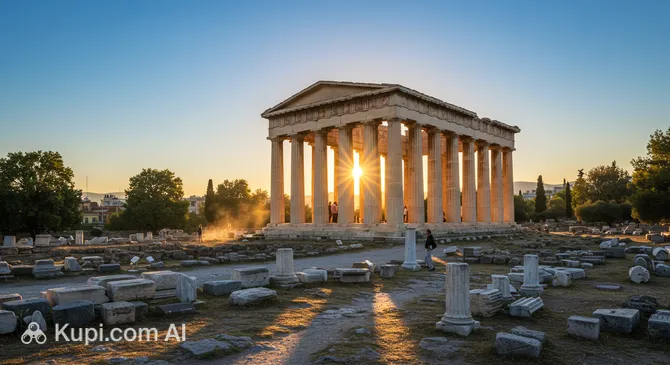
Ancient Agora of Athens. Illustration.
Source: Kupi.com AI

Traveler photos:

In antiquity, life was in full swing here: the Agora served as the center of civic administration, justice, bustling trade, and commerce. It was where the first theatrical performances were staged, athletic competitions were held, and heated intellectual debates took place. One could say that the foundations of Western civilization were laid right here, as the most important philosophical and political ideas were discussed in this square.

Today, the Athens Agora is a unique open-air archaeological park. Walking among the ruins of temples and public buildings, it is easy to imagine the daily life of the ancient Greeks.

Its convenient location at the foot of the Acropolis and next to the colorful Monastiraki district makes the Agora a mandatory stop on the itinerary of any traveler wishing to touch great history.

Contacts

To contact the administration of the "Ancient Agora of Athens" archaeological site or to find up-to-date information on opening hours and ticket prices, please use the official channels. The complex is located at: Adrianou 24, Athina 105 55, Greece.

How to contactContact
AddressAthens 105 55, Greece
Phone number+30 21 0321 0185
Websiteodysseus.culture.gr

What to Do

A visit to the Ancient Agora of Athens is a true immersion into history. As you wander through its vast territory, you can explore numerous archaeological monuments, including the ruins of administrative buildings, ancient temples, and public services that were once the center of life in Athens. This is a unique opportunity to see for yourself where democracy was born and public thought flourished in Greece.

Several impressive sites draw particular attention from tourists. You will see the monumental pedestals of the statues of Giants and Tritons, which once decorated the facade of one of the buildings. Equally interesting is the Odeon of Agrippa—an ancient concert hall built in 15 BC, designed for 1,000 spectators. Imagine this grand structure with its two-story gallery, where audiences once gathered to enjoy musical performances and lectures.

After exploring the ancient ruins, your journey can continue in the neighboring Monastiraki district, which lies right next to the Agora. This place is famous for its lively market-like atmosphere, with numerous shops and stalls. Here you can feel the flavor of Greek folklore, find unique souvenirs, and simply enjoy the vibrant atmosphere of the modern city, which contrasts so sharply with the tranquility of the ancient ruins.

Getting There

Getting to the Ancient Agora of Athens is easy thanks to its excellent location in the heart of the historic center of Athens. The archaeological park is situated at the foot of the Acropolis in the lively Monastiraki district. This makes it simple to include in a walking tour of the city's main attractions. The walk from the Acropolis takes no more than 10–15 minutes.

The most convenient way to reach the Agora is by using the Athens Metro. There are two nearby stations: Thissio on the Green Line (M1) and Monastiraki, where the Green (M1) and Blue (M3) lines intersect. From both stations, the entrance to the complex is just a 5–7 minute walk. City bus No. 227 also stops nearby, providing an additional alternative.

If you prefer comfort, taxi services are always available. A trip from the city center will be quick and inexpensive. However, walking or taking public transport allows you to better experience the atmosphere of this ancient city by passing through streets that are themselves part of Greece's rich history.

Nearest city: Athens

History & Facts

The history of the Ancient Agora of Athens is closely intertwined with the development of the city itself. Originally, it was an open, haphazardly built-up area at the foot of the Acropolis. Over time, however—especially during the Hellenistic and Roman periods—the Agora acquired a clearer and more distinct structure. It is believed that during the reforms of Solon, it was designated as the central marketplace, after which the first significant buildings began to appear.

The Agora was not only a center of trade but also the most vital information hub of ancient Athens. The texts of new laws, court decisions, decrees, and official reports were displayed here on special stone slabs and stelae. Thus, any citizen could come to the square and learn about the most important events and regulations affecting the life of the polis. This made the Agora the true heart of social and political life.

Unfortunately, many of the Agora's buildings have not reached us in their original form. In 267 AD, the Heruli, a Germanic tribe, raided Athens and destroyed a significant part of the square, including the majestic Odeon of Agrippa. It was only in the 20th century that the world was able to rediscover this historical site. Starting in 1931, the American School of Classical Studies at Athens, under the direction of archaeologist T. Leslie Shear, conducted large-scale excavations, thanks to which we can see the preserved fragments of the ancient center today.

Time Needed

To fully explore the Ancient Agora of Athens, we recommend setting aside approximately 2–3 hours. This will be enough time to leisurely walk through the entire archaeological park, examine the ruins of ancient buildings, and soak in the atmosphere of this historic site. If you are short on time, a quick tour can be done in an hour and a half, but you would then have to sacrifice visiting the museum or studying individual monuments in detail.

Most of the time is spent visiting two key sites: the exceptionally well-preserved Temple of Hephaestus and the reconstructed Stoa of Attalos, which houses the Museum of the Ancient Agora. You should budget about 45–60 minutes for the museum alone—its exhibition, which includes artifacts found here, helps to better understand the daily life of ancient Athenians. The rest of the time will be spent walking through the site itself, where you can see the ruins of the Bouleuterion (council meeting place), the Tholos, and other structures.

If you are truly passionate about history and archaeology, you could easily spend half a day at the Agora. This will allow you not only to see all the sights but also to carefully study the information boards, find the best angles for photos, and simply sit on one of the benches, imagining how life once buzzed here and great philosophers spoke.

Working Hours

The Ancient Agora of Athens archaeological complex is open to visitors year-round, although the opening hours depend on the season. During the summer period (roughly from April to October), the Agora typically stays open longer, usually from 8:00 AM to 8:00 PM. In the winter season (from November to March), visiting hours are reduced, and the site closes earlier, around 5:00 PM. It is important to note that the last entry is approximately 30-40 minutes before closing. The Agora may be closed on public holidays such as December 25-26, January 1, and Easter.

To avoid long queues, especially during the high tourist season, it is recommended to purchase tickets online in advance. This can be done through the official Hellenic Heritage website or partner sites. There are also combined tickets available that allow you to visit several key attractions in Athens, including the Acropolis, which can be a cost-effective option. Nevertheless, we strongly advise checking the latest information on opening hours and potential changes on the official website of the Greek Ministry of Culture before your visit, as schedules are subject to change.

8:00 – 20:00

Nearby

A visit to the Ancient Agora of Athens is just the beginning of a fascinating journey through the historic heart of Athens. Thanks to the compact location of the main monuments, exploring the surrounding area won't take much time but will allow you to get a more complete picture of the ancient city's grandeur. The historic center of the Greek capital is literally saturated with iconic landmarks that are easy to reach on foot.

Just a few minutes' walk from the Agora are other outstanding attractions, each holding its own unique story. Walking through these sites will enrich your experience and help you dive deeper into the atmosphere of antiquity. Below is a list of nearby points of interest along with their distance from the Ancient Agora of Athens.

NameDistance
Temple of Hephaestus0.1 km
Areopagus Hill0.3 km
Roman Agora0.4 km
Picky Brunch & Specialty Coffee0.4 km
Acropolis of Athens0.5 km
Odeon of Herodes Atticus0.5 km
Parthenon0.6 km

Have you reached the end of the page?

So the route has been studied inside and out