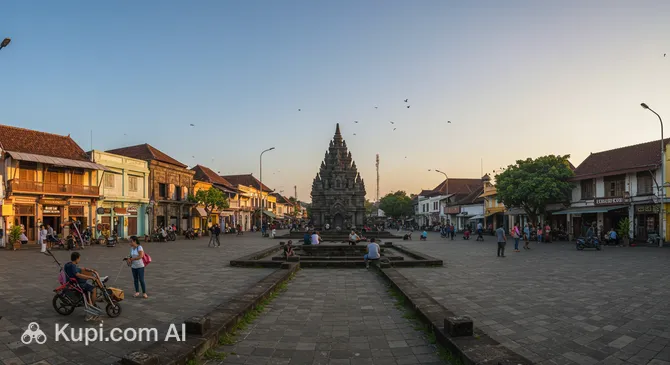
Banjar is a dynamically developing city in the West Java province, which became an independent municipality in 2003. Situated at the junction of important transport routes, it serves as a kind of "gateway" between the eastern and western parts of Java island. Unlike the bustling tourist metropolises of Indonesia, this city maintains an atmosphere of peaceful provincial life, where traditions are closely intertwined with administrative development.
Banjar. Illustration.
Source: Kupi.com AI
Geographically, the city is located at an altitude of about 107 meters above sea level and covers an area of 132 km². With a population of over 203,000 people, it is a typical Indonesian mid-sized city oriented towards the comfortable living of its local residents. Studying the city's history of development, one can notice how rapidly it transformed from a small settlement into an important administrative center of the region.
For a traveler, Banjar is primarily interesting as an authentic place where you can see the everyday life of the Javanese people without tourist embellishments. Walking through local neighborhoods and visiting central squares allows you to feel the true rhythm of West Java. We invite you to visit this hospitable city to discover Indonesia from a new, less explored side.
Weather Overview
The climate in Banjar is typical for tropical West Java: a monsoon cycle prevails here with clearly defined wet and dry seasons. The air temperature remains stable throughout the year, fluctuating in the range of 23°C to 30°C. High humidity is a characteristic feature that travelers should be prepared for in advance.
The heaviest precipitation falls between November and March, when the number of rainy days can reach 25–30 per month. During this time, showers are usually short-lived but very intense. A drier and more comfortable period for walking begins from June to September. You can study the detailed city's climate by month to choose the ideal time for your trip.
Thanks to its location at an altitude of 107 meters above sea level, it can be slightly cooler here in the evening hours than on the coast, which brings pleasant relief after the daytime heat. Despite the dense buildings, natural ventilation from the hills helps maintain a relatively comfortable microclimate in the central districts of the municipality.
Average monthly temperature
Average monthly precipitation
Interesting Facts
Banjar officially gained the status of an independent municipality quite recently—on February 21, 2003.
The city is showing impressive demographic growth: its population has nearly quadrupled since 1990.
On a national scale, Banjar ranks 128th in population among all cities in Indonesia.
The central part of the city is located at an altitude of 107 meters above sea level, which provides a slightly milder climate compared to coastal regions.
The municipality is divided into four administrative districts (kecamatan), each having its own unique characteristics of management and lifestyle.
How to Get There
Banjar is an important transport hub in West Java province, providing connections between major metropolises. Travelers most often arrive here from Jakarta or Bandung. The journey by car from the capital is about 250 km and can take from 5 to 7 hours due to the terrain and traffic density on Javanese roads. If you are planning a trip in advance, it is worth exploring all the ways of how to get to the city with maximum comfort.
The city does not have its own airport. The nearest major air hub is Husein Sastranegara in Bandung, located approximately 120–150 km away. From there, you can reach Banjar by transfer, intercity bus, or rental car in 3–4 hours. Mini-vans (angkot), which regularly run between the province's cities, are also popular.
Railway communication is one of the most convenient ways to get to Banjar. The local station accepts regional trains connecting the city with key settlements in Java. This allows you to avoid traffic jams and enjoy scenic views of rice fields and hills during the journey. It is recommended to check the current schedule, as weather conditions during the rainy season can affect the travel time.
Station
Passenger traffic
Distance
Ketapang railway station
5
64 km
Jember railway station
5
140 km
Malang railway station
7
259 km
Surabaya Gubeng railway station
8
265 km
Surabaya Pasar Turi railway station
7
268 km
Main Attractions
Although Banjar is not a recognized tourist center, it offers guests several interesting locations to get acquainted with local life. The central points of attraction here are the city squares (Alun-alun), which become meeting places for local residents in the evening. Here, you can feel the atmosphere of community unity and try popular street snacks surrounded by the municipality's administrative buildings.
An important part of city life is the local markets, distributed across the four districts of the city. Visiting these markets is an excellent opportunity to see the variety of Javanese products, spices, and handicrafts. These trading zones are not tourist-oriented, making a visit even more insightful for those seeking genuine cultural exchange.
For those interested in architecture and government structure, the city hall buildings and the government quarter, reflecting Banjar's modern administrative status, are noteworthy. Despite the absence of famous historical monuments, the city charms with its simplicity and sincerity, serving as an excellent transit point for exploring the natural beauty of West Java.
Local Cuisine
The gastronomic map of Banjar is steeped in the traditions of Sundanese cuisine, typical of West Java. The basis of the diet here is rice (nasi), served with various side dishes. Be sure to try local dishes using tofu and tempeh—fermented soy products that are prepared here with special skill. A bright highlight of any lunch is sambal—a spicy chili paste, with each chef having their own recipe.
Street food is the heart of the city's culinary scene. In numerous warungs, you can find freshly prepared soups, fried fish, and vegetable salads with peanut sauce (gado-gado). Products at the markets are always fresh, as the region is rich in agricultural land. Seafood lovers should pay attention to dishes made from river fish, which are often grilled with aromatic herbs.
As for drinks, Banjar will delight connoisseurs of strong Javanese coffee and sweet jasmine tea, served both hot and iced. Alcohol is not common due to local traditions, but the variety of freshly squeezed tropical fruit juices will impress any gourmet. The food culture here is simple and democratic: food should be hearty, fresh, and shared among friends.
Travel Tips
Preparing for your trip to Banjar will help you spend your time with maximum comfort and avoid minor troubles. These tips are based on travel experiences in West Java.
Clothing and Dress Code: Choose light clothing made of natural fabrics, as it is humid and hot in the city. Considering the Muslim traditions of the region, when visiting administrative buildings and walking in residential areas, it is worth giving preference to modest clothing (shoulders and knees covered).
Transport within the city: Use angkots or ojeks for moving around. If you plan to rent a scooter, be prepared for heavy traffic and always wear a helmet.
Finances: In Banjar, it is better to always have a supply of cash (Indonesian Rupiah) with you. ATMs are available in the center, but they may not accept cards from some international systems. Tipping is not mandatory, but a couple of thousand rupiahs for good service in a cafe will be received with gratitude.
Health: Drink only bottled water and use it even for brushing your teeth. In the evening, be sure to use insect repellent.
Communication: It is better to buy a local SIM card immediately upon arrival at the airport or at specialized points in the city center. Wi-Fi is available in most hotels, but its speed may be unstable.
Local Etiquette: Indonesians are very friendly. Greet people with a slight nod of the head. Important: use only your right hand to hand over money or food.
What to Avoid: Do not show intense emotions (anger) in public—this is considered very impolite. Also, avoid walking alone in poorly lit outskirts at night.
Additional Tip: Learn a few basic phrases in Indonesian (Bahasa Indonesia). Even a simple "Terima kasih" (Thank you) will significantly win over the local residents.
Following these simple rules, you will be able to fully enjoy the hospitality of Banjar and discover the real life of Indonesia.
Entertainment & Nightlife
The entertainment scene in Banjar is primarily focused on quiet family vacations and the traditional Javanese lifestyle. You won't find noisy nightclubs or large-scale concert halls here, but you can enjoy the coziness of local street cafes (warung). In the evenings, city residents often gather in these establishments to discuss news over a cup of traditional coffee and watch TV programs.
For those seeking more active nightlife, cinemas, and large shopping complexes, it is recommended to plan trips to neighboring Bandung. The journey takes about 2–3 hours, but that is where the region's main youth movement is concentrated. In Banjar itself, evening activity winds down quite early, leaving room for quiet strolls along the illuminated central streets.
Safety in the city is at a decent level; however, for nighttime travel, it is better to use verified taxi services or motorcycle taxis (ojek). This is not only the fastest way to get to your destination but also a way to avoid walking through unlit outskirts late at night.
Parks & Museums
The park infrastructure of Banjar is currently under active development. At the moment, the main recreational areas are small squares and landscaped areas near government buildings in the city center. Local residents often use these spaces for evening walks when the daytime heat subsides and the city fills with the soft light of lanterns.
There are no full-scale museums with large exhibitions in the city yet, as the administrative focus is on infrastructure development. However, the cultural heritage of the region is manifested in the architecture of mosques and the design of public spaces, which in themselves can serve as an object of interest for a thoughtful tourist studying the modern history of Indonesia.
For those seeking larger recreational areas, it is recommended to take a trip outside the city, where picturesque views of the Javanese countryside open up. The surroundings of Banjar are rich in natural landscapes that more than compensate for the lack of classic museums or large city parks.
Getting Around
The public transport system of Banjar is mainly represented by mini-vans traditional to Indonesia—angkots (angkot). They run on set routes between the four districts of the city and are the cheapest way to get around. Payment is made in cash to the driver upon exiting, and fixed stops are often absent—just wave your hand by the road.
For faster and more individual trips over short distances, motorcycle taxis (ojek) are ideal. This is the most mobile transport, allowing you to effectively bypass traffic jams that often occur during rush hours or near markets. Recently, taxi-hailing apps have also been gaining popularity in the region, making the moving process more transparent for tourists.
Considering the city's area of 132 km², many travelers prefer to rent a scooter for complete freedom of movement. This allows you to easily reach the outskirts and neighboring settlements. However, it is worth remembering the chaotic driving style in Java and the need to have an international driving permit. There are no subways, trams, or trolleybuses in the city, so the main focus is on wheeled transport.
Accommodation
Accommodation options in Banjar are mainly geared towards transit travelers and business people visiting the municipality on official business. Small city hotels and guesthouses (losmen) predominate here, offering basic amenities at very affordable prices. There are no luxury five-star complexes in the city, but cleanliness and Indonesian hospitality are guaranteed in most establishments in the central part of the city.
For a longer stay, you might consider renting apartments or houses from local residents. This is a popular option among expats and those working in the region. It is best to choose accommodation closer to the main transport routes or the administrative center for quick access to markets and cafes.
When planning a trip during peak periods, such as local holidays or weekends, it is recommended to book a room in advance. Although there is usually no shortage of places, booking ahead through online platforms will help secure the best option at a favorable price. The average price per night at a local hotel will pleasantly surprise a budget traveler.
Nearby Cities
Banjar is an excellent starting point for exploring the picturesque surroundings of the island. Thanks to the developed bus and rail links, travelers can easily go on day trips to larger cultural centers or quiet natural corners of the region.
Just 14 kilometers from the city is Singaraja, an ancient city with a rich heritage, and a bit further is the famous cultural center Ubud, where it is worth going for the artistic atmosphere and walks among rice terraces. It is also convenient to get to Denpasar from Banjar if you need to visit capital shopping centers or administrative institutions.
We recommend not limiting yourself to city walks and taking time to explore neighboring areas. The region around the city offers an amazing variety of landscapes—from mountain ranges to authentic villages where time seems to have stood still.
Shopping & Souvenirs
Shopping in Banjar is primarily an immersion into the life of the local population through visiting traditional markets (Pasar). Each of the four districts of the city has its own trading points where you can buy the freshest fruits, vegetables, and various spices. The largest markets are in the central district, where the main commercial activity is concentrated.
For buying everyday items, clothing, or electronics, residents and guests of the city visit small shopping centers and specialized stores along the main streets. There are no global brand boutiques here, but prices for local products remain very affordable. It's a great place to buy high-quality Indonesian textiles or batik items without the tourist markup.
As souvenirs from Banjar, it is worth bringing back local coffee, packs of traditional tapioca or tempeh chips, as well as products from local craftsmen. Shops usually operate from early morning until evening (around 20:00–21:00), and at markets, payments are made primarily in cash in the local currency. Don't forget that at traditional bazaars, appropriate and polite bargaining is part of the communication culture.