Support

Rocca Maggiore

About

Rocca Maggiore is an impressive medieval fortress standing proudly on a hill overlooking the city of Assisi in Italy. This majestic fortification is a classic example of the country's medieval military architecture and offers visitors breathtaking panoramic views of Assisi itself and the picturesque surrounding landscapes.
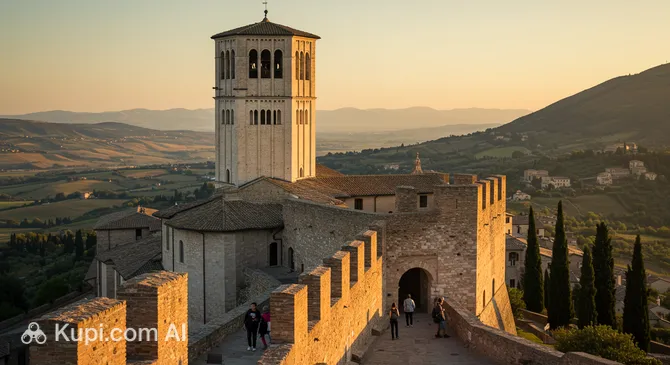
Rocca Maggiore. Illustration.
Source: Kupi.com AI

Traveler photos:

The architectural appearance of Rocca Maggiore is executed in the traditional style of Italian medieval fortifications. Characteristic features include massive fortress walls, watchtowers, and spacious inner courtyards. Throughout its centuries-long history, the fortress has been repeatedly rebuilt and reconstructed, which is why various types of masonry and architectural elements belonging to different historical periods can be observed in its structure today, making it particularly interesting to study.

Visiting Rocca Maggiore is not only an opportunity to touch history but also to enjoy some of the best views in the region. Walking along its walls and towers allows you to imagine what life was like in medieval Assisi and admire the beauty of the Umbrian valleys.

Contacts

Since Rocca Maggiore is a prominent historical landmark towering over Assisi, specific contact phone numbers are generally not published. The primary way to reach the fortress is via a scenic walk from the town; you should also inquire locally about the availability of local transport if it is provided.

For up-to-date information on opening hours, admission fees (if applicable), and the best routes, it is best to check the official Assisi tourism portals or visit the tourist information centers directly in the city.

How to contactContact
AddressVia della Rocca, 06081 Assisi PG, Italy
Phone number+39 075 813 8680
Websitewww.visit-assisi.it

What to Do

A visit to Rocca Maggiore is a true immersion into the atmosphere of medieval Italy. Once inside the fortress, you can explore its many rooms and imagine how its inhabitants lived centuries ago. It is definitely worth climbing the mighty walls and watchtowers, which offer truly breathtaking panoramic views of ancient Assisi and the picturesque Umbrian countryside stretching out around it.

While walking through the grounds of Rocca Maggiore, pay attention to the unique architectural features that eloquently tell the story of the evolution of military architecture over the centuries. The fortress's inner courtyards showcase different types of stonework from various periods of construction and reconstruction, dating back as far as the 12th century. This turns the fortress into a kind of open-air museum where you can visually study the development of medieval building techniques and see firsthand the traces of bygone eras.

Getting There

To reach Rocca Maggiore, which majestically overlooks Assisi, you can choose from several methods, though the most popular and scenic is a walk. The fortress sits at the top of a hill, and the journey from the historic city center is an adventure in itself, offering beautiful views of the Assisi surroundings and the Umbrian countryside.

The route to Rocca Maggiore typically begins in the heart of Assisi and leads uphill. The climb can be steep in places, so it is recommended to wear comfortable shoes and bring water, especially during the warmer months. Travel time depends on your pace, but the walk allows you to enjoy the beauty of the Umbrian landscapes as you gradually approach this historic monument.

If the uphill walk seems too tiring, you can use a taxi service. You can easily find a taxi in Assisi that will take you closer to the entrance of the fortress, significantly shortening the walking portion of the route. As for public transport, direct bus routes to Rocca Maggiore itself may be unavailable due to its hilltop location. However, it is always useful to check with the local tourist information center about the nearest stops or alternative ways to get up there, if any exist.

Nearest city: Assisi

History & Facts

The history of Rocca Maggiore dates back to the 12th century. The first mentions of this majestic fortress date to 1174, when it was built as a feudal possession of the German emperors. This period was marked by the significant influence of the Holy Roman Empire on many Italian cities, and Rocca Maggiore served as an important strategic point, symbolizing imperial power in the Assisi region.

A new important stage in the life of the fortress began in the late Middle Ages. Significant restoration and reconstruction work on Rocca Maggiore was undertaken in 1356 at the initiative of the influential Cardinal Albornoz (1310-1367). These large-scale transformations were carried out by special order of the church authorities, emphasizing not only the military but also the political significance of the fortress for the Papal States during that complex historical period.

Over the centuries, Rocca Maggiore has been a silent witness to the changing of eras and rulers, reflecting the turbulent history of the Umbria region and all of Italy. Its strategic location on the hilltop not only provided control over Assisi and the surrounding valleys but also made it a coveted target in numerous medieval conflicts. Beyond major renovations, the fortress likely adapted continuously to changing military technologies and the needs of its garrisons, adding another layer to its rich history—one not always obvious at first glance but felt within its ancient walls.

Time Needed

For a visit to Rocca Maggiore in Assisi, a typical visitor should allocate approximately 1.5–2 hours. This is generally enough time to leisurely explore the main parts of the fortress, climb the towers and walls, and enjoy the magnificent panoramic views of the city and the surrounding Umbrian valleys.

If you have a deep interest in medieval history and architecture, plan to take many photographs, or simply want to linger longer to admire the scenery, your visit could take up to 3 hours. The time will also depend on how thoroughly you wish to explore the various corners of the fortress and imagine the lives of its past inhabitants.

Also, factor in the time to walk up to the fortress, as it is located on a hill. The walk to Rocca Maggiore from the center of Assisi can take between 15 and 30 minutes one way, depending on your pace and the chosen route. Therefore, when planning your visit, set aside this additional travel time.

Working Hours

Rocca Maggiore is generally open to visitors year-round, but opening hours may vary depending on the season. Typically, during the summer months, the fortress stays open longer, while in the winter, visiting hours may be reduced. It is highly recommended to check the official Assisi tourism website or inquire at local tourist information centers upon arrival for precise information regarding current hours and admission prices. Occasionally, hours may change due to special events or weather conditions.

As for ticket booking, advance purchase is usually not required for individual visitors, especially during the low season. However, during the peak tourist season or if you plan to visit Rocca Maggiore as part of a large group, pre-booking or inquiring about this possibility may be advisable to avoid queues and guarantee entry. It is always a good idea to check official resources for the latest information before your visit to this famous Italy landmark.

10:00 – 18:15

Nearby

Visiting Rocca Maggiore is certainly one of the highlights of exploring Assisi, yet this amazing city and its surroundings hold many more treasures. Exploring the attractions located near the fortress will allow you to delve deeper into the history and culture of this unique corner of Italy, complementing your impressions with new discoveries and vivid moments.

A stroll through the ancient streets of Assisi leading from Rocca Maggiore to other iconic sites can be an exciting adventure in itself. Every building and every square here breathes history, and discovering nearby churches, museums, or simply picturesque corners will enrich your experience and make your journey even more fulfilling.

NameDistance
Roman Forum and Archaeological Museum0.2 km
Piazza del Comune0.2 km
Church of Santa Maria sopra Minerva0.2 km
Cathedral of San Rufino0.3 km
Portico of Monte Frumentario0.4 km
Basilica of Saint Clare0.5 km
Le Terrazze di Properzio0.6 km

Have you reached the end of the page?

So the route has been studied inside and out