Support

Bergamo Cathedral

About

Bergamo Cathedral, also known as Duomo di Bergamo, is the main Catholic church in the city of Bergamo, Italy. This majestic structure, which holds immense spiritual and cultural significance, attracts pilgrims and tourists with its rich history and architectural splendor.
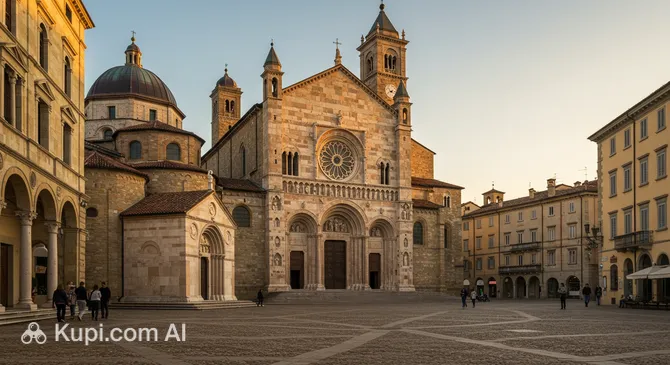
Bergamo Cathedral. Illustration.
Source: Kupi.com AI

Traveler photos:

Construction of this grand cathedral spanned several centuries, from the 15th to the 19th. This long history is reflected in its architectural appearance: the cathedral features an impressive Neoclassical facade, while expressive Baroque elements are also visible in the building's overall structure.

The main entrance to the cathedral is graced by a monumental staircase with symmetrically placed columns. Sculptural compositions are set above the entrance, including a notable statue of Saint Alexander the Martyr – the patron saint of Bergamo. The temple's interior is striking in scale, capable of accommodating over a thousand people, making Bergamo Cathedral one of the largest religious buildings in the region.

Contacts

For the most up-to-date information on the opening hours of Bergamo Cathedral, visiting conditions, or available tours, it is recommended to visit the attraction's official website or contact the tourist information centers directly in Bergamo. The cathedral is located in the heart of the Upper Town (Città Alta) and is easily accessible on foot from other key historical sites in this picturesque part of the city.

How to contactContact
AddressPiazza Duomo, 24129 Bergamo BG, Italy
Phone number+39 035 210223
Websitecattedraledibergamo.it

What to Do

A visit to Bergamo Cathedral, dedicated to Saint Alexander, offers tourists not only the chance to connect with the city's spiritual life but also to enjoy its cultural heritage. Religious services and liturgies are held regularly and are open to all. Special attention should be paid to the organ concerts that periodically take place within these majestic walls. The sound of Italian sacred music in such acoustics provides a truly unforgettable experience and creates an atmosphere of peace.

Inside the cathedral, visitors will find a rich collection of rare religious art. The interior of the temple itself is a work of art, reflecting various architectural styles due to its long construction period. History and architecture buffs will find many interesting details here, from elegant frescoes and sculptures to magnificent altars. Every corner of the cathedral tells its own story, providing a deeper understanding of the site's cultural and religious significance for Bergamo.

One of the cathedral's unique features is the preserved crypt. This underground chamber is part of the earlier 9th-century Church of St. Vincent, upon which the current cathedral was built. Exploring the crypt allows you to literally look into the past and feel the connection between eras, imagining how this sacred place appeared many centuries ago. This makes a visit to Bergamo Cathedral even more rewarding and educational.

Getting There

Bergamo Cathedral, dedicated to Saint Alexander, is located in the heart of Bergamo's historical center – the so-called Upper Town (Città Alta). This picturesque part of the city is situated on a hill and can be reached in several ways.

The most popular and perhaps most impressive way to reach the Upper Town is by taking the funicular, which connects it with the Lower Town (Città Bassa). The funicular ride is a small adventure in itself and offers beautiful views. Alternatively, walking enthusiasts can climb to the Upper Town through charming medieval streets, enjoying the atmosphere of old Bergamo. City buses also run between the Lower and Upper Towns.

If you are arriving in Bergamo by train, you can take city bus No. 1 or a taxi from the railway station in the Lower Town to the Upper Town. The bus ride takes about 15-20 minutes. Once in the Upper Town, finding the Cathedral is easy – it is located on the main square, Piazza Duomo, next to other iconic landmarks such as the Colleoni Chapel and the Basilica of Santa Maria Maggiore.

Nearest city: Bergamo

History & Facts

The history of Bergamo Cathedral is rooted in antiquity. Research suggests that a structure existed on this site even in Roman times, though its exact purpose remains a mystery. The first documentary evidence of a religious building here dates back to the 9th century, when it was the Church of St. Vincent. Interestingly, only the crypt has survived from that early structure, hidden beneath the modern cathedral as a silent witness to centuries of history.

Construction of the current majestic cathedral began in 1459. However, as was often the case with such large-scale projects, the construction faced difficulties. Around 1470, work effectively stopped and did not resume for another two centuries, at the end of the 17th century. This long pause, followed by phased construction over the centuries, left a unique mark on the temple's appearance.

The renowned architect Antonio Averlino, better known as Filarete, played a key role in shaping the cathedral's original 15th-century look. It was he who gave the building its Latin cross shape and, notably, ordered the floor level to be raised by a full meter. Later, another prominent architect, Carlo Fontana, worked on the project, contributing to the architectural ensemble. These changes and additions by different masters across various eras give the cathedral special historical value.

Construction work on the Cathedral in Bergamo continued until the 19th century. Such a long construction period inevitably led to a blend of architectural styles: one can see elements of the early construction stages harmoniously coexisting with Neoclassical features and ornate Baroque details. Despite its long and occasionally intermittent history, the final result is striking in its grandeur, monumentality, and internal harmony, making the cathedral one of the city's main gems.

Time Needed

When planning a visit to Bergamo Cathedral, you should expect that a full introduction to this significant Bergamo landmark will take about 1-1.5 hours. This time is generally sufficient to leisurely admire the cathedral's impressive facade, explore the rich interior decoration, descend into the crypt, and see the collection of religious artifacts on display.

This timeframe will allow you to get a general sense of the cathedral's grandeur and history. However, if you are an aficionado of organ music and plan to attend an organ concert, which are periodically held in the cathedral, you should add another 1-2 hours to the main visit. Concert durations can vary, so it is best to check the schedule in advance. Thus, the total duration of your visit could range from one to three and a half hours, depending on your interests and plans.

Working Hours

Bergamo Cathedral, also known as the Cathedral of Saint Alexander, is an important religious and architectural landmark in Bergamo. Typically, churches in Italy are open to the public daily, but operating hours can vary, especially depending on the season and religious services. Often, morning hours (approximately 9:00-10:00 to 12:00-13:00) and afternoon hours (approximately 15:00-16:00 to 18:00-19:00) are standard for visiting. Entrance to the cathedral is usually free, but a ticket may be required for certain areas, such as the crypt or museum.

For the most accurate and up-to-date information on opening hours, potential schedule changes due to services or events, and whether advance booking is needed (which is unlikely for general entry but possible for group tours), it is highly recommended to check the official website of Bergamo Cathedral or contact the local tourist information center upon arrival in the city. The cathedral is generally open to visitors year-round.

DayOpening hours
Monday7:30 – 12:30, 3:00 – 18:30
Tuesday7:30 – 12:30, 3:00 – 18:30
Wednesday7:30 – 12:30, 3:00 – 18:30
Thursday7:30 – 12:30, 3:00 – 18:30
Friday7:30 – 12:30, 3:00 – 18:30
Saturday7:00 – 19:00
Sunday7:00 – 19:00

Nearby

A visit to Bergamo Cathedral is certainly a highlight for any traveler in Italy, but you shouldn't stop there. Exploring the surroundings will allow you to dive deeper into the atmosphere of ancient Bergamo, discover hidden gems, and get a more complete picture of this amazing city.

Many interesting sites are located in the immediate vicinity of the cathedral, making it easy to combine your visit with a walk through the historical center and visits to other significant architectural and cultural monuments. Below is a list of some of these, along with estimated distances.

NameDistance
Civic Tower (Campanone)0 km
Basilica of Santa Maria Maggiore0 km
Colleoni Chapel0 km
Piazza Vecchia0.1 km
Venetian Walls of Bergamo0.2 km
Piazza Mercato delle Scarpe0.2 km
Porta San Giacomo0.3 km

Have you reached the end of the page?

So the route has been studied inside and out