Support

Juliet's Tomb

About

Juliet's Tomb (Italian: Tomba di Giulietta) is an iconic landmark in the city of Verona, Italy, attracting fans of one of the world's most famous love stories. It is a 13th–14th-century sarcophagus made of red marble, which popular legend and literary tradition have firmly linked to the tragic fate of the heroine in William Shakespeare's play "Romeo and Juliet."
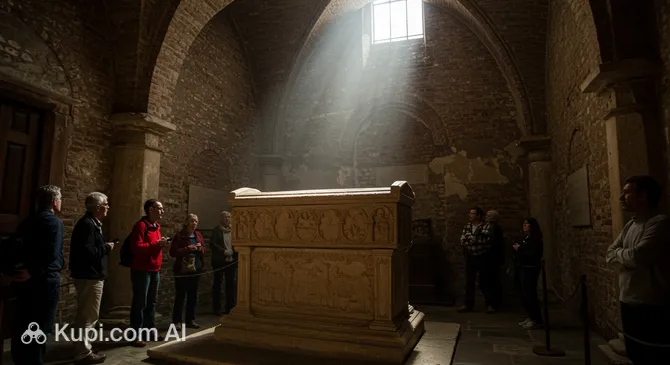
Juliet's Tomb. Illustration.
Source: Kupi.com AI

Traveler photos:

This historical site is located in the crypt of a former Capuchin monastery. The sarcophagus itself is ancient, lidless, and some suggest it may have been created as far back as the Roman Empire. For a long time, it remained in the monastery garden before finding its current location, which has become a pilgrimage site for romantics and literature lovers.

While there is no direct historical evidence that Shakespeare's Juliet was actually laid to rest here, this does not diminish the site's appeal. Juliet's Tomb has become a powerful symbol of eternal love and tragedy, a place where visitors can immerse themselves in the atmosphere of the legend, leave a note with wishes, or simply reflect on the power of human emotion.

Contacts

Juliet's Tomb is part of a museum complex. For the most up-to-date information on opening hours, ticket prices, and detailed directions, it is recommended to visit the official website of the G.B. Cavalcaselle Fresco Museum (Museo degli Affreschi Giovanni Battista Cavalcaselle), where it is located. You can also find useful information on Verona tourism portals.

How to contactContact
AddressVia Luigi da Porto, 5, 37122 Verona VR, Italy
Phone number+39 045 800 0361
Websitemuseodegliaffreschi.comune.verona.it

What to Do

The main attraction for visitors to Juliet's Tomb is, of course, the ancient red marble sarcophagus. Legend identifies it as the final resting place of Shakespeare's tragically deceased heroine. Once here, you can see this symbolic artifact and soak in the atmosphere of the romantic story that made Verona world-famous.

For many, this place is not just a landmark but a reason to reflect on eternal values. It is no wonder that Juliet's Tomb has attracted prominent figures for centuries, from royalty to famous writers. For instance, Lord Byron, who visited this site, left a poignant description of the sarcophagus, calling it "plain, open, with withered leaves around it... as sad as her love."

Your visit is not limited to just viewing the legendary sarcophagus. The same complex houses the G.B. Cavalcaselle Fresco Museum. Here, you can explore a collection of ancient frescoes, which will be a wonderful addition to your journey through Verona and allow you to learn more about the cultural heritage of Italy.

Getting There

Juliet's Tomb is located in Verona, within a former Capuchin monastery that is now part of the G.B. Cavalcaselle Fresco Museum. Getting to this iconic landmark is quite easy, as it is situated not far from the city's historical center.

One of the most convenient ways is by public transport. Verona has a well-developed bus network. You will need to find routes that pass near Via Luigi da Porto, where the tomb is located. The nearest bus stops are usually within a few minutes' walk. It is best to check specific route numbers and schedules on-site or on the Verona transport company website.

If you prefer comfort and speed, you can always take a taxi. A trip from central Verona districts, such as the Arena di Verona or Piazza Bra, to Juliet's Tomb will take very little time and is moderately priced. Taxis can be called by phone, through an app, or found at designated taxi stands.

For those who enjoy walking and want to better feel the city's atmosphere, Juliet's Tomb is easily reachable on foot from many central points in Verona. This allows you to enjoy the city views and perhaps discover other interesting spots along the way. Follow the signs or use a navigator—finding the tomb is quite simple.

Nearest city: Verona

History & Facts

The history of Juliet's Tomb dates back to the 16th century. It was first mentioned in a 1524 novella by Luigi da Porto. The author described a church at a Capuchin monastery in Verona, near which, by the outer walls, there were stone vaults. One of these ancient vaults, according to the novella, served as the burial place for the Cappelletti family, and it is there, according to legend, that young Juliet found her final resting place. This literary connection gave rise to the legend that turned the tomb into a place of pilgrimage.

For many centuries, the sarcophagus now associated with Juliet stood in the monastery garden, attracting numerous admirers of the tragic love story. However, the nuns, seeking to stop what they considered "pagan worship," moved the tomb and allegedly even used it as a water trough for animals. This fact was mentioned in the writings of the famous author Charles Dickens, and indirect confirmation can be seen in the plugged drainage hole at the bottom of the sarcophagus.

After the monastery closed in the 1800s, Juliet's Tomb was forgotten for a time. However, it was later decided to revive the legend that drew travelers to Verona. The site became popular once again, and its notable visitors included figures like Archduchess Marie Louise of Austria. In 1822, she even commissioned jewelry made from stone fragments taken from the tomb. Heinrich Heine and other famous personalities also visited, drawn by the romantic aura of this site in Italy.

Time Needed

Viewing Juliet's Tomb in Verona itself usually takes 30 minutes to 1 hour. This is typically enough time to see the famous red marble sarcophagus, soak in the unique atmosphere of this legendary site, take commemorative photos, and perhaps leave a symbolic note with wishes, as many visitors do.

However, it is important to note that Juliet's Tomb is part of a larger museum complex—the G.B. Cavalcaselle Fresco Museum (Museo degli Affreschi G.B. Cavalcaselle), located in the former Capuchin monastery. If you plan to also explore its collection, which includes interesting medieval and Renaissance frescoes, your total visit time will certainly increase. A thoughtful tour of the museum's exhibits may require an additional 1-1.5 hours.

Thus, for a full immersion into the romantic and historical atmosphere of Juliet's Tomb and a visit to the adjacent Fresco Museum, you should plan for about 1.5-2.5 hours. Some visitors who wish to see everything at a leisurely pace and enjoy every moment may spend up to half a day here. If your interest is focused solely on the tomb itself and the legend of Juliet, then one hour may be quite sufficient for a visit to this iconic landmark in Italy.

Working Hours

Juliet's Tomb is generally open to visitors year-round; however, exact opening hours may vary depending on the season and day of the week. Typically, museums in Italy operate from morning until evening, sometimes with a lunch break. To get the most current information regarding the schedule and any possible changes, it is strongly recommended to check the official website of the G.B. Cavalcaselle Fresco Museum (Museo degli Affreschi G.B. Cavalcaselle), where the tomb is located, or contact Verona tourist information centers directly before your visit.

Regarding ticket booking, for popular attractions, especially during the tourist season, purchasing tickets online in advance often helps avoid queues and guarantees entry. While this may not be as critical for Juliet's Tomb as it is for some other sites, it is still worth considering this option, especially if your time is limited. Check the official museum website for the availability and necessity of advance booking.

DayOpening hours
MondayClosed
Tuesday10:00 – 18:00
Wednesday10:00 – 18:00
Thursday10:00 – 18:00
Friday10:00 – 18:00
Saturday10:00 – 18:00
Sunday10:00 – 18:00

Nearby

Visiting Juliet's Tomb is undoubtedly one of the most romantic experiences in Verona. However, to make your journey even more enriching, it is worth paying attention to the attractions located nearby. Exploring the surrounding area will allow you to dive deeper into the atmosphere of this amazing city and discover its other treasures.

In the immediate vicinity of the tomb, you will find historical monuments as well as other interesting spots to enrich your itinerary. A short walk from Juliet's Tomb can lead you to new discoveries, complementing the impressions of the main goal of your visit to Italy.

NameDistance
Bagel Road0.7 km
Porta Leoni0.8 km
Torcolo0.8 km
Hotel Marco Polo0.8 km
Castelvecchio Museum1 km
Piazza delle Erbe1 km
Porta Borsari1 km

Have you reached the end of the page?

So the route has been studied inside and out