Support

Castelvecchio Bridge

About

The Castelvecchio Bridge, also known as the Scaliger Bridge (Ponte Scaligero), is one of the most iconic and impressive landmarks in Verona. Spanning the Adige River, it is an integral part of the mighty medieval Castelvecchio castle, built in the 14th century. This bridge is a striking example of military Gothic architecture, which continues to amaze today with its monumentality and austere beauty.
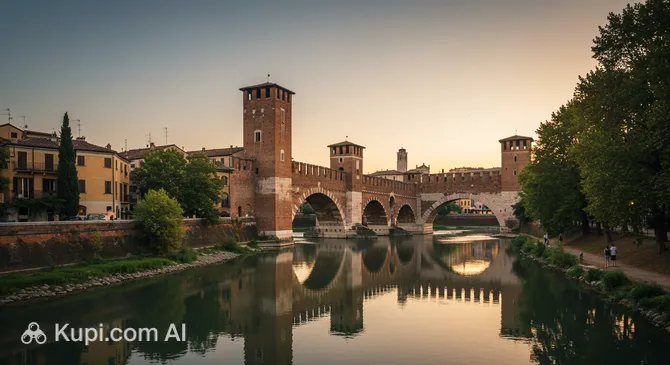
Castelvecchio Bridge. Illustration.
Source: Kupi.com AI

Traveler photos:

Built of red brick, characteristic of the Scaliger dynasty's rule, the bridge served more than just a transportation function. Its main task was to provide a safe escape route for the city's rulers from the fortress in case of an uprising or enemy attack. This strategic detail adds a special historical depth to a walk across the bridge, which connects the castle with the city's left bank.

For tourists, the Castelvecchio Bridge is not just a beautiful structure, but a real journey through time. A walk along its powerful spans offers magnificent views of the Adige River and the surrounding landscapes. A visit to the bridge pairs perfectly with a trip to the City Museum located in Castelvecchio Castle, which houses a rich collection of medieval art. This is a must-visit spot for anyone wanting to touch history and feel the spirit of medieval Italy.

Contacts

Since the Castelvecchio Bridge is a public historical site, it does not have its own separate contact details. It is part of a single architectural complex with the castle of the same name. For any questions regarding visits to the bridge or the castle, it is recommended to contact the Castelvecchio City Museum (Museo Civico di Castelvecchio), which is located directly within the fortress.

How to contactContact
AddressCorso Castelvecchio, 2, 37121 Verona VR, Italy
Phone number+39 045 806 2640
Websitewww.turismoverona.eu

What to Do

Visiting the Castelvecchio Bridge is primarily an opportunity to enjoy some of the best panoramic views in Verona. While strolling across this medieval structure, you can admire the magnificent landscapes of the Adige River and the city's historical center. The bridge is an ideal spot for photographers, especially at sunset, when the rays of the setting sun paint the red brick in warm, picturesque tones, creating a truly magical atmosphere.

Since the bridge is an integral part of the castle complex, a walk across it is easily combined with a cultural program. It leads directly to the entrance of the Castelvecchio City Museum (Museo Civico di Castelvecchio), located within the walls of the castle itself. This is a wonderful opportunity to explore a rich collection of medieval art, including paintings and sculptures, making your visit to the bridge even more informative and engaging.

Getting There

Getting to the Castelvecchio Bridge is very easy, as it is located in the heart of Verona's historical center on the banks of the Adige River. The most pleasant way to reach it is by walking. The bridge is within walking distance of the city's main attractions, such as the famous Arena di Verona and the bustling Piazza delle Erbe. This allows you to easily include it in your walking route through the city while enjoying the picturesque streets along the way.

If you prefer to use public transport or are coming from more distant areas of the city, the bridge can be conveniently reached by city buses. Many routes pass through the center of Verona and have stops in the immediate vicinity of Castelvecchio Castle, with which the bridge forms a single complex. The nearest stop is just a few minutes' walk away, making this option both quick and economical.

For those traveling by car, it is important to remember that the bridge is located in a Limited Traffic Zone (ZTL), where entry for private vehicles is prohibited or restricted by time without a special permit. It is recommended to leave your car in one of the paid parking lots outside the ZTL and continue on foot. Additionally, you can always use taxi services, which can take you almost to the very entrance of the castle complex, providing the most comfortable way to reach your destination.

Nearest city: Verona

History & Facts

The history of the Castelvecchio Bridge is inextricably linked to the name of the ruler of Verona, Cangrande II della Scala. Construction, which likely took place between 1354 and 1356, served a purely practical purpose. The bridge was designed as a strategic escape route for the Lord and his family from the castle towards Tyrol in case of a popular uprising or other sudden attack. Thus, this monumental structure was originally not just a crossing, but a "back door" ensuring the ruler's safety.

One of the bridge's main mysteries is the identity of its architect. To this day, no precise records have survived regarding who designed this impressive structure. A document from 1495 mentions a certain Guglielmo Bevilacqua, who may have been involved in the project. Other historians, based on stylistic similarities with other buildings, suggest the authorship of Giovanni da Ferrara and Giacomo da Gozo, though no documentary evidence for this theory exists. This mystery only adds to the bridge's historical charm.

The bridge's fate proved to be dramatic. For a long time, it served military purposes, right up until 1870. However, its greatest trial came in 1945, when it was destroyed during historical events near the end of World War II. Fortunately, extensive restoration work began as early as late 1945. Engineers and restorers performed a monumental task, retrieving surviving fragments of the original bridge from the Adige River. Many details were carefully returned to their historical places, and in 1951, the fully restored Castelvecchio Bridge was reopened to the public, becoming a symbol of the city's rebirth.

Time Needed

When planning a visit to the Castelvecchio Bridge, keep in mind that the time spent exploring it can vary. For a leisurely stroll across the bridge to fully enjoy the views of the Adige River, examine the details of the medieval construction, and take a few memorable photos, 30-40 minutes will be quite sufficient. This is enough time to walk from one bank to the other and soak in the historical atmosphere of this unique structure.

However, since the bridge is part of a single complex with Castelvecchio Castle, which houses the City Museum, you should set aside more time for a more complete immersion in history. It is recommended to allow at least another 1.5-2 hours to explore the museum's rich collection. Thus, a comprehensive visit to the bridge and the castle will turn into an exciting journey lasting about 2-3 hours, allowing you to learn more about the history of Verona and medieval Italy.

Working Hours

The Castelvecchio Bridge is an open city site, so it is freely accessible 24/7 every day of the year. No tickets or prior booking are required to walk across the bridge and admire its architecture and views of the Adige River. This makes it one of the most accessible attractions in Verona.

However, if you plan to visit the Castelvecchio City Museum located in the adjacent castle, you should take its operating schedule into account. The museum is usually open from Tuesday to Sunday, with Monday being a closing day. Operating hours may change depending on the season, so it is highly recommended to check the latest information on the museum's official website before your visit. Purchasing tickets for museum entry is mandatory.

Open 24 hours

Nearby

A walk across the Castelvecchio Bridge is just the beginning of your journey into the rich history of Verona. This area of the city literally breathes the past, and every step reveals new and wonderful places. Exploring the surroundings of the bridge will allow you to dive deeper into the atmosphere of medieval Italy and gain a fuller understanding of this city's grandeur.

To help you plan your route, we have compiled a list of interesting sites located in the immediate vicinity of the bridge. Here you will find both world-famous architectural monuments and cozy spots that will add vibrant colors to your trip.

NameDistance
Castelvecchio Museum0.1 km
Arch of the Gavi0.1 km
Torcolo0.4 km
Elk Bakery0.4 km
Hotel Marco Polo0.4 km
Porta Borsari0.5 km
Romeo Ristorante, Bistrot & Cocktail Bar0.7 km

Have you reached the end of the page?

So the route has been studied inside and out