Support

Ponte Pietra

About

Ponte Pietra (Stone Bridge) is one of the most iconic landmarks in Verona and a true symbol of its rich history. This ancient Roman arch bridge majestically spans the Adige River, serving as a living reminder of the city's antique past. Notably, it is the only surviving Roman bridge in Verona, making it a priceless monument of engineering and architecture. Walking across it is not just crossing a river, but a journey through the centuries in the heart of beautiful Italy.

The bridge, built of stone and brick, consists of five elegant spans and reaches about 120 meters in length. Its appearance is unique due to the mixture of materials from different eras, a result of numerous reconstructions following floods and destruction. A special charm is added by the ancient watchtower located at one of its ends, which serves as a reminder of the bridge's strategic importance in the past.
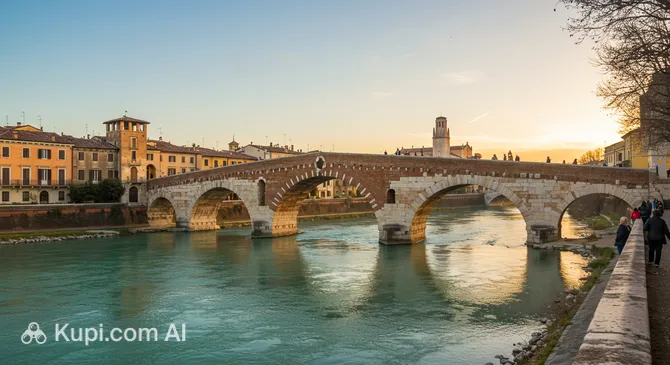
Ponte Pietra. Illustration.
Source: Kupi.com AI

Traveler photos:

Today, Ponte Pietra continues to play an important role in the life of the city, connecting the historic center with the district where the famous Roman Theater (Teatro Romano) is located. It attracts many tourists, photographers, and strollers who come here to enjoy the picturesque views of the Adige River and historical buildings. It is an ideal place to feel the unique atmosphere of Verona and take unforgettable photos to remember your trip.

Contacts

Since Ponte Pietra is a public historical monument rather than an organization, it does not have specific contact details such as a phone number or email address. The bridge is a part of the city’s infrastructure and is open to pedestrians around the clock.

Reaching it is very simple: it is located in the heart of the historic center of Verona, just a 10-15 minute walk from central squares like Piazza delle Erbe. The bridge connects the old town with the district housing the Roman Theater and is an easily accessible attraction for anyone walking through the city.

How to contactContact
Address37121 Verona, VR, Italy
Websitewww.comune.verona.it

What to Do

The main draw of Ponte Pietra is the opportunity to take an unforgettable walk across ancient stones while enjoying magnificent views of the Adige River and the historic center of Verona. It is one of the best places in the city for photoshoots, especially at sunset, when the soft light envelops the city and the embankments are picturesquely reflected in the water. From here, a stunning panorama of old buildings and San Pietro Hill opens up, making every step across the bridge special.

The bridge is of great interest to history and architecture enthusiasts. While walking across it, you can examine the unique masonry in detail, noticing the differences between the original Roman fragments of white stone and the later red brick additions made during various restorations. Ponte Pietra also offers a beautiful view of the nearby Roman Theater, allowing you to fully appreciate the historical landscape of this part of Italy.

Beyond the views, this location often becomes a stage for street performances and small cultural events, which adds to its liveliness and dynamism. A walk across the bridge is not just sightseeing; it is a full immersion into the atmosphere of Verona, where history meets modernity and city landscapes inspire new discoveries.

Getting There

Thanks to its location in the heart of Verona, getting to Ponte Pietra is quite easy. The bridge is situated in the historic center and is easily accessible on foot from any part of it. If you are at the famous Piazza delle Erbe, for instance, the walk to the bridge will take no more than 10–15 minutes. This route passes through picturesque ancient streets, making it a pleasant part of your city exploration.

For tourists arriving in Verona by train at the Verona Porta Nuova station, the most convenient way to reach the bridge is by public transport. Numerous city buses run regularly toward the center, and the trip takes very little time. Alternatively, you can always use a taxi, which will quickly take you to this iconic landmark.

If you are traveling by car, it is important to remember that the historic center of Verona is a Limited Traffic Zone (ZTL). Therefore, the best solution is to leave your car in one of the city parking lots located on the edge of the pedestrian area and continue to the bridge on foot. This will not only help you avoid fines but also allow you to enjoy a leisurely stroll through the city's charming streets.

Nearest city: Verona

History & Facts

The history of Ponte Pietra dates back to ancient times. The bridge was built by the Romans around 89 BC and was originally named Pons Marmoreus, which translates to "Marble Bridge." It earned this name due to its construction material — white and red Veronese marble. In ancient times, the bridge held great strategic importance for Roman Verona, connecting the city with the eastern bank of the Adige River and playing a key role in the development of trade and the movement of troops.

Throughout its centuries-long history, the bridge has undergone many changes and restorations, resulting in a blend of materials from different eras. Every period left its mark. For example, in the 13th century, one of its arches was rebuilt by order of Alberto I della Scala, the ruler of Verona. Later, during the Renaissance, architects added elegant decorative elements, including new arches and balustrades, while carefully preserving the medieval structure.

One of the most dramatic and yet inspiring facts in the history of Ponte Pietra is linked to the 20th century. In 1945, during the retreat of German troops, the bridge was completely destroyed. However, the city's residents could not accept the loss of such an important symbol. Between 1957 and 1959, an extensive and meticulous restoration effort was carried out. Remarkably, the reconstruction used original stones and fragments that were carefully recovered from the riverbed. This act of rebirth is a vivid testament to the love the people of Verona have for their heritage and history.

Time Needed

Visiting Ponte Pietra doesn't require much time, making it a convenient stop on any tourist route through Verona. For a proper walk across the bridge, to enjoy the views, take memorable photos, and feel the atmosphere of this ancient site, 30 to 45 minutes is usually enough. This time is sufficient to cross the Adige River at a leisurely pace and observe the unique combination of Roman masonry and later brickwork.

If you plan a more detailed exploration of the surroundings, you should extend your visit. For example, if your walk includes a visit to the nearby Roman Theater or if you want to linger on the embankment to admire the scenery, feel free to set aside up to 1.5 hours. Thus, a visit to Ponte Pietra can be either a brief but vivid episode of your journey through Italy or part of a longer and more fulfilling excursion through the city's historic center.

Working Hours

You can visit Ponte Pietra at any time convenient for you, which makes this attraction particularly appealing to tourists. The bridge is open for walks 24/7 and year-round, and there is no need to buy tickets — entry is absolutely free. Since it is a public pedestrian bridge that is part of the city's infrastructure, no advance booking or registration is required. You can simply include it in your Verona itinerary and enjoy a walk across this ancient structure whenever you wish.

Open 24 hours

Nearby

A walk across the Ponte Pietra is just the beginning of your acquaintance with the rich history of Verona. The surroundings of this ancient Roman structure are packed with iconic sites located just a few minutes' walk away. Exploring nearby attractions will allow you to dive deeper into the city's atmosphere and gain a more complete understanding of its cultural and architectural heritage without spending much time on travel.

This region of Italy, situated on the banks of the Adige River, is a true open-air museum. Literally around every corner, ancient churches, majestic castles, and cozy squares await you. To help you plan your route, we have compiled a list of interesting places located very close to the bridge.

NameDistance
Castel San Pietro Funicular0.1 km
Castel San Pietro0.2 km
Archaeological Museum at the Roman Theatre0.2 km
Verona Cathedral0.3 km
Basilica of Saint Anastasia0.3 km
Piazza dei Signori0.5 km
Palazzo Maffei House Museum0.5 km

Have you reached the end of the page?

So the route has been studied inside and out