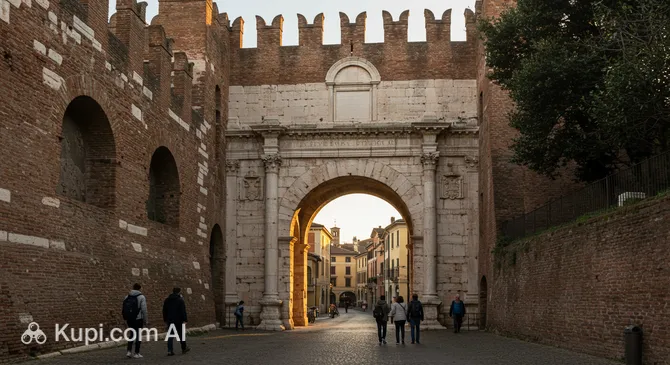
Porta Palio is a monumental city gate located in the historic center of the famous city of Verona. Built in the mid-16th century, it is an outstanding example of Renaissance architecture in Italy. This gate served not only as part of the defensive system but also as a ceremonial entrance, emphasizing the city's grandeur.
Porta Palio. Illustration.
Source: Kupi.com AI
Traveler photos:
The architectural project belongs to the master Michele Sanmicheli, who managed to combine the rugged power of fortification with the elegance of ancient forms. The outer facade of the gate, facing away from the center, resembles a Roman triumphal arch decorated with Doric columns and decorative busts of warriors. The inner side surprises with a light gallery of six arches, creating the atmosphere of a classical atrium.
Today, Porta Palio is considered one of Verona's most interesting attractions for those who appreciate the harmony of lines and the history of engineering. Located near Castelvecchio Castle, it remains a silent witness to the former power of the Venetian Republic, maintaining its grand appearance after five centuries.
Contacts
For those who wish to obtain more detailed information about current events or the possibility of visiting the interior of the monument, it is worth checking the official communication channels. Although the site is part of the city's architecture, cultural events are occasionally held here. We recommend saving these details to make your visit to Porta Palio as comfortable as possible.
When visiting Porta Palio, the first thing to notice is the architectural contrast of its facades. Examine the exterior side of the gate, where rough rusticated stone is combined with strict Doric columns and bas-reliefs. This is the perfect place to appreciate how Renaissance architects interpreted ancient heritage for defensive needs.
A walk through the internal gallery will make you feel as if you are in a classical Roman courtyard. After viewing the gate, be sure to stop by the small park located to the left of the entrance — this quiet and picturesque spot is excellent for relaxation. To the right of the structure is a staircase leading to the adjacent bastion, from where you can look at the city's defensive structures from a different angle and take panoramic photos.
Many tourists use Porta Palio as a starting or midpoint of a walking route. From here, it is very convenient to reach Castelvecchio Castle by moving along the historical canal. This is a great way to combine studying Verona's military history with a pleasant walk through less crowded but equally beautiful corners of the city.
Getting There
The attraction is conveniently located on Stradone Porta Palio, which is about 700 meters from the famous Castelvecchio Castle. If you are already walking through the city's historic center, a stroll to the gate through picturesque streets will be a pleasant addition to your route.
For those who prefer public transport, city buses regularly run in the area of Porta Palio and the nearby castle. If you are arriving in the city by train, you can reach the gate from the main Verona Porta Nuova railway station by bus or taxi in just 10–15 minutes.
Travelers arriving by car should keep in mind that the center of Verona is a Limited Traffic Zone (ZTL), so it is best to look for parking in the vicinity of the gate. One of the most pleasant ways to get here remains a walk from the Verona Arena or a ride on a rented bicycle along the city's ancient roads.
Nearest city: Verona
History & Facts
The history of Porta Palio began in the mid-16th century when the outstanding architect Michele Sanmicheli was commissioned to strengthen the city's southern borders. Built between 1547 and 1557, these gates became a symbol of the Renaissance approach "Munire et ornare" — which means "to fortify and adorn." They replaced old medieval structures on the path of the ancient Via Postumia.
The name of the gate itself is also curious. "Palio" refers to traditional horse races — tournaments that were held nearby and which were even mentioned by the great Dante Alighieri. Initially, the gate was built as a defensive structure; however, it was almost never used for military purposes. Instead, it was opened only twice a year: for the solemn harvest gathering and for those very horse races.
Architect Sanmicheli, being a master of fortification, turned a purely military object into a work of art. He chose not to install heavy artillery in this part of the walls, focusing instead on aesthetic perfection and classical proportions. Today, Porta Palio is considered one of the most harmonious examples of Renaissance defensive architecture in all of Europe.
Time Needed
For a basic tour of Porta Palio, including examining both facades and a short walk through the adjacent park, 30–60 minutes is usually sufficient. This time is enough to appreciate the architect's skill, take striking photographs, and climb the neighboring bastion for an interesting perspective of the city walls.
If you plan to include the gate in a full walking route through the southern part of the city, allow about 2 hours. This will let you walk leisurely to Castelvecchio Castle or stroll along the defensive ramparts, enjoying the atmosphere of old Verona and its green spaces.
Working Hours
Since Porta Palio is part of the city's architectural fortifications, its exterior can be viewed 24/7 and for free. You can admire the facades and walk near the gate at any time convenient for you, whether it's early morning or in the evening hours when the lighting gives the stone a special charm.
However, it should be noted that access to the interior rooms may be limited or temporarily closed for restoration work. To get up-to-date information on possible excursions or indoor access, it is recommended to check Verona's official tourism portals or the site's social media page before your trip.
Nearby
Exploring the area around Porta Palio allows you to dive deeper into the city's rich history and see how its architecture has changed over the centuries. Grand fortresses and cozy squares are located nearby, all easily accessible on foot.