Support

Basilica of San Zeno Maggiore

About

The Basilica of San Zeno Maggiore (Basilica di San Zeno Maggiore) is a jewel of Romanesque architecture located in the charming city of Verona, Italy. This temple is considered one of the most significant and beautifully preserved examples of the Romanesque style in all of Northern Italy. The basilica was built over the burial site of Saint Zeno of Verona, the city's first bishop and patron saint, which gives it special spiritual significance.
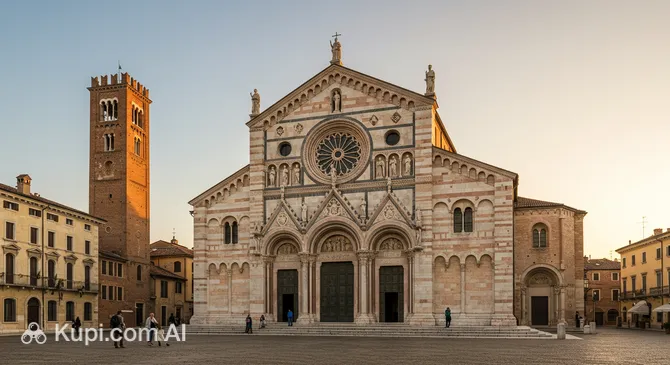
Basilica of San Zeno Maggiore. Illustration.
Source: Kupi.com AI

Traveler photos:

The architectural appearance of San Zeno Maggiore impresses with its harmony and monumentality. It is a three-aisled basilica whose facade is richly decorated and features a magnificent portal created in the 12th century by Master Niccolò. Every detail of the facade and interior tells a story of centuries, immersing visitors in the medieval atmosphere.

Significant structures adjoin the main building of the basilica: an elegant bell tower dating from the 11th century and a later 13th-century tower that was once part of a Benedictine monastery. One of the complex's main attractions is the famous 12th-century cloister. Its galleries, framed by elegant double columns with arches, create a peaceful atmosphere and are a perfect place for reflection and enjoying the silence.

A visit to the Basilica of San Zeno Maggiore is not just a tour of a historical monument, but a real journey through time, allowing you to touch the rich cultural and spiritual heritage of Verona and all of Italy.

Contacts

To plan your visit to the Basilica of San Zeno Maggiore and find the latest information on opening hours, ticket prices, or potential guided tours, we recommend checking the attraction's official website.

Please note that the information on the aforementioned site is provided in Italian. Additional details can also be obtained from the tourist information centers in Verona.

How to contactContact
AddressPiazza San Zeno, 2, 37123 Verona VR, Italy
Phone number+39 045 592813
Websitewww.chieseverona.it

What to Do

A visit to the Basilica of San Zeno Maggiore is an immersion into the world of medieval art and spirituality. Inside the temple, your eyes will certainly be drawn to the magnificent frescoes decorating the walls and the famous altar triptych by the outstanding artist Andrea Mantegna, which is one of the basilica's main treasures. Equally worthy of attention are the skillfully crafted column capitals with various motifs and the unusual portal of the side altar, whose columns appear to be "tied in a knot" – a unique detail that intrigues all visitors.

Descending into the basilica's crypt, you can see the final resting place of Saint Zeno, the patron saint of Verona, where his relics are kept. Be sure to walk through the peaceful cloister, where you can admire medieval tombstones, including the tomb of a member of the famous Veronese Scaliger family, dating back to 1313. Fragments of ancient paintings have also been preserved here, and the cloister is adjacent to the lapidarium – a collection of ancient inscriptions that adds historical depth to your visit.

For many tourists, a visit to the basilica also carries a romantic tone. According to popular legend, it was within the walls of San Zeno Maggiore that Romeo and Juliet, the heroes of Shakespeare's immortal tragedy, were secretly married. Although this is a legend, it gives this holy place a special aura and makes it even more attractive to lovers and fans of the great playwright who dream of touching the story of eternal love.

Getting There

The Basilica of San Zeno Maggiore is located in the district of the same name in Verona, on Piazza San Zeno. As a significant historical site, it is relatively easy to reach using various modes of transport.

One of the most common ways to reach the basilica is by public transport. Verona has a well-developed city bus network. You will need to find routes that pass through Piazza San Zeno or stop nearby. We recommend checking current bus line numbers on the official website of Verona's transport company or at tourist information centers. Usually, the stop is within a few minutes' walk of the basilica itself.

If you prefer a more comfortable and faster way to travel, you can always use taxi services. A taxi ride from central areas of Verona, such as the Arena di Verona or the Verona Porta Nuova railway station, to the Basilica of San Zeno Maggiore does not take long. This is an especially convenient option if you are traveling with small children or have limited time for sightseeing.

For those who enjoy walking and want to get to know the city better, the route to the Basilica of San Zeno Maggiore from the historical center of Verona can be a pleasant adventure. The walk takes approximately 20-30 minutes and allows you to see less touristy but equally picturesque corners of the city. The basilica is a well-known landmark, so finding it by following signs or a map will be easy.

Nearest city: Verona

History & Facts

The history of the Basilica of San Zeno Maggiore dates back to the distant 5th century. It was then, by order of King Theodoric the Great, that a modest church was built over the burial site of Saint Zeno, the first bishop of Verona. However, the fate of this first temple was difficult: in the 9th century, it was destroyed, and a new building was constructed in its place by decree of King Pepin. But even this church did not last long – in the 10th century, it was destroyed by the Magyars. It is important to note that even after these upheavals, the relics of Saint Zeno were saved and carefully placed in the surviving crypt, where they rest to this day.

The majestic Romanesque building of the Basilica of San Zeno Maggiore that we see today was founded in 967. This was made possible thanks to the support of Emperor Otto the Great. In the following centuries, the temple continued to grow and change: in the 11th century, an elegant bell tower was added, becoming an integral part of its silhouette. The earthquake of 1117 damaged the church, but by 1137 it was not only restored but significantly expanded, taking on an increasingly monumental appearance. The finishing touch of this period was the replacement of the roof and the construction of a Gothic apse in 1398, adding notes of a later style to the architectural ensemble.

Unfortunately, in the 19th century, the Basilica of San Zeno Maggiore went through difficult times and fell into some neglect. This period of oblivion could have caused irreparable damage to this unique architectural monument if not for large-scale restoration work. It was only in 1993, through the efforts of specialists and dedicated individuals, that the basilica was restored to its historical appearance and splendor. Today it stands before us in all its beauty, witnessing centuries of Verona's history and serving as one of the most significant Romanesque churches in Italy.

Time Needed

To fully explore the Basilica of San Zeno Maggiore, including visiting the church itself, descending into the crypt, and walking through the picturesque cloister, most visitors will need approximately 1.5-2 hours. This time is usually enough to appreciate the splendor of Romanesque architecture, examine major works of art such as Andrea Mantegna's famous San Zeno Altarpiece, and soak in the atmosphere of this historical site.

Of course, the duration of your visit may vary depending on your interests. If you are an admirer of medieval art and wish to study the numerous frescoes, sculptural decorations of capitals and portals in detail, or spend more time in the peaceful silence of the cloister or crypt, you should plan for up to 2.5-3 hours. For those with limited time who plan only a quick overview of the basilica's main highlights, about 1 hour might suffice, but in that case, there is a risk of missing many interesting details of this unique architectural monument.

Working Hours

The Basilica of San Zeno Maggiore is generally open to visitors year-round, but exact opening hours may vary depending on the season, day of the week, and religious services. Typically, churches in Italy are open in the morning, then close for a lunch break, and reopen in the afternoon until early evening. Nevertheless, to get the most up-to-date and accurate information on visiting hours for the Basilica of San Zeno Maggiore, it is highly recommended to check the attraction's official website (chieseverona.it) or contact local tourist information centers in Verona directly before your visit.

Regarding ticket bookings, for many churches in Italy, advance booking is not mandatory unless you are planning a visit as part of a large group or wish to use the services of a guide. However, during the peak tourist season or to visit particularly popular parts of the complex (if any require a separate ticket), purchasing tickets online in advance can help save time and avoid queues. We recommend checking this information on the official website or at the entrance to the basilica.

DayOpening hours
Monday9:00 – 18:30
Tuesday9:00 – 18:30
Wednesday9:00 – 18:30
Thursday9:00 – 18:30
Friday9:00 – 18:30
Saturday9:00 – 18:00
Sunday1:00 – 18:30

Nearby

Visiting such an iconic landmark as the Basilica of San Zeno Maggiore is a highlight in itself. However, to make your trip to Verona even more fulfilling and memorable, it is worth paying attention to its surroundings. Often, nearby sites – whether they are other historical monuments, cozy cafes, or picturesque corners – help you dive deeper into the city's atmosphere and form a more complete impression.

Exploring what is near the Basilica of San Zeno Maggiore allows you not only to expand your cultural itinerary but also to discover unexpected gems that may not be part of standard tourist routes. This is a great opportunity to see Verona from different angles and make your adventure truly unique. Below is a list of some interesting places located nearby.

NameDistance
Castelvecchio Museum0.7 km
Castelvecchio Bridge0.7 km
Porta Palio0.8 km
Arch of the Gavi0.8 km
Elk Bakery0.8 km
Hotel Marco Polo0.9 km
Torcolo1 km

Have you reached the end of the page?

So the route has been studied inside and out