Support

St. Patrick's Well

Nearby interesting places

About

St. Patrick's Well (Pozzo di San Patrizio) is not just a water source, but a true marvel of Renaissance engineering located in the city of Orvieto, in the heart of Italy. This unique hydraulic structure was built in the 16th century by order of Pope Clement VII, who wanted to ensure a reliable water supply for the city in the event of a long siege. Today, it is one of the most famous and unusual attractions in the region.

The main feature of the well, designed by architect Antonio da Sangallo the Younger, lies in its ingenious construction. Two independent spiral staircases descend to a depth of 53 meters and never intersect. This clever solution allowed mule-drawn carts to go down for water on one spiral and climb up the other without creating traffic jams or interfering with one another. Natural light enters through 70 windows, creating a mystical atmosphere.
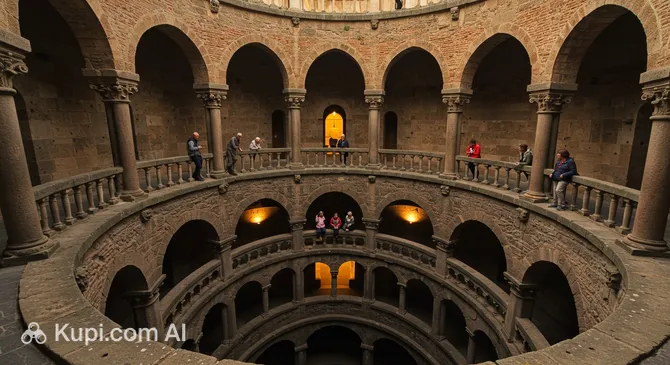
St. Patrick's Well. Illustration.
Source: Kupi.com AI

Traveler photos:

With its impressive diameter of 13.4 meters, the well is a striking example of how functionality can be combined with architectural sophistication. The structure was named after the Irish saint whose name was associated with a deep cave leading to purgatory, emphasizing the well's impressive depth. Today, descending into its mysterious depths is a thrilling adventure that allows you to fully appreciate the scale and brilliance of its creators' vision.

Contacts

For the most accurate information regarding opening hours, ticket prices, and potential schedule changes, it is recommended to visit the official website of the attraction or contact the administration directly. Below are the primary contact details.

How to contactContact
AddressPiazza Cahen, 5B, 05018 Orvieto TR, Italy
Phone number+39 0763 343768
Websiteliveorvieto.com

What to Do

Visiting St. Patrick's Well is a unique opportunity to literally descend into the depths of history. The main activity for tourists is walking down and up the two independent spiral staircases that do not cross each other. Each features 248 steps leading to a depth of over 50 meters. This sophisticated design allowed animal-drawn carts to descend for water on one path and ascend on the other without causing obstruction.

During the journey deep into the well, visitors can appreciate the genius of 16th-century engineering. The descent is illuminated by natural light entering through 70 windows cut into the walls. This creates a mystical atmosphere and offers excellent photo opportunities: the play of light and shadow on the spiral sections allows for impressive shots. At the bottom of the well, you can see the water, the level of which is maintained by a natural spring.

In addition to the descent itself, it's worth paying attention to the details. Above the entrance to the well, you can see a Latin inscription: "QUOD NATURA MUNIMENTO INVIDERAT INDUSTRIA ADIECIT," which translates as "What nature begrudged for protection, industry added." Visiting this site is not just a sightseeing trip but a true immersion into the Renaissance era and an introduction to one of the most impressive hydraulic structures of its time.

Getting There

St. Patrick's Well is very conveniently located in the southern part of the historic center of Orvieto, right by the upper funicular station. Thanks to excellent transport links, reaching it is easy by both public transport and car. The city of Orvieto itself is situated in the heart of Italy, making it easily accessible from major cities like Rome or Florence.

The simplest and fastest way to reach the attraction is by train. The journey from Rome or Florence takes approximately 1–1.5 hours. Orvieto railway station is located at the foot of the cliff on which the city stands. From there, you can ascend to the historic center via a scenic funicular, which takes you directly to Piazza Cahen, where the entrance to the well is located. The entire journey from the station to the entrance takes only a few minutes.

If you are traveling by car, take the A1 motorway and use the "Orvieto" exit. You can leave your car in one of the paid parking lots in the city center, from where the well is easily reachable on foot by following the "Pozzo di San Patrizio" signs. Another convenient option is to park in the lower part of the city near the railway station and, like many other tourists, take the funicular up.

Nearest city: Orvieto

History & Facts

The creation of St. Patrick's Well is directly linked to the dramatic events of the 16th century. Its construction began in 1527 and lasted ten years. The catalyst was the sack of Rome by the troops of Emperor Charles V, after which Pope Clement VII was forced to seek refuge in the fortified city of Orvieto. Fearing a long siege and wishing to provide the city with a reliable source of drinking water, the pontiff commissioned this grandiose structure, even though there were already other wells in the city.

The project was entrusted to Antonio da Sangallo the Younger, a prominent architect from a famous Florentine dynasty. He designed an ingenious engineering solution: a double helix staircase, which became a true masterpiece of its time. This design allowed mule-drawn carts to descend for water on one ramp and ascend on another without crossing paths or creating congestion. This solution ensured maximum efficiency and a continuous water supply for the city even under the most difficult conditions.

The origin of the well's name is also interesting. Its depth and mysterious atmosphere reminded contemporaries of a legendary cave in Ireland known as "St. Patrick's Purgatory." According to legend, this cave served as an entrance to the afterlife, and the analogy with the deep structure plunging into the earth in Italy seemed very accurate. Thus, what was essentially a utilitarian building acquired a mystical and memorable name that has survived to this day.

Time Needed

When planning your visit to St. Patrick's Well, you should expect a full tour to take from 40 minutes to 1 hour. This time is usually enough to descend one of the spiral staircases to the bottom without rushing, admire the views, take several photos, and climb back up the other. Given that you will have to cover a total of nearly 500 steps, this time buffer will allow you to enjoy the atmosphere of this unique place at a comfortable pace.

The duration of your visit may depend on several factors. For instance, if you are a photography enthusiast, you might need more time to catch the perfect shot in the play of light and shadow created by the 70 windows. You should also consider your physical fitness and the number of other visitors—during the peak tourist season, the stairs can be quite busy, which may slow your movement slightly.

The recommended hour includes exploring the well itself and its immediate surroundings. If you wish to explore the area further, such as walking through the park of the neighboring Albornoz Fortress, which offers magnificent views, feel free to add at least another 30–40 minutes to your plan. This will allow you to get the most out of your visit to this part of Orvieto.

Working Hours

St. Patrick's Well is open to visitors year-round, but opening hours may vary depending on the season. During the summer months (from May to August), the attraction is usually open from 9:00 to 20:00. In the shoulder seasons, such as March, April, September, and October, the closing time is moved to 19:00. In the winter months (from November to February), you can visit the well from 10:00 to 17:00.

Given the possibility of changes, it is highly recommended to check the current schedule on the official website before your visit. You can also find information about purchasing tickets there. While special reservations are usually not required, buying tickets online in advance can help you avoid queues, especially during the height of the tourist season.

9:00 – 19:30

Nearby

A visit to St. Patrick's Well is just the starting point for exploring the amazing city of Orvieto. Situated on top of a tufa cliff, this city is an attraction in itself, where every corner holds a piece of history. Many other iconic sites are within walking distance, and exploring them will provide a complete and vivid impression of the cultural richness of this corner of Italy.

A stroll around the well's surroundings will enrich your journey with new discoveries. You can not only appreciate the grandeur of medieval architecture but also immerse yourself in the mysterious atmosphere of the underground labyrinths for which the city is famous. Below is a list of nearby interesting places worth including in your itinerary.

NameDistance
Adriano's Labyrinth0.8 km
Orvieto Cathedral0.8 km
Orvieto Underground0.9 km
Bottega Vèra0.9 km
Palace of the Captain of the People0.9 km
Torre del Moro0.9 km
FEBO1 km

Have you reached the end of the page?

So the route has been studied inside and out