Support

Fontana Pretoria

About

The Pretoria Fountain (Fontana Pretoria) is an impressive architectural creation located in the heart of Palermo on Piazza Pretoria. This monumental fountain is one of the main attractions of Italy, and more specifically, its sunny island of Sicily. Built in the Mannerist style, it features a complex multi-tiered composition with numerous sculptures, elegant basins, and pools that create a mesmerizing sight.
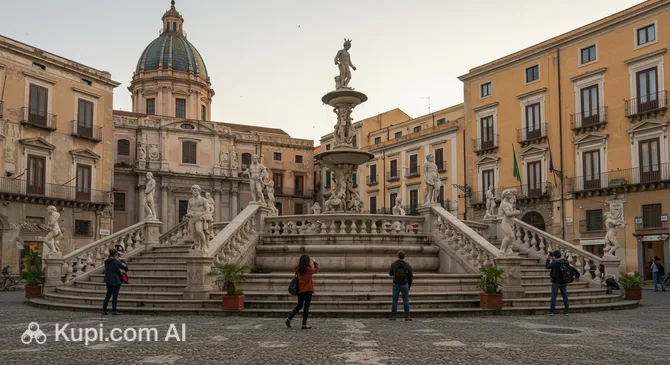
Fontana Pretoria. Illustration.
Source: Kupi.com AI

Traveler photos:

The fountain's history is quite fascinating. It was originally created by the Florentine sculptor Francesco Camilliani for the garden of the Spanish aristocrat Don Pedro Álvarez de Toledo in Florence. However, later in 1574, the fountain was purchased by the Senate of Palermo, dismantled into 644 pieces, transported, and installed at its current location. This grand structure was intended to beautify the city and showcase its grandeur.

Interestingly, among the locals, the Pretoria Fountain earned the nickname "Fountain of Shame" (Fontana della Vergogna). It earned this name because of the abundance of nude sculptures depicting mythological characters, gods, and allegorical figures. In the 16th century, when the fountain was installed, such an explicit depiction of nudity caused quite a stir among conservative citizens and the clergy.

Despite initial controversies and its mixed reputation, today the Pretoria Fountain is one of Palermo's most recognizable symbols. It draws crowds of tourists with its beauty, intricate detailing, and rich history. It is a popular spot for strolls and photography, where you can enjoy the atmosphere of an old Sicilian city and admire a masterpiece of sculptural art.

Contacts

The Pretoria Fountain is a public city landmark, so no specific contact details are required for a visit. For more information about the fountain and other interesting sites in Palermo, you can contact local tourist information centers or visit the city's official tourism website.

How to contactContact
AddressPiazza Pretoria, 90133 Palermo PA, Italy
Websiteturismo.comune.palermo.it

What to Do

A visit to the Pretoria Fountain is a unique opportunity to immerse yourself in the world of art and history right in the heart of Palermo. The main thing to do here is, of course, to study the fountain itself in detail. You can take a close look at the many magnificent sculptures by Francesco Camilliani, representing mythological figures such as nereids, tritons, and other mythical creatures. Walk slowly around the fountain's perimeter to appreciate the craftsmanship of every detail of this architectural masterpiece of Italy and take some impressive photos.

The fountain is situated on the picturesque Piazza Pretoria, which is a lovely place to relax in its own right. Here you can sit down, soak in the atmosphere of the historic Sicilian city, and watch its vibrant life unfold. Many tourists also prefer visiting the fountain at different times of day—morning, afternoon, and evening. This allows you to see how its appearance and the play of light on the sculptures change under different lighting conditions, which will undoubtedly add new colors to your impressions.

Additionally, Piazza Pretoria is surrounded by other significant landmarks, such as ancient churches and historic buildings. Therefore, viewing the fountain is easily combined with a walk through the center of Palermo and visits to nearby points of interest. This will allow you to delve deeper into the city's history and culture, making your visit even more rewarding and memorable.

Getting There

The Pretoria Fountain is conveniently located in the very heart of Palermo's historic center, on the square of the same name, Piazza Pretoria. Thanks to its central location, reaching this famous landmark in Italy is quite simple, especially if you are already in the central part of the city.

If you are exploring the historic center of Palermo on foot, you will likely find the fountain with ease as it is located in a pedestrian zone. From Palermo’s main railway station (Palermo Centrale), you can reach Piazza Pretoria in about 20–25 minutes at a leisurely pace, enjoying the city views along the way. This is a great way to experience the atmosphere of Palermo.

For those who prefer public transport, Palermo has a well-developed bus network. Several routes pass near Piazza Pretoria, and the nearest stops are just a few minutes' walk from the fountain. You can also always take a taxi, which will bring you directly to the square quickly and comfortably, especially if you are traveling with luggage or are short on time.

Nearest city: Palermo

History & Facts

Surprisingly, the history of the magnificent Pretoria Fountain begins not in Palermo, but in the heart of Tuscany—Florence. This masterpiece was created by the talented Florentine sculptor Francesco Camilliani between 1554 and 1555. The original patron was none other than Don Pedro de Toledo, the Spanish Viceroy of Naples. The fountain was intended to decorate his luxurious Tuscan residence—specifically, the gardens of the villa of his son, Luigi de Toledo. The master and his team worked for six years to create the complex elements of this aquatic spectacle.

The fountain's fate changed dramatically in 1574 when Don Pedro's heir decided to relocate it to Palermo. This was a massive undertaking involving significant costs and even some controversy. Imagine this: the fountain, already partially assembled in Florence, had to be carefully dismantled, shipped by sea to Sicily, and then reassembled at its current site on Piazza Pretoria. This complex operation was overseen by Camillo Camilliani, the son of the fountain's creator, Francesco, adding a touch of family legacy to the story.

However, the fountain's arrival in Palermo was not met with universal acclaim. The exorbitant cost of the acquisition, along with the explicit depictions of nude mythological figures, sparked a backlash among conservative residents. It was then that the fountain earned its unofficial but enduring nickname—the "Fountain of Shame" (Fontana della Vergogna). This fact vividly illustrates the social norms of the time and the contrast between Renaissance artistic freedom and the strict moral values of 16th-century Sicilian society, making the fountain not just a gem of Italy, but a unique historical artifact.

Time Needed

To fully appreciate the beauty and detail of the Pretoria Fountain, the average visitor should set aside about 30–60 minutes. This will be enough time to leisurely walk around the fountain from all sides, examine the numerous sculptures closely, admire the craftsmanship, and, of course, take commemorative photos of this magnificent structure.

If you plan to not only see the fountain itself but also spend time at the surrounding Piazza Pretoria and visit some of the nearby attractions in Palermo, it is better to allow more time. In this case, a full exploration of this corner of Italy may take 2 to 3 hours, allowing you to soak in the atmosphere of the city's historic center without rushing.

Working Hours

The Pretoria Fountain is located on the open public square of Piazza Pretoria, so it is available for viewing 24/7, year-round. There are no specific opening hours for this landmark, and you can visit it at any time convenient for you, day or night. No advance booking or tickets are required, as access to the fountain is free.

While the fountain is open at all times, for the best experience and photos, it is recommended to visit during daylight hours when all the sculptural details are clearly visible. The Pretoria Fountain also looks particularly beautiful in the evening when the lighting is turned on, creating a magical atmosphere and highlighting the elegance of this work of art.

Open 24 hours

Nearby

Visiting the Pretoria Fountain will certainly be a highlight of your trip to Palermo. However, to make your experience even more complete and multifaceted, don’t limit yourself to just this magnificent structure. The historic center of Palermo, where the fountain is located, is literally packed with other interesting sites that are within walking distance and well worth your attention.

Exploring the area around the Pretoria Fountain will allow you to dive deeper into the unique atmosphere of this Sicilian city, discover hidden architectural gems and cozy squares, and learn more about the rich history and culture of Italy. Every street here breathes history, and a new discovery may await you around every corner.

NameDistance
Quattro Canti0.1 km
Church and Monastery of Saint Catherine of Alexandria0.1 km
Church of the Gesù (Casa Professa)0.3 km
Teatro Santa Cecilia0.4 km
Funnaco PizzaLab0.5 km
Palazzo Conte Federico0.5 km
CuFu0.5 km

Have you reached the end of the page?

So the route has been studied inside and out