Support

Palatine Chapel and Royal Palace

About

The Palatine Chapel and Royal Palace in Palermo are not just an attraction, but a true treasure of Italy, an outstanding historical and architectural complex inscribed on the UNESCO World Heritage list. Located at the highest point of the city, it is one of the most important monuments of the Arab-Norman style and attracts travelers from all over the world with its unique history and architecture.
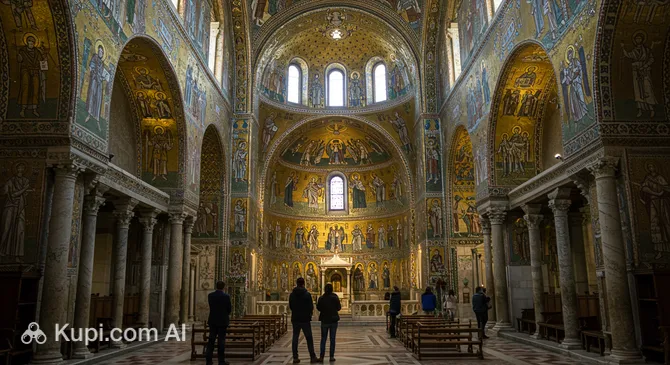
Palatine Chapel and Royal Palace. Illustration.
Source: Kupi.com AI

Traveler photos:

The heart of the complex is the Palatine Chapel (Cappella Palatina), the royal chapel of the Sicilian kings and viceroys, located on the second floor of the Norman Palace. It captures the imagination with its splendor: famous 12th-century Byzantine mosaics, created by both Byzantine and local craftsmen, cover the walls, while the ceiling is decorated with Arabic carvings, a rare feature in Europe. The chapel has no facade of its own, being integrated into the structure of the palace, which makes it even more mysterious and alluring.

The Royal Palace itself, also known as the Norman Palace (Palazzo dei Normanni), has a rich history and today serves as the seat of the Sicilian Regional Assembly—the parliament of this autonomous region of Italy. Visiting the palace and the chapel is a unique opportunity to touch centuries of history, where Byzantine, Arabic, and Norman cultures intertwined, leaving behind a one-of-a-kind heritage.

Contacts

To obtain the most up-to-date information regarding opening hours, ticket prices, and available tours at the Palatine Chapel and Royal Palace, we recommend contacting the tourist information center of Palermo. Useful information can also often be found on Sicily's official tourism website or directly on-site at the entrance to the complex, where information stands are usually located.

How to contactContact
AddressPiazza del Parlamento, 1, 90134 Palermo PA, Italy
Phone number+39 091 705 5611
Websitewww.federicosecondo.org

What to Do

When visiting the Palatine Chapel, your attention will undoubtedly be drawn to the magnificent 12th-century Byzantine mosaics covering its walls. These masterpieces depict various biblical stories, including scenes from the Book of Genesis and images of apostles, such as Saint Paul. No less impressive is the unique carved Arabic ceiling—a rare phenomenon in European architecture. Furthermore, since masses are held daily in the chapel, visitors have the opportunity not only to explore the historical monument but also, if they wish, to attend a service and experience the special atmosphere of this holy place.

In addition to the chapel itself, depending on the schedule of the Sicilian Regional Assembly, you may be fortunate enough to tour some of the state rooms of the Royal Palace. Notable among them are the Roger's Room (Sala di Ruggero), decorated with 12th-century secular mosaics rare for Norman Sicily, and the Hercules Room (Sala d'Ercole)—a historically significant site where sessions of the first parliament of the Kingdom of Sicily were held in 1812. Touring these rooms allows for a deeper understanding of the palace's historical role.

A visit to the Palatine Chapel and Royal Palace is a true immersion into the rich history of Palermo and all of Sicily. Here you will see firsthand how different cultures—Norman, Arabic, and Byzantine—intertwined and enriched each other over the centuries. This unique blend of styles and traditions is reflected in the unrivaled architecture and decorative splendor of the complex, leaving every visitor with deep and vivid impressions of the great heritage of Italy.

Getting There

The Palatine Chapel and Royal Palace are located in the heart of Palermo, within the grounds of the Norman Palace. Entrance to the chapel, which is situated on the second floor of this grand structure, is through Independence Square (Piazza Indipendenza). Since the Norman Palace stands on the highest point of the historic city center, it serves as an excellent landmark for travelers.

Getting to this iconic landmark in Italy is quite easy. You can use Palermo's public transport. Many city buses stop in the immediate vicinity of Piazza Indipendenza, making the journey convenient and fast. Just check the routes passing through Piazza Indipendenza, and you will easily reach your destination.

If you prefer walking and are staying in central Palermo, you can reach the Palatine Chapel and Royal Palace on foot. A stroll will allow you to better experience the city's atmosphere. Look for signs for Palazzo dei Normanni or Palazzo Reale—these are alternative names for the Royal Palace. Since the palace is one of the main attractions, finding it will be no trouble at all.

Nearest city: Palermo

History & Facts

The history of the Palatine Chapel and Royal Palace dates back to ancient times, long before the arrival of the Normans. The site where this majestic complex stands today has seen a succession of civilizations: it is believed that Carthaginian and later Roman fortifications were located here. In the 5th century AD, the Byzantines converted an existing temple into a church. Later, in the early 11th century, Arab conquerors, who made Palermo their capital, built a fortress known as the Qasr on this strategically important site.

A new chapter in the history of this site began with the arrival of the Normans. They drove out the Arabs and rebuilt the fortress into their royal residence, known as the Norman Palace. It was the first King of Sicily, Roger II, who personally oversaw the construction of the palace's jewel—the Palatine Chapel. Although the exact chronology of its famous mosaics is not entirely clear, it is known that these masterpieces were created in the 12th century by skilled Byzantine and local craftsmen. Interestingly, some additions to the mosaic decoration were made until the end of the 18th century, testifying to the chapel's continuous life and significance.

The Royal Palace itself has also undergone changes over the centuries. In 1616, it acquired an elegant Renaissance facade that today faces Parliament Square. In the 18th and 19th centuries, the palace's interiors were updated to reflect the tastes and needs of the time. However, the palace's history is not frozen in the past: since 1947, it has housed the Regional Assembly—the parliament of the autonomous region of Sicily. This makes the Norman Palace not only an invaluable cultural monument but also an active administrative center where the modern history of the region is written.

The significance of this unique ensemble was officially recognized worldwide on July 3, 2015, when the Palatine Chapel was inscribed on the UNESCO World Heritage list. This event highlighted its exceptional historical and artistic value, preserved through centuries of intertwining cultures and eras. A visit to the Palatine Chapel and Royal Palace is an opportunity to touch living history, where every stone and mosaic tells its own amazing story.

Time Needed

To fully enjoy the splendor of the Palatine Chapel and tour the rooms of the Royal Palace open to the public, we recommend allowing approximately 1-2 hours. This time is usually enough to leisurely admire the chapel's famous Byzantine mosaics, the unique Arabic ceiling, and, if you are lucky, some of the palace's historic rooms.

It is worth noting that the Royal Palace (also known as the Norman Palace) is the active residence of the Sicilian Regional Assembly. Therefore, access to some of its parts may be restricted during sessions. To avoid potential inconvenience and make the most of your time, it is better to plan your visit for the morning. This will increase the likelihood of seeing all the areas open to the public.

Thus, by planning for 1-2 hours, you can get a comprehensive overview of this unique historical and architectural complex in Palermo, which is a jewel of Italy. Don't forget to check the current opening hours before your visit to ensure your trip is as comfortable and rewarding as possible.

Working Hours

When planning a visit to the Palatine Chapel and Royal Palace in Palermo, it is important to consider the specifics of this unique complex's schedule. Since the Norman Palace, of which the chapel is a part, has hosted the Sicilian Regional Assembly since 1947, access hours for tourists can be inconsistent. Generally, the attraction is open to visitors year-round, but the exact schedule may vary.

It is strongly recommended to plan your visit to the Palatine Chapel for the morning to minimize the risk of encountering access restrictions due to parliamentary sessions. The most reliable way to find out the current opening hours is to check the information immediately before your visit—this can be done on the official website of the attraction (if available), the tourism portals of Palermo, or by contacting local tourist information centers. Pre-booking tickets, if such an option is available, can also be a good idea, especially during the peak tourist season.

DayOpening hours
Monday8:30 – 16:30
Tuesday8:30 – 16:30
Wednesday8:30 – 16:30
Thursday8:30 – 16:30
Friday8:30 – 16:30
Saturday8:30 – 16:30
Sunday8:30 – 12:30

Nearby

A visit to such a significant site as the Palatine Chapel and Royal Palace is a highlight in itself. However, to truly soak up the atmosphere of Palermo and enrich your experience, it is worth paying attention to the nearby attractions. Exploring the surroundings will allow you to gain a more complete picture of the historical and cultural heritage of this amazing city in Italy.

Numerous other interesting sites are concentrated around the Palatine Chapel and Royal Palace, each holding its own piece of history. A walk through this district of Palermo can turn into a fascinating journey through time, revealing new facets of the Sicilian capital. Below is a list of some attractions within walking distance that can complement your itinerary.

NameDistance
Palace of the Normans0 km
The Ventimiglia Family House0.1 km
Church of San Giovanni degli Eremiti0.2 km
Porta Nuova0.2 km
Parco d'Orleans Zoological Garden0.2 km
Palermo Cathedral0.4 km
Palazzo Conte Federico0.5 km

Have you reached the end of the page?

So the route has been studied inside and out