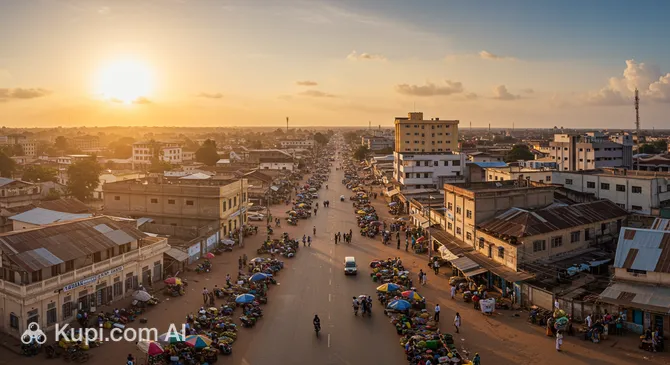
Koumassi is one of the most colorful and vibrant communes of Ivory Coast, part of the country's largest metropolis, Abidjan. Located south of the Ébrié Lagoon, this district is a densely populated and dynamically developing suburb. Here, modern urban bustle is closely intertwined with the traditional way of life, creating a unique atmosphere of authentic Ivorian daily existence.
Koumassi. Illustration.
Source: Kupi.com AI
Geographically, Koumassi occupies a favorable position in the central part of the metropolis, which has made it an important commercial and residential hub. The history of this area begins from a small village that rapidly transformed into a densely built-up urban district in the 20th century. Today, the commune's population exceeds 412,000 people, and its streets are filled with shops, workshops, and markets that never go quiet.
For a traveler, Koumassi is interesting primarily as a place where you can see Ivorian life "without embellishments." It is a typical working-class district where economic activity is in full swing. The main points of attraction here are the huge local markets, selling everything from exotic fruits to bright African fabrics. A visit to Koumassi is an invitation to immerse yourself in the noisy, crowded, and incredibly energetic life of a real African city.
Weather Overview
The climate in Koumassi is classified as tropical, which means consistently high temperatures and significant humidity throughout the year. Due to its proximity to the Ébrié Lagoon and the Gulf of Guinea, there are no sharp temperature fluctuations. If you want to learn more about seasonal changes, take a look at the section on the Koumassi climate.
Typical weather in this area is characterized by two main seasons. From June to July, the peak of the rainy season occurs: for example, in June, rainfall can reach an impressive 319 mm. Heavy downpours are possible during this period, but they are often followed by bright sun. Air temperatures generally range from +24°C at night to +31°C during the day.
The most comfortable time to visit is considered to be the winter months (December and January). At this time, there is significantly less rainfall, and humidity becomes more tolerable. The water temperature in the gulf never drops below +23°C, which maintains a warm and mild microclimate in the commune year-round.
Average monthly temperature
Average monthly precipitation
Interesting Facts
Koumassi is a city with a special character and a history hidden in its everyday life. Here are a few facts to help you get to know this place better:
The city's name comes from the Akan language: the word "Kumasɛ" translates as "place of abundance" or "prosperous land," emphasizing the historical importance of this territory for trade.
Koumassi is located at an altitude of about 75 meters above sea level, occupying the territory immediately south of the picturesque Ébrié Lagoon.
The city is one of the most densely populated communes in Ivory Coast, demonstrating the incredible rates of urbanization characteristic of 21st-century Africa.
The status of this district is an "undiscovered gem" for explorers; on popular travel resources like TripAdvisor, the number of reviews for it is minimal, which guarantees an absence of tourist crowds.
How to Get There
Koumassi is an integral part of Abidjan's transport system, making it easily accessible for travelers. Due to its location in the southern part of the metropolis, the commune is connected to key city hubs by a network of roads and waterways. To plan your route in advance, you can study detailed information on how to get to this area.
The main air gateway is Abidjan's Félix-Houphouët-Boigny International Airport (ABJ). It is located just 20–30 kilometers from Koumassi. You can get from the airport to the commune by official taxi or on comfortable buses from the state transport company Sotra. Depending on the traffic density, which can be quite intense in Abidjan, the trip will take from 45 to 90 minutes.
If you are already in the center of Abidjan, for example in the Plateau business district, the easiest way to reach Koumassi is by local mini-buses known as "woro-woro" or by regular orange taxis. The distance is about 10 kilometers, and the journey time usually does not exceed 40 minutes. Rail links in this area are poorly developed, so road transport remains the primary mode of travel.
Station
Passenger traffic
Distance
Gare ferroviaire Treichville
2
8 km
Kojokrom Train Station
1
249 km
Bouaké railway station
2
290 km
Main Attractions
Although Koumassi is not a tourist center in the classic sense and does not possess historical monuments of world significance, the city attracts those seeking authenticity. The main "attraction" here is the atmosphere of the bustling metropolis itself. A walk through the streets of the commune allows you to see the daily life of Ivorians, hidden from the eyes of visitors to fashionable hotels.
The centers of social and economic life are the local markets. These are vast spaces filled with sounds, smells, and bright colors. Here, you can not only purchase unique goods but also observe the art of local trade. Koumassi's markets are considered some of the busiest in Abidjan, reflecting the city's status as an important commercial crossroads.
In addition, residential neighborhoods with their dense buildings and small artisan zones are of interest for exploration. Here you can see how everyday items, furniture, and clothing are created. The absence of specialized tourist sites is compensated by the opportunity to see Ivory Coast as it truly is — dynamic, hardworking, and very friendly.
Local Cuisine
The gastronomy of Koumassi is a true feast for lovers of authentic African cuisine. You won't find refined Michelin-starred restaurants here, but you will find the most delicious and honest Ivorian dishes. The foundation of the local menu consists of gifts from the land and sea, prepared according to traditional recipes passed down through generations.
You should definitely try attiéké — grated and steamed cassava, which resembles couscous in texture. It is usually served with fried fish, fresh tomatoes, onions, and a spicy sauce. Another signature dish is fufu, a thick mash made of plantains or yams, eaten with aromatic sauces based on peanuts, palm oil, or okra seeds.
In Koumassi's markets and street stalls, you can always find freshly squeezed mango and pineapple juices, as well as try local palm wine. The food culture here is closely linked to street trade: the tastiest discoveries await you in the small kiosks where food is prepared right in front of you. This is a place where food brings people together, and the hospitality of the locals makes every meal special.
Travel Tips
When planning a visit to Koumassi, you are preparing to encounter one of the most energetic districts of Abidjan. To ensure your trip is comfortable and leaves only pleasant impressions, we have prepared some practical tips.
Clothing and Essentials: Choose lightweight clothing made from natural fabrics, as it is hot and humid in Ivory Coast all year round. Be sure to bring sunglasses and a hat. For walking through markets, only comfortable closed shoes are suitable.
Transport: To move between districts, use official taxis or apps like Yango. Keep in mind that traffic jams during peak hours can significantly increase travel time.
Finances: The local currency is the West African CFA franc (CFA). Cards are accepted very rarely in Koumassi, so always carry a supply of cash in small denominations for markets and transport.
Health: Drink only bottled water and always have hand sanitizer with you. Before the trip, it is recommended to check the current requirements for yellow fever vaccination.
Communication: The main language of communication is French. Knowing even basic phrases (greeting, thank you) will significantly ease communication. English is not widely spoken.
Local Etiquette: When entering a shop or starting a conversation, always greet people politely. Ivorians greatly value politeness and formal greetings.
What to Avoid: Do not photograph people, their goods, or government buildings without prior permission. It is also not recommended to carry valuables and large sums of money in plain sight.
Specific Advice: Visit the local markets in the morning — at this time the products are freshest, and the atmosphere is at its most lively, but not yet too exhausting from the heat.
Koumassi is a place for those who want to feel the pulse of the real Africa. Be open to communication, follow basic safety rules, and this city will reveal its most interesting side to you!
Entertainment & Nightlife
The entertainment scene in Koumassi is predominantly local in character. You won't find huge concert halls or chain nightclubs here; however, the district remains active until late in the evening. The main focus of residents is on small street bars and eateries where groups gather in the evenings to discuss the news to the sounds of popular Ivorian coupé-décalé music.
For those looking for larger-scale nightly entertainment, Koumassi serves as a convenient starting point. Most residents and guests of the commune prefer to head to neighboring districts of Abidjan — for example, Plateau or Marcory. A taxi ride takes about 20–40 minutes, and that is where the most famous discos, fine-dining restaurants, and cultural centers of the metropolis are concentrated.
Daytime leisure in Koumassi primarily involves exploring shopping areas and interacting with the local community. In the evening, it is worth visiting one of the local "maquis" — traditional Ivorian open-air restaurants. This is the best way to feel the rhythm of the city, enjoy the cool air after a hot day, and taste local delicacies in a completely relaxed atmosphere.
Parks & Museums
From the perspective of cultural and natural recreation, Koumassi is a very densely built-up district where classic parks and museums are practically non-existent. This is typical for the working-class communes of Abidjan, where every free meter of land is used for housing or trade. Nevertheless, the proximity to the Ébrié Lagoon gives residents the opportunity to enjoy water views, although there are few organized embankments here.
There are no specialized art galleries or historical exhibitions in the city itself. Koumassi is a "living museum" of urbanization and Ivorian culture in its own right. If your soul craves classical art or the silence of botanical gardens, you should head to neighboring districts of the metropolis. The nearest cultural centers and large green zones are located in Plateau and Cocody.
The lack of museums in Koumassi is compensated by an abundance of craft workshops where you can observe the creation of traditional items in real time. For a tourist, this can be an even more interesting experience than looking at static exhibits. Here, history and traditions do not gather dust under glass but live and develop in the hands of masters working right on the city streets.
Getting Around
The public transport system in Koumassi is a complex but functioning mechanism that ensures the commune's connection with the rest of Abidjan. The basis of transportation consists of bright orange taxis and the famous "woro-woro" — shared taxis that follow specific routes. This is the fastest way to move around the district, although you should be prepared for the fact that there will be several other passengers in the car.
The state company Sotra operates a network of bus routes connecting Koumassi with key points in the metropolis. Buses are a budget option; however, they are often overcrowded, especially during rush hours. Fares on buses are paid in cash to the conductor or through special travel cards, while in taxis, the price of the trip is often negotiated in advance.
For tourists, the most convenient alternative remains ride-hailing apps (such as Yango or Uber), which actively operate in Abidjan. This helps avoid the language barrier when explaining the route and guarantees a fixed price. Within Koumassi itself, many prefer to travel short distances on foot, as the dense network of streets and active trade at every step make a walk an interesting experience.
Accommodation
The hotel infrastructure in Koumassi is primarily geared toward those who value practicality and wish to immerse themselves in the local environment. There are practically no luxury five-star hotels here, but budget guesthouses and apartments are widely represented, often chosen for long-term stays or business trips.
Most accommodation options are concentrated along the main transport arteries of the commune, which is convenient for moving quickly around Abidjan. When choosing accommodation in Koumassi, it is worth focusing on reviews about cleanliness and the presence of air conditioning, as the tropical climate makes a cool room a necessity. The price range here is significantly lower than in prestigious districts like Cocody, which attracts budget-conscious travelers.
For those who prefer a high level of service and international standards, it is recommended to consider hotels in neighboring communes, which can be reached quickly by taxi. In Koumassi itself, it is better to book accommodation in advance, especially if your trip coincides with major holidays or trade fairs. Popular online booking services will help you find a suitable option even in this non-touristy but very lively district.
Nearby Cities
Koumassi is located in the heart of the bustling life of the capital region, making it an excellent starting point for exploring the surroundings and other interesting districts of Abidjan. Thanks to the developed system of taxis and buses, you can find yourself in a completely different setting within minutes.
Just 4 kilometers away is the commune of Marcory, known for its shopping centers and a wider selection of restaurants. For those who want to see the "showcase" of Ivory Coast, the business center of Abidjan (Plateau district) with its skyscrapers and museums is a must-visit. If you are looking for a calmer atmosphere and elite neighborhoods, head to Cocody, where universities and embassies are located.
Don't forget to also visit Port-Bouët to enjoy the ocean breeze and proximity to the airport, or ancient Bingerville, which has preserved the charm of colonial architecture. Exploring these places will allow you to form a complete picture of life in Ivory Coast, seeing all its facets — from the working rhythm of Koumassi to the splendor of the capital.
Shopping & Souvenirs
Shopping in Koumassi is primarily an adventure for the senses at the local markets. The city is not famous for huge malls with global brands, but it is known as a place where you can find everything needed for daily life at the best prices. The spirit of traditional African trade reigns here, where the ability to bargain is considered an important social skill.
The main shopping areas are the spontaneous and organized markets scattered throughout the commune. Here, you should pay attention to Ivorian fabrics, including the famous wax prints with bright patterns. Also, Koumassi is an excellent place to buy fresh tropical spices, household utensils, and folk crafts. Souvenirs here are more authentic and cheaper than in specialized tourist shops in central Abidjan.
Shops usually operate from early morning until sunset, and markets are most active in the first half of the day. Payment is made predominantly in cash in the local currency (West African CFA francs), so it is worth taking care of small change in advance. Although a Tax-Free system exists in Ivory Coast, it is practically inapplicable in Koumassi's market conditions, as most traders are small private entrepreneurs.