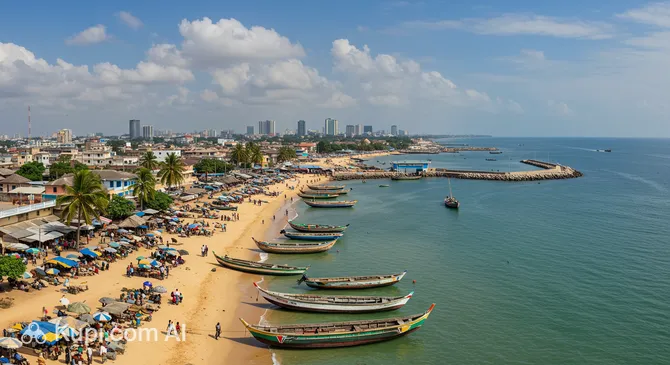
Port-Bouët is a dynamic and bustling suburb of Abidjan, the largest metropolis in Ivory Coast. Located south of the picturesque Ébrié Lagoon, this district serves as the country's primary "gateway by air." Port-Bouët harmoniously combines the features of a major transport hub and a densely populated residential area, home to more than 600,000 people.
The district's geographical position defines its atmosphere: its proximity to the Atlantic Ocean and the lagoon creates a unique landscape carved by canals and roads. Although the area is considered predominantly residential and industrial, its historical development is inextricably linked to the growth of the seaport and the region's colonial past, which has left its mark on the architecture of the old quarters and the rhythm of life for local residents.
Port Bouet. Illustration.
Source: Kupi.com AI
For the traveler, Port-Bouët is primarily a point of first acquaintance with Ivorian hospitality. You won't find the glamour of the central districts here, but there is authenticity in abundance: from bustling markets with vibrant fabrics to coastal restaurants serving the freshest fish. Visiting this district allows you to experience the real, unpolished rhythm of life in a modern African city.
Weather Overview
The climate in Port-Bouët is tropical, characterized by consistently high temperatures and significant humidity throughout the year. Average annual figures hover around 27–30°C, and the proximity to the lagoon and the ocean makes the air particularly saturated with moisture.
There are two rainy seasons during the year: the main one (from May to July) and a less intense one (in October and November). During these periods, heavy downpours are possible, which, however, are often followed by bright sunshine. The most favorable time for a visit is considered the dry season from December to April, when rainfall is minimal and the city's climate becomes most comfortable for walking.
Expect warm days with temperatures around 30°C and mild nights, when the thermometer rarely drops below 24°C. A light sea breeze sometimes brings welcome coolness to coastal areas, but deep within Port-Bouët's dense urban sprawl, the humidity can feel more intense.
Average monthly temperature
Average monthly precipitation
Interesting Facts
Transport Heart: Port-Bouët is home to Ivory Coast's largest airport, which serves as the main hub for the national carrier, Air Côte d'Ivoire.
Demographic Explosion: The city's population has shown incredible growth: since the late 1990s, the number of residents has nearly tripled, reaching 618,795 people.
Unique Geography: It is one of the four communes of Abidjan located entirely south of the Ébrié Lagoon, making it effectively an island part of the metropolis, connected to the mainland by bridges.
Economic Foundation: Approximately 70% of the entire country's Gross Domestic Product passes through the port facilities adjacent to Port-Bouët.
Colonial Roots: The district began to develop actively in the early 20th century when French colonizers established a port here, which later allowed Abidjan to become the colony's capital in 1934.
How to Get There
Thanks to its strategic position, Port-Bouët is the most accessible district for those arriving in the country by air. It is home to the region's main aviation hub, providing connections between the city and many world capitals and neighboring African nations.
The primary facility is Félix-Houphouët-Boigny International Airport (ABJ). This is a modern and convenient terminal located directly within the commune. A trip from the airport to the residential quarters of Port-Bouët takes only 10–15 minutes. If your destination is the center of Abidjan, the journey by taxi or bus is about 16 km and can take anywhere from 30 minutes to an hour, depending on traffic at the bridges across the lagoon.
If you are traveling within the country, Port-Bouët can be reached by bus or intercity taxi via the A1 highway. From the country's capital, Yamoussoukro, the journey takes about 4–5 hours. There is also a maritime connection: some passenger routes pass through the Autonomous Port of Abidjan, although they are more commonly used for travel between coastal districts within the metropolis itself.
Station
Passenger traffic
Distance
Gare ferroviaire Treichville
2
16 km
Kojokrom Train Station
1
241 km
Bouaké railway station
2
299 km
To plan a detailed route and explore all available options, we recommend checking the how to get there section, which contains up-to-date information on schedules and prices.
Main Attractions
Since Port-Bouët is primarily an important infrastructure and residential center of Abidjan, there are not many classic tourist attractions here. The main "landmark" seen by every visitor to the city is the Félix-Houphouët-Boigny International Airport. It is a modern complex reflecting the country's ambitions and its status as a regional economic leader.
Fans of industrial landscapes and maritime charm will find it interesting to explore the area around the Autonomous Port of Abidjan, located on the border with the neighboring Treichville district. The massive ships, container terminals, and the hustle and bustle of one of the largest ports in West Africa leave a strong impression and provide an idea of the scale of the local economy.
For those seeking the flavor of everyday life, local markets are a must-visit. You won't find museum-like silence here, but there is a riot of color, the scent of exotic spices, and the chance to observe traditional trade. The shoreline of the Ébrié Lagoon also offers pleasant views, especially during the sunset hours when the water turns golden and fishermen in pirogues head out for their catch.
Local Cuisine
The gastronomy of Port-Bouët is a vibrant reflection of Ivorian culinary traditions, where simple preparation is paired with rich flavors. The main local specialty that is a must-try is attiéké—a side dish made from fermented cassava couscous, which is similar in texture to regular couscous but has a pleasant, slightly sour taste. It is usually served with fried or baked fish, most often tilapia.
Street food is ubiquitous in Port-Bouët. In markets and near transport hubs, you are bound to encounter vendors selling alloco—sweet fried plantains that serve as an excellent snack. For those looking for heartier dishes, it's worth trying foutou (or fufu)—a thick, elastic dough made from yams or plantains, eaten by hand and dipped into aromatic sauces and soups, such as alligala (a fish soup with vegetables).
The dining culture here is centered around "maquis"—small local restaurants. The atmosphere is as relaxed as possible, and the food is always fresh. Locals prefer to wash down spicy dishes with refreshing natural juices made from mango, pineapple, or papaya. Also popular is palm wine, known locally as "pshadé" or "bangui," which has a specific taste and is an important part of the local social culture.
Travel Tips
Preparing for a trip to Port-Bouët requires considering some local specifics that will make your stay comfortable and safe.
Clothing and Essentials: Choose light clothing made from natural fabrics (cotton, linen), as the city is always hot and humid. Don't forget sunscreen, sunglasses, and comfortable shoes for walking through markets. When visiting official institutions or religious sites, it is better to wear modest clothing.
Transport: To move around the commune during the day, use taxis or gbakas. In the evening and at night, it is strongly recommended to use only official taxi services. Keep in mind the traffic jams during peak hours near the Ébrié Lagoon.
Finances: The official currency is the CFA franc (XOF). Cards are only accepted in large hotels and at the airport, so always carry cash for markets and transport. Banknotes should be clean and not worn out.
Health: Vaccination against yellow fever is mandatory—a certificate may be checked upon arrival. Malaria prophylaxis and the use of repellents are recommended. Drink only bottled water.
Communication: The primary language is French. Knowing basic phrases (greetings, thank you, asking for a price) will significantly simplify communication. English is not widely spoken. A local SIM card can be purchased directly at the airport.
Local Etiquette: Ivorians are very polite. Always start a conversation with a greeting like "Bonjour" or "Bonsoir." Respect for elders is a cornerstone of local etiquette.
What to Avoid: Do not take photos of government buildings, bridges, or military sites—this can cause issues with the police. Also, avoid walking alone in poorly lit outlying areas at night.
Connectivity: Wi-Fi is available in most hotels, but for stable internet, it is better to rely on 4G mobile data, which works reasonably well.
Following these simple rules will help you focus on exploring this colorful corner of Abidjan and ensure you have only positive experiences.
Entertainment & Nightlife
The entertainment scene in Port-Bouët is predominantly local in character, focused on the daily life of the city's residents. Nightlife here is less formal than in Abidjan's business center and is concentrated in small bars and open-air cafes known as "maquis." In these open-air establishments, you can enjoy a cold drink and rhythmic music in the "coupé-décalé" style.
If you are looking for large-scale nightclubs or concert venues with world-renowned names, it is best to head to neighboring districts like Marcory or Plateau. A taxi ride takes about 20–30 minutes, where you will find venues for every taste—from sophisticated lounge bars to noisy discos that stay open until dawn.
During the day, the primary focus for locals is sports. Football is a true passion here, and you can often see impromptu matches on any available patch of land. Joining the fans at a local stadium or simply watching a game on the beach is a great way to feel the city's atmosphere and interact with Ivorians in an informal setting.
Parks & Museums
There are virtually no classic museums or art galleries in Port-Bouët, as the district historically developed as a transport and residential hub. Cultural life here is more concentrated in the streets and the daily traditions of the locals. If your goal is to explore the rich art of masks and Ivorian history, you should head to Abidjan's central districts, such as Plateau.
As for green spaces, the high building density limits the number of parks in the heart of the commune. However, the shore of the Ébrié Lagoon serves as a natural recreational area. Despite the lack of developed embankments in the European sense, the lagoon's shores provide opportunities for walking and observing nature. You can see mangroves and a variety of local birds here.
For a full outdoor retreat, Port-Bouët residents often travel to adjacent districts where the space allows for park zones. Nevertheless, the rhythm of life in Port-Bouët itself, with its open spaces near the airport and proximity to the ocean, creates a sense of openness rarely found in the densely populated centers of other African metropolises.
Getting Around
The transport system in Port-Bouët is typical of a large African suburb, where private carriers play the leading role. The main mode of transport here is gbakas. These are minibuses that run on set routes, connecting Port-Bouët with central Abidjan and other communes. They are easily recognizable by their bright designs and specific driving style.
Another popular option is woro-woro (shared taxis) and motorcycle taxis. Within the district, this is the fastest way to get around, especially if you need to reach the heart of residential quarters where large buses don't go. Motorcycle taxis are particularly in demand during the day as they allow for maneuvering through traffic flows.
It is important to note that Port-Bouët suffers from heavy traffic jams, especially during rush hours (7:00 to 9:00 AM and 5:00 to 7:00 PM). Bottlenecks at the lagoon bridges and airport access roads can significantly increase travel time. Regular taxis are available everywhere; it is recommended to agree on the price of the trip in advance, as meters are rarely used.
For tourists, the most comfortable and safe way to travel remains official taxis, which can be called through apps or picked up at designated ranks near the airport and major hotels. When planning trips, always allow extra time for potential delays due to traffic.
Accommodation
Accommodation in Port-Bouët is primarily geared toward transit passengers, business travelers, and those who value proximity to major transport arteries. You will find a wide selection of hotels located in the immediate vicinity of the airport, which is extremely convenient for early departures or late arrivals.
For budget-conscious travelers, numerous guesthouses and economy hotels are available. The cost of staying in such places usually ranges from $20 to $50 per night. Despite the affordable prices, many offer basic comforts, including air conditioning and Wi-Fi, which are critical in the tropical climate.
If you are planning a long-term stay, it is worth looking at apartments often rented by expats. This provides more personal space and the opportunity to cook for yourself. Those seeking luxury resorts with pools and ocean views should keep in mind that there are practically none within Port-Bouët itself—for that kind of holiday, it is better to head to neighboring coastal areas or central districts of Abidjan.
Booking accommodation in advance is recommended, especially for chain hotels near the airport, as they are in high demand among airline crews and business people. During peak seasons and major regional conferences, available rooms can sell out quickly.
Nearby Cities
Port-Bouët serves as an excellent starting point for exploring coastal areas and interesting sites located just a few dozen kilometers away.
One of the most recommended destinations is the historical town of Grand-Bassam. The former colonial capital and a UNESCO World Heritage site is located just 15 km to the east. Here, you can stroll among majestic, though slightly weathered, buildings from the French era, visit the costume museum, and enjoy a break on beautiful sandy beaches.
For those interested in culture and tranquility, a trip to Bingerville is ideal. This town is famous for its magnificent Botanical Garden, where you can escape the city bustle in the shade of exotic trees. It is also worth visiting Marcory—the neighboring commune that is the center for shopping and nightlife in Abidjan, offering modern shopping malls and fine restaurants.
Exploring the surrounding areas will allow you to see different sides of Ivory Coast: from colonial history and tropical nature to the modern rhythms of the metropolis. Thanks to a well-developed network of shared taxis, such trips are easy to organize as day tours.
Shopping & Souvenirs
Shopping in Port-Bouët is primarily about immersing yourself in the atmosphere of traditional African markets. You won't find massive air-conditioned shopping malls here, but you will experience the true rhythm of local trade. The most interesting purchases can be made at markets located along the main roads and near the airport.
Keep an eye out for textiles: Ivory Coast is famous for its wax print fabrics. Bright and featuring intricate patterns, they make excellent souvenirs or materials for sewing unique clothing. You can also find high-quality wooden crafts, woven baskets, and traditional pottery brought from various regions of the country at the markets.
If you are looking for gastronomic souvenirs, it is worth buying local coffee or cocoa—Ivory Coast is the world's leading producer of cocoa beans. Shops usually operate from early morning until sunset, and payment in most stalls is accepted only in cash in the local currency (CFA francs). Don't forget that polite bargaining is appropriate and even welcomed at the markets—it is an important part of social interaction.