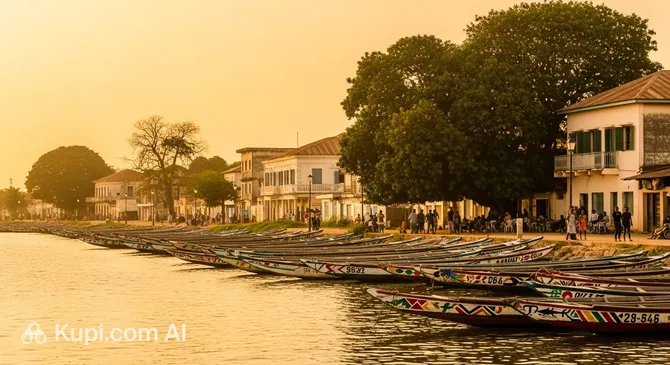
Situated on the picturesque northern shores of the Ébrié Lagoon, Dabou is an important administrative and port center of Côte d'Ivoire. This city in the Lagunes Region harmoniously combines the dynamics of a transport hub with the tranquil atmosphere of a coastal settlement. With a population of over 138,000, Dabou plays a key role in the economic life of the southeastern part of the country, serving as a link between the waterways and the mainland.
The city's geographical position at 76 meters above sea level provides it with a strategic advantage, while its proximity to the country's largest metropolis makes it easily accessible for business trips. Although the city primarily develops as a logistics center, its rich heritage and history are inextricably linked to the development of colonial trade and fishing in the region.
Dabou. Illustration.
Source: Kupi.com AI
For travelers, Dabou reveals itself as a place with an authentic rhythm of life. One of the city's main features is its immediate proximity to the vast lagoon, providing opportunities to get acquainted with the local fishing trade. You can also visit the International Club & Paintball Park here—a popular recreation area for active leisure.
Visiting this city is an excellent opportunity to see the "non-touristy," real Côte d'Ivoire, watch the port in action, and enjoy sunsets over the waters of the Ébrié. We recommend a stop here for those who appreciate the flavor of port cities and want to better understand the economic structure of West Africa.
Weather Overview
In Dabou, a typical West African tropical climate prevails, characterized by consistently high temperatures and significant humidity. The proximity of the Ébrié Lagoon and the Atlantic Ocean has a mitigating influence, yet air humidity remains high throughout the year. The average annual temperature stays around +26...+28°C, reaching peak values in February and March.
The city is characterized by a clear division into seasons: the rainy period reaches its peak in May and June, when the maximum amount of precipitation falls. During this time, the humidity can create a muggy feel, so travelers are recommended to plan trips for the drier months—January, February, or August. A detailed weather forecast for the city will help you better prepare for your visit, considering the likelihood of short but intense downpours.
Average monthly temperature
Average monthly precipitation
Interesting Facts
Dabou is located at an altitude of 76 meters above sea level on the northern coast of the Ébrié Lagoon, which provides the city with a unique microclimate.
The city has its own small airport (ICAO code: DIDB), located northwest of the city center.
Over recent decades, Dabou has demonstrated an impressive demographic leap: from 1975 to 2021, the city's population grew more than fivefold.
The city is located approximately 187 km from the official capital, Yamoussoukro, and is a key link in the transport logistics of the Lagunes Region.
Dabou is not just a port, but also an important administrative center of the department, coordinating the economic activity of the surrounding territories.
How to Get There
The transport accessibility of Dabou is largely determined by its proximity to the country's largest economic center. Travelers planning a route to the city should focus on road transport, which is the main and most reliable way to move around this region.
For those who prefer to travel by air, the nearest major hub is the international airport in Abidjan. Although Dabou itself has its own airport with the code ICAO: DIDB, its capacity is extremely limited, and it rarely accepts scheduled passenger flights. Most visitors arrive in the country through the main air gateway and then continue their journey by land transport.
A car trip from Abidjan takes between one and a half to two and a half hours, covering a distance of about 80–100 km along the scenic roads of the Lagunes Region. It is recommended to use licensed taxi services or a pre-booked transfer, as this guarantees comfort and a fixed price. Rail travel in this direction is currently not a primary mode of passenger transport.
Station
Passenger traffic
Distance
Gare ferroviaire Treichville
2
40 km
Bouaké railway station
2
271 km
Kojokrom Train Station
1
297 km
Main Attractions
Dabou is primarily a functional center, but an inquisitive traveler will find several interesting locations here. The city's main natural asset is the Ébrié Lagoon. Its shores are perfect for observing traditional fishing and the daily life of local residents. A walk along the water allows you to feel the true spirit of the region and enjoy the cool breeze.
For fans of active recreation and team games, the International Club & Paintball Park operates in the city. This is a modern entertainment space where you can not only play paintball but also simply relax in the company of friends. Such venues are a rarity for small Ivorian cities, making the club a notable spot on the local entertainment map.
An important part of Dabou's character is its port infrastructure. Observing the loading of ships and trade activity provides an insight into the city's economic importance to the country. Additionally, it is worth visiting Dabou's central markets, where life is in full swing from early morning: here you can see the full variety of goods from the Lagunes Region and experience the hospitality of local traders.
Local Cuisine
The gastronomic scene in Dabou is closely linked to its geographical location. The proximity to the lagoon and the ocean makes fish and seafood the staple of the local diet. You should try the tilapia or carp, grilled with aromatic spices purchased right there at the city markets.
One of the most popular dishes in Dabou, as in all of Côte d'Ivoire, is attiéké—a side dish made from fermented cassava, similar to couscous. It is usually served with fried fish and a spicy sauce made from fresh tomatoes, onions, and peppers. Rice-based dishes and fried plantains (alloco) are also ubiquitous.
To experience local cuisine, the best places are small family-run restaurants—maquis—where they cook according to traditional recipes. At local markets, you can always find the freshest tropical fruits: papaya, pineapples, and mangoes. Regarding drinks, look out for freshly squeezed juices and local beer, which perfectly complements the spicy dishes of Ivorian cuisine.
Travel Tips
Preparing for a trip to Dabou requires attention to detail to ensure your stay in this port city is comfortable and safe. These practical tips will help you better navigate the local environment.
Clothing and Essentials: Choose light clothing made from natural fabrics (cotton, linen), as the city has high humidity. For visiting official institutions or religious sites, it's worth sticking to a modest style. Don't forget comfortable shoes for walking around port areas and a type C or E power adapter.
Transport: The main way to get around is by shared taxis. For maximum convenience, it is better to rent a car with a local driver, especially for trips to Abidjan.
Finance: The official currency is the West African CFA franc. Always carry cash with you, as cards are rarely accepted. It is best to exchange currency at banks in major cities before arriving in Dabou.
Health and Safety: Use insect repellents and drink only bottled water. After dark, it is recommended to avoid walking in the port zone and to use official taxi services.
Communication: The main language of communication is French. English is not widely spoken, so learn basic phrases like "Bonjour" (hello), "Merci" (thank you), and "Combien ça coûte?" (how much does it cost?). A SIM card can be purchased from local operators in the city center.
Local Etiquette: Greetings are very important—always greet people before asking for anything. Requesting permission before photographing people or private property is mandatory.
What to Avoid: Do not take close-up photos of government buildings, official sites, or port infrastructure without special permission—this may raise questions from security.
Extra Tip: Plan important business for the first half of the day, as city activity decreases significantly after noon due to the humid heat.
May your introduction to Dabou be filled with interesting discoveries and warm encounters in the heart of the Lagunes Region!
Entertainment & Nightlife
Nightlife in Dabou has a quiet and local character, reflecting the city's administrative status. The main center of attraction for those seeking active leisure is the International Club & Paintball Park. During the day, exciting battles take place on the paintball field, and in the evening, the venue becomes a place for meeting and social interaction.
Outside of specialized clubs, evening activity is concentrated in small local bars and open-air cafes in the city center. A relaxed atmosphere prevails here, with traditional music playing and chilled drinks being served. No strict dress code is required for visiting such establishments; a neat casual look is sufficient.
It is worth considering that for more vibrant entertainment, large-scale nightclubs, and concert venues, locals and visitors most often head to neighboring Abidjan. In Dabou itself, entertainment ends relatively early, and for safety at night, it is recommended to use official taxis and avoid unlit port areas.
Parks & Museums
The cultural and park infrastructure of Dabou is in a developmental stage, so the city does not boast an abundance of classic museums or galleries. Nevertheless, the role of the main natural park here is played by the Ébrié Lagoon itself. Its shores offer a natural landscape where residents and visitors can enjoy walks and picturesque views of the water.
In the absence of large museum exhibitions, the architecture of the central quarters is of interest to tourists, preserving traces of colonial influence and traditional lifestyle. A walk through the streets of Dabou is a kind of open-air museum, where the exhibits are the daily life of the port and old administrative buildings.
For those looking for rich museum collections or manicured city gardens, a trip to Abidjan is recommended. There you can visit the National Museum or walk through Banco National Park, leaving Dabou for a more intimate encounter with the authentic atmosphere of a port settlement on the shores of the lagoon.
Getting Around
Dabou's transport system is oriented toward the practical needs of residents and port workers. The main form of public transport within and outside the city is minibuses and shared taxis. They run on established routes, connecting residential neighborhoods with the port area and neighboring settlements.
Taxis are found everywhere in Dabou and are the most comfortable way for tourists to get around. It's worth noting that cars usually lack meters, so the price of the trip must be negotiated with the driver in advance. For long-distance trips, for example to Abidjan, you can use intercity buses or hire a private car with a driver.
Fares in minibuses and taxis are paid in cash in the local currency. Tickets in the conventional sense are usually not issued; payment is collected by a conductor or the driver. Tourists are advised to avoid traveling during peak hours when transport can be very crowded and to always carry small bills for convenience.
Accommodation
Accommodation options in Dabou are limited due to its predominantly industrial and administrative purpose. Most properties are small hotels and guest houses in the central part of the city. They cater to business travelers and port service employees, offering a basic level of comfort without frills.
A significant portion of the housing available for short-term stays consists of private apartments. This is a convenient option for those planning to stay in the city for a few days. When searching for a place to stay, preference should be given to central areas, as they provide better accessibility to administrative buildings and markets.
Due to the small number of offers, travelers are strongly advised to book accommodation in advance through trusted online platforms. Alternatively, many prefer to stay in hotels in Abidjan, where there is a wide choice—from budget hostels to luxury global chains—and visit Dabou as part of a day trip.
Nearby Cities
Dabou serves as an excellent starting point for exploring the coastal region and visiting the country's major urban centers. Thanks to a developed road network, travelers can easily plan interesting day trips to neighboring cities.
The undisputed leader among travel destinations is Abidjan, located just 40 km away. This is a metropolis with skyscrapers, cathedrals, museums, and a vibrant nightlife. It is also worth visiting Yopougon, considered one of the liveliest and most colorful districts of the capital's agglomeration, where you can truly feel the modern rhythm of the country's life.
Exploring the surroundings of Dabou allows you to see the contrast between a quiet port city and the bustling centers of Côte d'Ivoire. Each such trip will enrich your experience of the Lagunes Region and provide a more complete understanding of the diversity of Ivorian culture.
Shopping & Souvenirs
Shopping in Dabou is primarily about experiencing the colorful local markets. There are no giant shopping malls here, but there is an abundance of fresh seafood, agricultural products, and local handicrafts. The city's central market is the heart of trade, where life never stops for a minute.
As souvenirs from Dabou, it is worth bringing back traditional Ivorian textiles and items with hand embroidery. Wooden masks and figurines reflecting the culture of local peoples are also popular. When buying goods at the market, remember that reasonable bargaining is part of the local communication culture, which helps to establish contact with the seller.
Shops in the city usually operate from early morning until evening, with a short lunch break during the hottest time of day. For payments, it is best to have cash in local currency (CFA francs), as card terminals are rare. For more extensive shopping and international brands, travelers are better off heading to Abidjan.