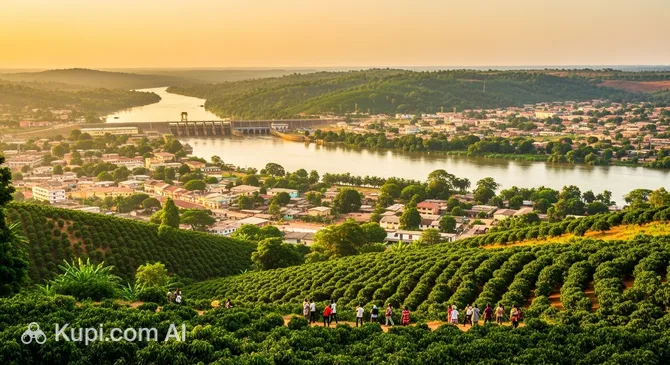
Soubré is a dynamically developing economic center located in the southwestern part of Côte d'Ivoire. The city is not your typical tourist resort with luxury hotels, but it possesses a unique atmosphere of an authentic African province, where life is inextricably linked to the land and its gifts. As the administrative center of the Nawa Region, it plays a key role in the agricultural life of the entire country.
Geographically, the city is surrounded by lush vegetation and hilly terrain, creating a picturesque backdrop for the daily hustle and bustle. Soubre. Illustration.
Source: Kupi.com AI
With a population of about 272,773, Soubré sees most of its residents employed in the agricultural sector. It is home to one of the main hubs for cocoa and coffee processing and trade, which has largely shaped the modern appearance and general energy of the place.
The modern history of the city began with rapid growth in the 1970s, when cocoa bean exports brought the region to a new level of development. Today, travelers stop by to see the real life of the Ivorian southwest, visit colorful local markets, and witness the endless plantations that provide a significant portion of the world's chocolate.
A visit to Soubré is an excellent experience for those seeking authenticity and wanting to get acquainted with the industrial-agricultural heart of West Africa. It is a city of workers and farmers, where the hospitality of the locals blends with the business rhythm of a trade hub.
Weather Overview
The climate in Soubré is classified as equatorial, which means consistently high temperatures and significant humidity throughout the year. Annual average temperatures hover around 26–28°C, creating ideal conditions for growing tropical crops. Thanks to the thick forests and plantations surrounding the city, the air here feels fresher than in large metropolises, although humidity remains high.
The region has two distinct rainy seasons: the first lasts from May to July, and the second from October to December. Heavy downpours are possible during these periods, which can sometimes lead to flooding but also provide vital moisture to the agricultural lands. January and February are considered the driest and hottest months, when temperatures can rise above 34°C. More detailed weather in Soubré by month will help you choose the ideal time for your trip.
Travelers should expect a warm summer with occasional short but intense rains. When packing your suitcase, focus on light clothing, but don't forget an umbrella or a light raincoat if your visit coincides with the wet season. Overall, the climatic conditions of Soubré are favorable for visiting year-round if you are comfortable with tropical heat.
Average monthly temperature
Average monthly precipitation
Interesting Facts
Soubré is a city whose character is shaped by the gold of the tropics—cocoa beans. Here are some curious facts about this place:
Chocolate Heart: Since the 1970s, Soubré has been one of the world's most important centers for cocoa cultivation, transforming a small settlement into a major economic hub.
Ethnic Kaleidoscope: The city is home to representatives of more than 60 different ethnic groups, creating a unique cultural and linguistic environment.
Transit Status: Major transport flows of agricultural products pass through Soubré on their way to the country's ports for further export.
Practicality Above All: Unlike the political capital, Yamoussoukro, with its grand cathedrals, the architecture of Soubré is highly functional and tailored to the needs of the agricultural economy.
Natural Filter: Thanks to the vast amount of forests and plantations around the city, the air remains relatively clean despite the dense development of the center.
How to Get There
The transport accessibility of Soubré largely depends on the road network of southwestern Côte d'Ivoire. Since the city does not have its own airport, most travelers begin their journey from the country's largest economic center. Detailed information on how to plan your route is available in the section describing how to get to Soubré.
The primary means of travel between cities are buses and intercity taxis. The distance from Abidjan is approximately 300–350 km. A bus journey can take between 6 to 8 hours, depending on road conditions and traffic congestion from cocoa-carrying trucks. During the rainy season, travel time can increase significantly due to washouts on certain sections of the highway.
There is no railway service in this region, so all passenger traffic relies on road transport. If you are planning a trip from neighboring cities like Daloa or Man, it is most convenient to use the services of local carriers. It is recommended to plan your trips during daylight hours and check schedules at bus stations in advance.
Station
Passenger traffic
Distance
Bouaké railway station
2
272 km
Gare ferroviaire Treichville
2
290 km
Main Attractions
While Soubré may not boast an abundance of world-renowned historical monuments, it offers tourists an immersion into the real economic life of the region. The main "attraction" here is the endless cocoa plantations surrounding the city. A walk through them allows you to see the entire production cycle of the famous beans—from the flowering trees to the harvest—which is a unique experience for visitors from northern latitudes.
At the heart of the city lies the center of daily activity: the Soubré Central Market. This is not just a place for shopping, but a true cultural hub where you can feel the rhythm of the city, hear dozens of local dialects, and see mountains of exotic fruits, spices, and, of course, cocoa products. The market is striking in its brightness and chaotic yet magnetic energy.
For those seeking tranquility, walking along the banks of local reservoirs or visiting the central squares where locals gather in the evenings can be interesting. Soubré is primarily fascinating as a living organism, showcasing the authentic way of life in modern Côte d'Ivoire without any filters, making it a valuable stop for thoughtful African explorers.
Local Cuisine
The gastronomy of Soubré is a celebration of traditional Ivorian flavors, where the main ingredients are yams, cassava, and plantains. A must-try dish is attiéké—a side dish made from fermented cassava with a texture similar to couscous. It is usually served with fried fish or chicken and a spicy vegetable sauce.
Local residents take great pride in their rich sauces. It is worth trying the legendary sauce graine, made from oil palm fruit, which has a deep, savory flavor. Foutou is also popular—a thick dough made from boiled yams or plantains, eaten by hand and dipped into aromatic soup or sauce.
The food culture in the city is centered around street food stalls and market counters. This is where you can find the freshest and most authentic food. For drinks, be sure to try the local palm wine or refreshing natural juices made from mangoes and pineapples, which are abundant here. The city's food scene is simple but incredibly unique and generous in vibrant taste sensations.
Travel Tips
A trip to Soubré will be an amazing adventure if you prepare in advance for the specifics of life in Africa's agricultural heart. These practical tips will help you feel confident and comfortable.
Clothing and Essentials: Choose light clothing made of natural fabrics (cotton, linen), as Soubré is very humid and hot. During the rainy season, be sure to have a sturdy raincoat and closed shoes for walking around the outskirts. Don't forget a universal power adapter.
Transport: Within the city, it is most convenient to get around by moto-taxi. For intercity travel, use reputable bus companies departing from the main stations, and try not to plan trips at night.
Finances: The official currency is the West African CFA franc (CFA). Cards are rarely accepted, so always carry a sufficient supply of cash. ATMs can be found in the city center, but they do not always work with international cards.
Health and Safety: Use insect repellent and drink only bottled water. It is recommended to consult a doctor regarding malaria prophylaxis before your trip. Stay vigilant in crowded places (like markets) to avoid pickpockets.
Communication: The main language of communication is French. English is not widely spoken, so learn a few basic phrases or use an offline translator. A local SIM card can be easily purchased at any mobile kiosk in the center.
Local Etiquette: Ivorians are very polite. Always say hello before asking for something. In Soubré, it is customary to treat elders with respect and not to photograph people without their explicit consent.
What to Avoid: It is not recommended to walk alone on the outskirts of the city and plantations after dark. Also, avoid discussing political topics or criticizing local customs in public places.
Extra Tip: Visit the local markets in the morning hours—this is the best time to see the city in its most active and authentic state.
By following these simple rules, you will be able to fully enjoy the hospitality of Soubré and bring home only warm memories of this amazing region.
Entertainment & Nightlife
The entertainment scene in Soubré is primarily geared toward locals and reflects the calm rhythm of an agricultural city. There are no large night clubs or noisy discos typical of Abidjan, as most residents follow an early daily routine. However, the city does not fall completely asleep in the evening: on the main streets and near the markets, small open-air bars operate where you can enjoy a cold beer and listen to modern Ivorian music.
The main daytime entertainment for locals is football. Matches are often held in city squares and makeshift fields, passionately watched by hundreds of spectators. Tourists can join the fans to feel the genuine emotion and passion Ivorians have for the game. Family gatherings in street cafes, where life flows slowly over discussions of the latest news, are also popular.
For those looking for larger cultural events or European-style nightlife, Soubré residents recommend heading to Abidjan or Daloa. In the city itself, it is worth focusing on harvest-related festivals, which are periodically organized by local communities and accompanied by traditional dances and songs.
Parks & Museums
In Soubré, there are no classic museums or art galleries, as the city developed as a purely functional agricultural center. Cultural heritage here lives not in display cases but in the streets, in the traditions of local communities, and at lively markets. If you are interested in history and art in the classical sense, you will have to head to Yamoussoukro or Abidjan for major exhibitions.
The city's park infrastructure is also limited. The main green zones are small squares in the center and shaded areas near administrative buildings. However, the real "park" begins just beyond the city limits: the city is literally immersed in tropical forests and plantation groves. For locals, these natural masses serve as places for recreation and walking.
The lack of man-made parks is compensated for by the proximity to wildlife and the region's majestic rivers. Tourists often find charm in walking along the city outskirts, where the richness of Côte d'Ivoire's flora can be seen. Despite the shortage of formal recreational zones, Soubré wins visitors over with its natural greenery that surrounds every neighborhood.
Getting Around
The transport system in Soubré is simple and efficient for the needs of a small city. The primary mode of transport here is moto-taxis, which locals call "zemidjan." This is the fastest and most affordable way to get anywhere in the city, especially through crowded market districts. You should always agree on the price of the ride in advance, as there are no meters here.
For longer trips or group travel, woro-woro are used—collective taxis or minibuses that follow specific routes. They depart as they fill up and are very inexpensive. "Bush taxis" are also popular, connecting Soubré with surrounding villages and plantations.
The payment system is exclusively cash everywhere. There are no metro or tram systems in the city, and the roads in the central part are mostly paved, though dirt roads are common on the outskirts. Tourists are recommended to use official taxi stands and to keep in mind that during peak hours, traffic around the markets can be very difficult due to the large number of trucks.
Accommodation
The hospitality market in Soubré is mainly focused on business travelers, agricultural sector specialists, and transit passengers. You won't find luxury five-star hotels here, but the city offers a decent selection of budget and mid-range accommodation options providing basic comfort.
The most popular types of accommodation are guesthouses and small hotels, such as Hotel Soubre, located in the central part of the city. The cost of a stay usually ranges between $20–$50 per night. Most establishments offer simple rooms with a fan or air conditioning, which is essential given the high tropical humidity.
When choosing accommodation, it is recommended to focus on the central areas of the city, where the main infrastructure, markets, and transport hubs are concentrated. It is better to book rooms in advance, especially if your trip coincides with the peak harvest season when many trade agents and specialists arrive in the city.
Nearby Cities
The city of Soubré is an excellent starting point for exploring the southwestern regions of the country, offering access to interesting neighboring towns. Exploring the surroundings, you can see how the landscape and lifestyle change from agricultural centers to coastal settlements.
Just 80 kilometers away is Gagnoa, a major trade and administrative center known for its markets and active cultural life. For those missing the ocean breeze, a trip to Sassandra—a picturesque coastal town with colonial history and beautiful beaches—is a great option. It is also worth visiting San-Pédro, the country's second-largest port, which offers a more developed tourist infrastructure.
Traveling through the surrounding areas allows for a deeper understanding of Côte d'Ivoire's diversity, transitioning from endless cocoa plantations to the Atlantic coast. Most trips can be made by taxi or bus, making day trips quite comfortable and informative.
Shopping & Souvenirs
Shopping in Soubré is primarily about visiting its legendary markets. You won't find modern shopping malls with glass storefronts here, but you can immerse yourself in the atmosphere of a real African bazaar. The Central Market of the city is the main point of attraction, where you can buy everything from the freshest produce to brightly colored fabrics with traditional patterns.
The main souvenir from this trip will undoubtedly be cocoa beans or coffee. In Soubré, you can purchase high-quality products directly from the producers. Also, look out for items made by local artisans from wood and palm fibers—these items will serve as a unique reminder of your journey. Traditional Ivorian fabrics are also very popular due to their durability and unusual ornaments.
Most shops and market stalls operate from early morning until sunset. Payment is made exclusively in cash in the local currency (West African CFA francs), so it's worth taking care of money exchange in advance. Bargaining at the markets is not only appropriate but is part of the local communication culture, allowing tourists to not only save money but also interact with friendly vendors.