Support

Shitennō-ji

About

Shitennoji (Shitenno-ji) is one of the oldest Buddhist temples in Japan and a true gem of the Kansai region. Although it is sometimes associated with the city of Nara, this significant temple complex is actually located in Osaka, about 30 kilometers west of Nara. Founded as early as the 6th century, it stands as a major witness to the country's religious and architectural history.
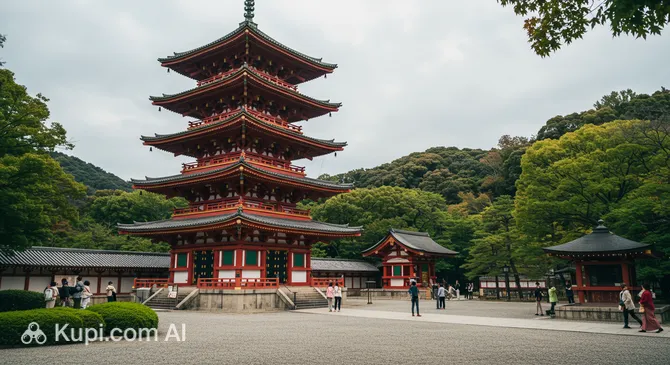
Shitennō-ji. Illustration.
Source: Kupi.com AI

Traveler photos:

The founder of Shitennoji is considered to be Prince Shotoku, a prominent figure in Japanese history who played a key role in spreading Buddhism and shaping the cultural foundations of the state. It was Shitennoji that received the status of the first state-sponsored Buddhist temple in the country, highlighting its special historical and spiritual importance.

The architectural ensemble of Shitennoji is truly unique and draws attention with its strict symmetry. The main buildings of the complex—the pagoda, the Golden Hall (Kondo), and the Lecture Hall (Kodo)—are aligned in a straight line from south to north, which is a distinctive feature of its layout compared to many other Japanese temples. A visit to Shitennoji allows you to touch the origins of Japanese Buddhism and enjoy the harmony of ancient architecture.

Contacts

If you are planning to visit Shitennoji, the primary contact information available is its physical address. Phone numbers, email addresses, or an official website for the temple are currently not provided.

For more detailed and up-to-date information, including opening hours and potential changes, it is recommended to check official tourism portals or the Osaka City information services.

How to contactContact
Address1-chōme-11-18 Shitennōji, Tennoji Ward, Osaka, 543-0051, Japan
Phone number+81 6-6771-0066
Websitewww.shitennoji.or.jp

What to Do

Visitors to Shitennoji can enjoy a leisurely stroll through its vast and well-maintained grounds. It is a wonderful opportunity to immerse yourself in the atmosphere of antiquity, observing the harmonious blend of ancient architecture and picturesque gardens. Here, you can often witness traditional religious ceremonies, which add a special touch to the visit.

At the heart of the complex are five main structures that are definitely worth seeing: the majestic South Gate (Nandaimon), the Middle Gate (Chumon), the famous five-story pagoda (Goju-no-to), the sacred Golden Hall (Kondo), and the Lecture Hall (Kodo). Additionally, there are four auxiliary buildings on the grounds, historically intended to provide social and medical aid to parishioners, highlighting the temple's social role throughout the centuries.

For those interested in history and culture, there is a museum on the temple grounds. Its exhibits feature valuable artifacts telling the story of Buddhism in Japan and the activities of Prince Shotoku, the temple's founder. Furthermore, Shitennoji regularly serves as a venue for various seasonal festivals, cultural events, exhibitions, and workshops, making a visit interesting not only for pilgrims but for all curious travelers.

Getting There

Shitennoji Temple is located in the city of Osaka. The most convenient way to reach it by public transport is the metro. You will need the Shitennoji-mae Yuhigaoka station, which is served by the Tanimachi Line. It is only a 5–10 minute walk from the metro exit to the main entrance of the temple complex. Since the temple is situated in a busy urban area, be prepared for active traffic around the site.

If you are planning a trip to Shitennoji from Nara, you will first need to get to Osaka. You can use the JR or Kintetsu lines, which run to Osaka Station. Upon arrival at the station, you will need to transfer to the metro and take the Tanimachi Line to the aforementioned Shitennoji-mae Yuhigaoka station. Total travel time will depend on the train schedule and transfer times.

For ease of movement, especially if it is your first time in this area of Osaka, it is recommended to use navigation apps on your smartphone or carry a city map. The temple complex is quite large, but finding your way around is easy. There are signs in both Japanese and English inside, as well as information boards that will help you plan your route through the main attractions of Shitennoji and make your self-guided visit more comfortable.

Nearest city: Nara

History & Facts

The history of Shitennoji dates back to the year 593. Its foundation is inextricably linked with the name of Prince Regent Shotoku, who ordered the construction of the temple to commemorate a significant victory of the pro-Buddhist forces over the supporters of traditional Shinto beliefs during a civil war. This event became a major milestone in the religious history of Japan, and Shitennoji itself became a symbol of this triumph and the spread of Buddhist teachings.

Throughout its centuries-old history, Shitennoji has faced severe trials. The temple complex has suffered numerous times from destructive fires and other disasters. For instance, in 836, the temple was seriously damaged by a lightning strike, and in 960, it was almost completely destroyed by fire. However, despite all the hardships, Shitennoji was restored every time with remarkable persistence, invariably maintaining its status as one of the most important Buddhist centers in Japan.

In the 11th century, after another large-scale restoration, Shitennoji experienced a new period of prosperity. It became a popular pilgrimage site for the Japanese aristocracy and even members of the Imperial family, testifying to its high spiritual authority. Additionally, the temple played an important role in education: many founders of various schools of Japanese Buddhism studied within the walls of Shitennoji, making it a true cradle for many religious traditions.

One of the notable features of Shitennoji is its architectural layout, where the main structures—the five-story pagoda, the Golden Hall (Kondo), and the Lecture Hall (Kodo)—are arranged strictly in a straight line. This style, known as "Shitennoji-garan," not only set the temple apart from others but also became a canonical model. Subsequently, many Buddhist temples across Japan were built following this symmetrical and harmonious composition.

Time Needed

When planning a visit to Shitennoji, it is worth setting aside enough time to enjoy its atmosphere and explore the main buildings without rushing. On average, a full tour of the temple complex and its grounds typically takes from 1.5 to 3 hours. This time is usually enough to walk through the main courtyards, visit the principal halls, the pagoda, and perhaps stop by the temple museum if it is in your plans.

If you want to study the architecture in more depth, sit quietly in the garden, or perhaps catch a ceremony, it is better to aim for the upper end of this timeframe—about 3 hours. If your schedule is tighter and you only plan a quick overview of the main highlights of Shitennoji, you can manage in 1.5–2 hours.

Keep in mind that the duration of your visit may vary depending on your personal pace, interest in details, and any special events or festivals that might be taking place at the temple on the day of your visit. In any case, Shitennoji is a place where you will want to linger, so try not to schedule your next stop too closely.

Working Hours

The Shitennoji temple complex in Nara is generally open to visitors daily. Standard operating hours are usually from 8:30 AM to 4:30 PM. This allows guests to conveniently plan their visit during the day.

It is important to remember that these hours may change depending on the season or due to special events. Therefore, before your trip, we strongly recommend checking the latest information on visiting times and any potential need for advance ticket booking on the official Shitennoji website or at local tourist information centers in Nara.

8:30 – 16:00

Nearby

A visit to Shitennoji is undoubtedly a highlight of any journey through Japan. This famous temple is located in the beautiful city of Nara, and to make your exploration of this amazing place even more complete, we recommend visiting other nearby attractions. Each is unique in its own way and will help you gain a more comprehensive understanding of the region's rich history and culture.

Discover more than just one landmark! The surroundings of Shitennoji in Nara offer many interesting places that can enrich your trip. Below is a list of some of them, along with distances, to help you plan your itinerary and make your stay in Nara even more fulfilling.

NameDistance
Shinsekai (New World)1 km
Nara Rare Animal Zoo2.5 km
Osaka Tenmangu Shrine4.6 km
Osaka Museum of Natural History4.9 km
Beer Museum12 km
Susuruka28.5 km
Mizuya Chaya30.3 km

Have you reached the end of the page?

So the route has been studied inside and out