Support

The Angel of Independence

About

The Angel of Independence (Spanish: El Ángel de la Independencia) is one of the most recognizable and significant symbols not only of Mexico City but of all Mexico. This majestic monument, located on the famous Paseo de la Reforma, was built to commemorate the centennial of the start of the war for independence. It is a classic victory column that draws the attention of tourists and serves as a point of national pride for Mexicans.

The central element of the monument is a 36-meter column, topped by a 24-karat gold-plated bronze statue of the Greek goddess of victory, Nike. The statue itself is nearly 7 meters tall. In her right hand, the goddess holds a laurel wreath, representing victory, and in her left, broken chains symbolizing long-awaited freedom. At the base of the column are sculptural groups representing War, Peace, Law, and Justice.
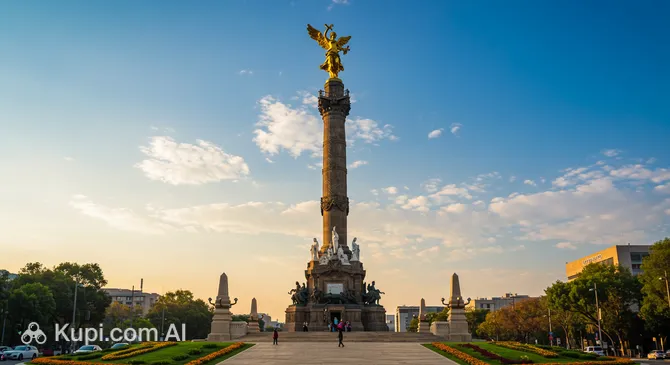
The Angel of Independence. Illustration.
Source: Kupi.com AI

Traveler photos:

The Angel of Independence is not just an architectural masterpiece but also a mausoleum where the remains of several heroes of the War of Independence rest. The monument is a must-see on any Mexico City tour, offering visitors a chance to touch history and enjoy city views by climbing to the observation deck inside the column.

Contacts

Since the Angel of Independence is a public monument located on a roundabout on Paseo de la Reforma, it does not have a dedicated visitor office with a phone number or email address. The monument's exterior can be viewed at any time.

To visit the observation deck inside the column, a special permit may be required, and access hours often change, especially after restoration work. The most reliable way to find up-to-date information is to ask the tourist police on-site or check official Mexico City government resources, such as the `mexicocity.gob.mx` website.

How to contactContact
AddressAv. P.º de la Reforma 342-Piso 27, Juárez, Cuauhtémoc, 06600 Ciudad de México, CDMX, Mexico
Websitemexicocity.cdmx.gob.mx

What to Do

The main highlight for many visitors is the chance to climb to the top of the monument. A spiral staircase with 200 steps is hidden inside the column, leading to the observation deck. After making the climb, you will be rewarded with a magnificent panoramic view of the famous Paseo de la Reforma and the surrounding districts of Mexico City.

Beyond the climb, the Angel of Independence offers much to see at its base. It is a great place for commemorative photos. Take a close look at the quadrilateral pedestal: it features bronze sculptures symbolizing Law, War, Justice, and Peace. Nearby is an expressive statue of a lion led by a child, which is also part of the monument's complex allegorical composition.

As you continue your tour, notice the marble statues of the heroes who fought for Mexico's independence, positioned on top of the base. In the very center of the pedestal, an inscription in Spanish reads: “La Nación a los Héroes de la Independencia,” which translates to “The Nation to the Heroes of Independence.” Studying these details allows for a deeper understanding of the history and significance of this grand monument.

Getting There

Getting to the Angel of Independence is quite simple, as the monument is located in the heart of Mexico City, on a roundabout of the famous Paseo de la Reforma. It is one of the busiest and most accessible spots in the city, so tourists have plenty of options for reaching it.

The most convenient and economical way is to use public transport. The Metrobús (bus rapid transit system) is the closest option. Line 7, which runs along the entire length of Reforma, has a stop called “El Ángel,” located almost at the foot of the monument. You can also take the metro: the nearest station is Insurgentes (Line 1, pink), from which you will need to walk for about 10–15 minutes. Additionally, many city bus routes pass by the Angel of Independence.

If you prefer comfort, you can always take a taxi or use ride-hailing apps like Uber or DiDi. The trip from most central areas of the city will be quick and inexpensive. For tourists, the double-decker Turibus is an excellent option, as its route always includes a stop at the Angel of Independence. Finally, if you are staying in the Roma, Condesa, or Juárez neighborhoods, walking to the monument along the scenic Paseo de la Reforma is a pleasant way to enjoy the city views.

Nearest city: Mexico City

History & Facts

The history of the Angel of Independence in Mexico City is closely tied to the desire to immortalize one of the most important events in the history of Mexico. The construction was initiated by President Porfirio Díaz, and the first stone was laid on January 2, 1902. The grand opening took place in 1910 and was timed to celebrate the centenary of the start of the war for independence, marking a significant milestone in the nation's cultural life.

A team of talented masters worked on creating this architectural masterpiece. The project was led by the renowned architect Antonio Rivas Mercado, and outstanding sculptors of their time—Manuel Gorospe and Gonzalo Garita—participated in creating the sculptural elements. Their joint efforts resulted in a monument that continues to inspire with its harmony and grandeur today.

The significance of the Angel of Independence for the Mexican people and world culture is hard to overstate. The monument is not just a reminder of a heroic past, but also a living symbol of national identity and inspiration for future generations. In 2018, its high historical and cultural value was officially recognized internationally when the monument was added to the World List of Objects of Particular Tourism Attraction.

Time Needed

When planning a visit to the Angel of Independence, it is worth considering that the time needed to see it can vary significantly. For a simple introduction to the monument, taking photos at its base, and studying the sculptural groups, 20–30 minutes will be sufficient. Since the monument is located at a busy traffic junction, such a quick visit is easy to fit into any tourist itinerary through Mexico City.

If your goal is not only to see the exterior but also to climb to the observation deck, you should set aside 1 to 1.5 hours. The path up consists of a spiral staircase with 200 steps, and the climb itself, along with time to enjoy the panoramic views of Paseo de la Reforma, will take additional time. It is important to note that access to the observation deck is often limited and may require obtaining a special free permit, so it is recommended to check for up-to-date information before your visit.

Working Hours

As an outdoor monument, the Angel of Independence is available for exterior viewing 24 hours a day, year-round, so you can admire it and take photos whenever it is convenient. However, access to the observation deck located inside the column is regulated and often limited. Inside is a 200-step staircase leading to the top.

Visiting the observation deck is usually only possible on certain days and hours, such as weekend mornings. It is important to note that access may be temporarily closed for restoration or other reasons; while you don't need to book tickets in advance, it is highly recommended to check for current information on operating hours before your visit. Sometimes a free permit issued by local authorities may be required for the climb. The most reliable way is to check the official Mexico City government websites or visit tourist information centers upon arrival in the city.

Open 24 hours

Nearby

Visiting the Angel of Independence is just the beginning of your acquaintance with the rich cultural and historical heritage of Mexico City. The monument is located in one of the city's most vibrant areas, and a walk through its surroundings will allow you to discover many other iconic spots within walking distance. Exploring nearby attractions will enrich your experience and help you form a more complete picture of the Mexican capital's many facets.

From grand historical monuments and world-famous museums to cozy bars and nightclubs, everything is close by. To help you plan your route, we have prepared a list of interesting places located near the Angel of Independence.

NameDistance
El Péndulo0.3 km
BeerGarden Roma0.6 km
Jazzatlán Capital1.3 km
Chapultepec Castle1.7 km
National Museum of Anthropology2 km
Saks Polanco2.3 km
Museum of Memory and Tolerance2.6 km

Have you reached the end of the page?

So the route has been studied inside and out