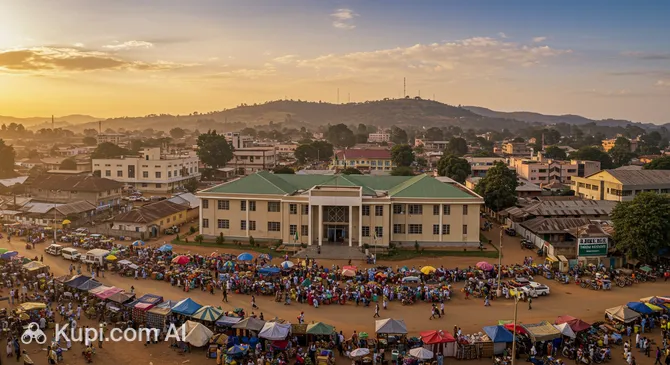
Located in the picturesque savanna foothills of the Shebshi Mountains, Jalingo is an important administrative and commercial center in northeastern Nigeria. As the capital of Taraba State, the city attracts visitors with its authentic atmosphere, where modern university life intertwines with the traditional way of life of local communities. The city's population is growing rapidly and, according to recent estimates, exceeds 600,000 people, making it a dynamic and bustling regional hub.
Jalingo. Illustration.
Source: Kupi.com AI
Founded in 1893, the city has a rich history of development, beginning its journey as a military camp for the Muri Emirate. Today, Jalingo serves as a key hub for the region's agricultural economy, specializing in farming and livestock. Although the city is not a typical tourist center with flashy urban glitz, it wins visitors over with its peaceful reputation and the hospitality of its residents, who are predominantly members of the Fulani, Jukun, and Mumuye ethnic groups.
Among the city's main architectural landmarks are the majestic Palace of the Emir of Muri and the modern campus of Taraba State University. Jalingo also serves as a "gateway" to the state's natural treasures, including the famous Mambilla Plateau. We invite you to visit this city to see the real, non-touristy Nigeria, get acquainted with its cultural diversity, and enjoy the views of the endless savannas.
Weather Overview
The climate in Jalingo is typical of the savanna region and is characterized by a clear division into two seasons. It remains warm throughout the year, with average annual temperatures ranging between 28–32°C. The hottest month is usually March, when daytime temperatures can reach an impressive 39°C, creating conditions for true tropical heat.
The wet season in the city lasts from April to October, with peak rainfall occurring in August and September. During this time, the savanna transforms and turns green, but humidity increases significantly. The dry season arrives in November and continues until March; during this period, dusty winds enter the city, and rain is virtually non-existent. Before your trip, we recommend checking a detailed weather forecast for Jalingo to choose your wardrobe correctly.
The foothills of the Shebshi Mountains play a special role in shaping the local weather, providing natural protection and sometimes bringing a slight coolness in the evening hours. However, travelers should be prepared for heavy dust in the air during the dry season and potential water supply disruptions in the driest months, which are characteristic features of the region.
Average monthly temperature
Average monthly precipitation
Interesting Facts
The name "Jalingo" originates from the Fulfulde language and translates to "superior place," emphasizing the city's significance in the region.
The city has the status of a university center: it is home to Taraba State University (TSU), which is the primary educational hub for youth in the northeast of the country.
The city's airport, named after Danbaba Suntai, is one of the most "exclusive" in terms of its schedule—flights from the nation's capital, Abuja, are accepted here only three times a week.
Jalingo was officially proclaimed the capital of Taraba State only in 1991, following the division of the former Gongola State into two parts.
The city maintains the influence of a traditional monarchy—the Emir of Muri's Palace is still an active residence and a major ceremonial site for the city.
How to Get There
The accessibility of Jalingo largely depends on land transport, as the city is an important link between the states of northeastern Nigeria. If you are planning a trip, it is worth researching all the options for how to get to the city in the most comfortable way.
The main air gateway for the region is Danbaba Suntai Airport. It is located in close proximity to the city, but flights here are infrequent—usually a few flights per week from Abuja operated by Overland Airways. Due to the limited schedule, it is recommended to book tickets well in advance.
Most travelers arrive in Jalingo by car or intercity bus. The city is connected by good highways to neighboring regional centers such as Yola, Wukari, and Abuja. The trip from the nation's capital can take between 10 to 12 hours depending on road conditions and traffic at the entrances to towns. The city is also linked by road to neighboring Cameroon, making it an important point for cross-border trade.
Station
Passenger traffic
Distance
Bauchi Railway Station
1
232 km
Jos Terminal
1
295 km
Ngaoundéré Central Station
2
298 km
Main Attractions
Although Jalingo is better known as an administrative center, it has several sites that deserve the attention of travelers. The architectural and cultural jewel of the city is the Emir of Muri's Palace—a majestic structure reflecting the region's traditional Islamic heritage. This site allows visitors to touch the history of the local emirate and appreciate the craftsmanship of African builders.
In the heart of the city lies the Jalingo Roundabout, which serves not only as an important transport hub but also as a popular landmark for meetings. The main urban activity is concentrated around it. It is also worth visiting the local markets, which are true trading hubs where you can observe the daily life of the townspeople and purchase items made by local artisans.
For those seeking natural beauty, the city serves as a starting point for grander attractions. From here, it is relatively easy to reach the Mambilla Plateau and the Gashaka-Gumti National Park, both known for their unique landscapes and biodiversity. Within the city itself, modern government buildings and the Taraba State University campus, which has become a center for education and youth culture in the region, are worth seeing.
Local Cuisine
The culinary traditions of Jalingo are inextricably linked to the agricultural wealth of Taraba State. The staples of the diet here consist of dishes made from yam, maize, sorghum, and rice. One of the most popular dishes to try is Tuwo Shinkafa—a thick porridge made from mashed rice, traditionally served with various soups, such as Peanut Soup or Egusi soup, prepared from the seeds of a local melon.
Dairy products hold a special place in local cuisine, due to the strong influence of the Fulani people. Fresh milk and traditional yogurts can often be found at local markets. Root vegetable dishes characteristic of the Jukun people are also popular. Meat lovers should look out for Suya—spiced skewers grilled over an open flame and sold everywhere as street food.
Regarding beverages, local palm wine and refreshing sorghum drinks are popular in Jalingo. The city's gastronomic life is concentrated in the markets and small street cafes where food is prepared from the freshest farm products. Hotel restaurants offer a more familiar international menu, but it is at the markets where you can experience the true taste of northeastern Nigeria.
Travel Tips
Planning a trip to Jalingo requires some preparation to ensure your journey through Taraba State is as comfortable and safe as possible. These practical tips will help you better navigate the local specifics:
Clothing and Items: Choose light clothing made from natural fabrics, as Jalingo is hot year-round. In respect of local traditions and the mixed ethno-religious population, it is recommended to wear modest clothing that covers shoulders and knees. Don't forget sunglasses and comfortable closed shoes for walking on dusty roads.
Transport: The best way to get around the city is by tricycle. For long-distance trips or travel to the airport, it is highly recommended to rent a car with a local driver.
Finances: The primary currency is the Nigerian Naira. ATMs in the city are limited and do not always accept international cards, so be sure to carry a supply of cash. Tipping culture is appreciated but remains at your discretion.
Health: Drink only bottled water and avoid ice in drinks. Before your trip, a yellow fever vaccination is mandatory, along with a doctor's consultation regarding malaria prevention.
Safety: Move around the city primarily during daylight hours. Avoid traveling alone at night and stick to central areas or the university campus, which is considered a safe zone.
Communication: The official language is English, but Hausa and Fulfulde are also widely spoken. Knowing a few greeting phrases in Hausa will help you build rapport with local residents more quickly.
Etiquette: Always ask for permission before photographing people or their homes. Greetings are very important here and are usually accompanied by a handshake.
Connectivity: Buy a local SIM card (such as MTN or Airtel) for mobile internet access, as Wi-Fi in hotels can be unstable.
Following these simple rules will make your acquaintance with Jalingo pleasant and leave only positive impressions of the hospitality of northeastern Nigeria!
Entertainment & Nightlife
The entertainment scene in Jalingo is primarily geared towards the local population and students, giving it a calm and relaxed character. You won't find loud, European-style nightclubs here—the city's evening life is centered around the bars and restaurants of major hotels. For example, establishments at the Blue Nile and Grand Shield hotels offer a cozy atmosphere where you can spend an evening over a drink and lively conversation in relative safety.
Daytime entertainment is mainly linked to visiting markets and participating in cultural events. The ATC university district is a hub of youth activity, where student festivals and sports competitions are occasionally held. The main spectacle for the townspeople remains football matches at local stadiums, which always draw many passionate fans.
For those who prefer more active outdoor recreation, city residents often organize weekend trips to the foothills of the Shebshi Mountains or the banks of the Benue River, located about 40 kilometers from the city. Evenings in Jalingo are a time for leisurely strolls in the central part of the city and home gatherings, which perfectly aligns with the conservative and friendly culture of Taraba State.
Parks & Museums
In Jalingo itself, park culture is moderately developed, and the city largely retains its natural savanna landscape. However, for residents and visitors, the main place for outdoor walks is the grounds of Taraba State University. The campus is designed with a need for recreation areas and offers green spaces that contrast favorably with the dense urban development.
There are currently no specialized historical or art museums in the classical sense in the city. The role of guardian of cultural heritage is performed by the Emir of Muri's Palace, which is a living monument of history and architecture in itself. Visitors can view the majestic building and learn about the traditions of local peoples directly within this historical environment.
Ecological recreation in the region is more associated with trips outside the city limits. The proximity of the Shebshi Mountains foothills provides excellent opportunities for picnics and light trekking. Despite the lack of large urban parks, the surrounding nature with its endless horizons and unique savanna flora compensates for this for those seeking solitude and the beauty of the African landscape.
Getting Around
Public transport in Jalingo is represented by a set of vehicles typical for Nigeria, among which tricycles (keke-napep) and motorcycle taxis (okada) lead the way. This is the fastest and most convenient way to move through narrow streets and between the main areas of the city, such as the center and the ATC university campus. A ride on a tricycle is usually inexpensive, but it is worth agreeing on the price in advance.
Small buses (danfo) also run in the city, connecting Jalingo with suburban areas and neighboring settlements. It is worth noting that during peak hours, public transport can be overcrowded, and traffic jams often occur at the city entrances. There is no unified system of electronic tickets; payment is always made in cash to the conductor or driver.
For tourists, the most comfortable and safest transportation option is to rent a car with a local driver. This will provide the necessary flexibility and help avoid difficulties with navigating the chaotic city roads. Walking during the day is possible in the central areas, but due to the intense heat and dust, most prefer to use transport on unlit sections.
Accommodation
The hotel stock in Jalingo is primarily oriented toward business travelers, government officials, and those visiting the city for university purposes. The choice of accommodation is not very large, but the available options offer basic comfort corresponding to a 3-star level. Most modern hotels are concentrated in the central part of the city and the ATC district (near the university).
Among the most popular places to stay are the Blue Nile and Grand Shield hotels. They offer air-conditioned rooms, access to restaurants and bars, and rates starting from approximately $36 per night. The Fast Track hotel is also popular in the city, often chosen for its convenient location and good value for money.
For those planning a long-term stay, rental apartments are available in Jalingo, which is a common practice among expats and visiting specialists. Tourists are recommended to book accommodation in advance, especially during periods of official events or major university functions, when the best rooms may be occupied.
Nearby Cities
Jalingo serves as an excellent starting point for exploring the northeastern region of Nigeria and the border territories. Thanks to its location, the city allows travelers to make interesting excursions into neighboring states and even into neighboring Cameroon.
One of the most popular destinations is the city of Yola, the capital of neighboring Adamawa State. The trip there takes only a few hours and allows you to see another important cultural and economic center of the region. Also worth noting are the town of Numan, located at a picturesque river confluence, and Gombe, which is famous for its architecture and markets.
For nature lovers, a trip towards the border with Cameroon to the settlement of Koncha is a must. Exploring the surroundings of Jalingo will reveal a diversity of ethnic groups and landscapes, from river valleys to majestic mountain plateaus.
Shopping & Souvenirs
Shopping in Jalingo is primarily about visiting the colorful local markets, which are the heart of the city's trade. There are no giant shopping malls with global brands here, but you can find unique goods that reflect the spirit of the region. The main market squares are concentrated in the city center and in the ATC university area, where life is always buzzing and trade is brisk.
Items of folk crafts are worth bringing back from Jalingo as souvenirs. Pay special attention to traditional fabrics and embroidered clothing characteristic of the Jukun and Fulani peoples. The region is also famous for its leather handicrafts and woven baskets. At the markets, you can buy high-quality agricultural products, spices, and even traditional musical instruments.
Shops in the city usually operate from early morning until sunset, while trade in the markets begins at dawn. Payments are primarily made in cash using the local currency (Naira), so tourists are recommended to always carry a sufficient supply of bills. Cards are accepted only in the largest hotels and some modern supermarkets, but you won't need them for full-fledged shopping at the bazaars.