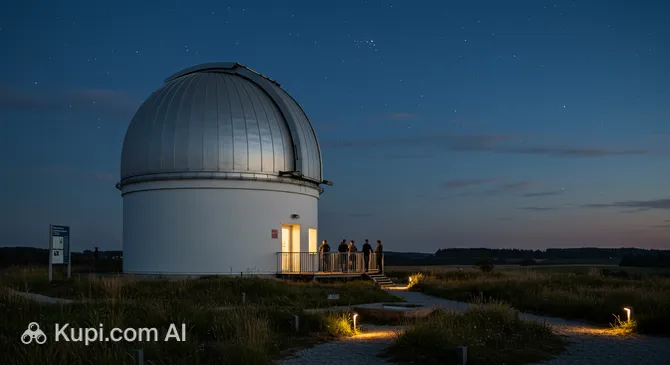
Imagine a historic structure that, instead of water, now preserves knowledge of the infinite Universe. The Olsztyn Astronomical Observatory is a unique scientific and educational space housed within the walls of an old water tower dating back to 1897. The building crowns Saint Andrew's Hill, the highest point in Olsztyn, making it an ideal location for contemplating celestial bodies.
Traveler photos:
The observatory opened its doors in 1979 and has since become a magnet for anyone drawn to the stars. It is the only place in Poland that houses authentic lunar rock samples brought to Earth by the Apollo 11 mission crew. Additionally, you can see the rare Shortt-Synchronome clock—one of the most accurate mechanical clocks in history—and a specialized detector that visualizes the trajectories of cosmic particles.
The creation of the observatory is inextricably linked to the name of Nicolaus Copernicus, who lived and made his discoveries in these lands. Today, the complex combines the charm of Neo-Gothic architecture with the power of modern telescopes, offering visitors the rare opportunity to see sunspots by day or distant constellations on a clear night.