Support

English Garden

About

The English Garden (Jardin Anglais) is one of the most picturesque and popular landscape parks, located in the heart of Geneva, on the left bank of Lake Geneva. Established in 1854, it was the city's first park designed in the traditional English style, with its winding paths and informal tree plantings. This cozy green space in Switzerland is an integral part of Geneva's reputation as one of the greenest cities in Europe.

The park was laid out on land reclaimed from the lake after the demolition of old city fortifications and has been constantly expanded and improved ever since. Today, it is more than just a place for a walk; it is a true symbol of the city. One of the garden's main attractions is the world-famous Flower Clock (L'horloge fleurie), created in 1955 as a tribute to the country’s watchmaking tradition. Its dial consists of thousands of live flowers, with a composition that changes several times a year.

In addition to the Flower Clock, the English Garden features a monumental fountain installed in 1862 and the National Monument, which symbolizes Geneva's joining of the Swiss Confederation. Strolling along the shaded paths, you can admire centuries-old trees and beautiful views of the lake and the famous Jet d'Eau fountain. It is an ideal place to relax, where you can enjoy nature and tranquility in the center of a bustling city.
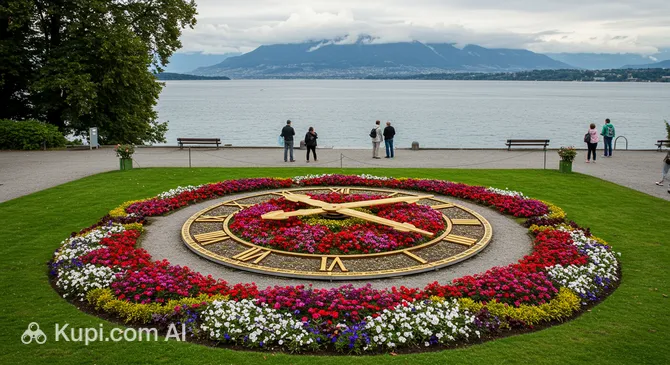
English Garden. Illustration.
Source: Kupi.com AI

Traveler photos:

Contacts

Since the English Garden is a public park, it is open 24 hours a day and admission is free. There is no single contact number for tourists, but all the necessary information about its location and access is readily available. Finding it is easy—it’s located right in the city center, on the Quai du Général-Guisan.

You can reach the garden on foot from central Geneva or use public transport. Near the park is the major Métropole stop, served by numerous trams and buses. You can also take the “Mouettes” water taxis, which dock at the Molard pier, located right next to the garden.

How to contactContact
AddressQuai du Général-Guisan 34, 1204 Genève, Switzerland
Websitewww.ville-geneve.ch

What to Do

A visit to the English Garden is an opportunity to see the famous symbols of Geneva. The main point of interest is, without a doubt, the world-renowned Flower Clock (L'horloge fleurie). This is not just a flowerbed, but a functioning and incredibly precise mechanism, whose dial is made of thousands of live flowers creating unique patterns that change with the seasons. Walking further, you will find the National Monument—a majestic sculpture erected to commemorate Geneva’s accession to Switzerland. You can also admire the large bronze fountain by Parisian sculptor Alexis André and busts of famous artists in the park.

The English Garden offers many options for peaceful relaxation. Its shaded, winding paths are perfect for leisurely strolls. You can rest on one of the many benches, enjoying the magnificent view of Lake Geneva and the famous Jet d'Eau fountain, which is clearly visible from the park's promenade. Well-kept green lawns serve as a great spot for a picnic, allowing you to relax in the very heart of the city. It is a favorite spot for both tourists and locals looking for a break from the city bustle.

For photography enthusiasts, the English Garden is a true find. Every corner of the park offers picturesque angles, whether it’s views of the lake, flower arrangements, or architectural details. Particularly successful shots can be taken with the Jet d'Eau in the background. Since the seasonal flower arrangements are regularly updated, the park looks different at any time of year, making each visit unique and offering fresh impressions.

Getting There

Thanks to its central location on the shores of Lake Geneva, reaching the English Garden is very simple. If you are in the city center, one of the best ways is a leisurely stroll. For example, the walk from the main Gare Cornavin train station toward the lake takes no more than 15–20 minutes. This is a wonderful opportunity to enjoy the views of Geneva on your way to one of the city's main green spaces.

For those who prefer public transport, Geneva offers a convenient and extensive network. Numerous trams, trolleybuses, and buses run regularly through the center, and the nearest stops to the park are just a few minutes' walk away. You can also use water taxis, with one route connecting the Molard pier at the English Garden to the opposite shore. This is a fast and efficient way to reach the garden from almost anywhere in the city.

If you are traveling by car, paid underground and street parking can be found nearby. However, keep in mind that, as in the center of any major European city, parking spaces in Geneva are limited. During the height of the tourist season, finding a free spot can be difficult, so it is recommended to plan your route in advance or opt for public transport.

Nearest city: Geneva

History & Facts

The history of the English Garden in Geneva began in the mid-19th century, when city authorities decided to create an elite district on the site of a former harbor and lumber warehouse. The park was established in 1854 and became the first in the city to be designed in the English style. Its concept was the complete opposite of strict, symmetrical French gardens, offering citizens a more natural and scenic space for relaxation. The idea was to create a landscape that blended harmoniously with nature, featuring flowing lines and a free-form layout.

The garden owes its existence to extensive improvements of the quay: part of the pier had to be filled in, so a significant portion of the park was literally reclaimed from the lake. From the very beginning, landscape masters sought to embody the key principles of the English style: naturalness, picturesque winding paths, and carefully placed groups of trees. Throughout its history, the park has been expanded several times; for instance, its area increased significantly after the construction of the Mont Blanc Bridge in 1862. Over time, it was enriched with new elements, such as a large bronze fountain and the National Monument, which commemorates Geneva’s joining of Switzerland.

Today, the English Garden is not just a historical park, but one of Geneva's most vibrant and beloved green spaces. It is a striking example of how a natural oasis can be harmoniously integrated into the heart of a city. The garden gained worldwide fame thanks to its celebrated Flower Clock, created in 1955 as a tribute to the country’s watchmaking art. This masterpiece, made up of thousands of flowers that are changed several times a year, remains one of the main symbols of both the park and Geneva itself.

Time Needed

To fully experience the English Garden, most visitors will find that 1 to 2 hours is sufficient. This provides enough time to stroll leisurely along the scenic paths, admire the famous Flower Clock, see the National Monument and the fountain, and enjoy beautiful views of Lake Geneva. Such a visit allows you to get a complete impression of the park without rushing.

If you want to immerse yourself more deeply in the atmosphere of this place, you might need more time. For instance, you could have a small picnic on the well-kept lawn, study the park's diverse vegetation in more detail, or simply relax on a bench while watching passersby and the views of the Jet d'Eau fountain. Thus, the duration of your visit is easily adapted to your interests: from a quick half-hour walk to see the main sights to several hours of relaxed rest.

Working Hours

Although the English Garden, as mentioned, is open to the public 24 hours a day and free of charge, there are a few nuances to consider when planning the perfect walk. The most comfortable time for a visit is certainly during daylight hours. It is during the day that you can fully enjoy the beauty of the famous Flower Clock, take vibrant photos, and admire the views of Lake Geneva in the sunlight.

The garden is beautiful at any time of year, and each season gives it a special charm. At night, its central paths are illuminated, creating a pleasant atmosphere for evening walks, though some remote corners may be less accessible for sightseeing. It is also important to remember that in rare cases, such as during special city events or due to unfavorable weather conditions, access to certain areas of the park may be temporarily restricted.

Open 24 hours

Nearby

A walk through the English Garden is a wonderful start to exploring Geneva, but to truly feel the city's atmosphere, it’s worth exploring its surroundings as well. Thanks to the park's ideal central location, many iconic sites are within walking distance. This makes it easy to combine outdoor relaxation with a rich cultural program.

Exploring nearby attractions will enrich your experience and help you get a fuller picture of Switzerland's history and modern life. Just a few minutes' walk from the garden's shaded paths, historical squares, majestic cathedrals, and famous city symbols await you.

NameDistance
Claire Bar0.4 km
Place du Bourg-de-Four0.5 km
Brunswick Monument0.5 km
Museum of Art and History0.5 km
Hotel des Bergues0.5 km
Reformation Wall0.6 km
Beau-Rivage Geneva Bar0.6 km

Have you reached the end of the page?

So the route has been studied inside and out