Support

Flower Clock

About

The Flower Clock in Geneva, Switzerland, is not just a landmark but a true work of art and engineering. Located in the picturesque English Garden (Jardin Anglais) on the shores of Lake Geneva, it is a massive, functioning clock mechanism with a dial masterfully decorated as a vibrant floral arrangement. This unique combination of Swiss watchmaking precision and natural beauty attracts thousands of tourists.
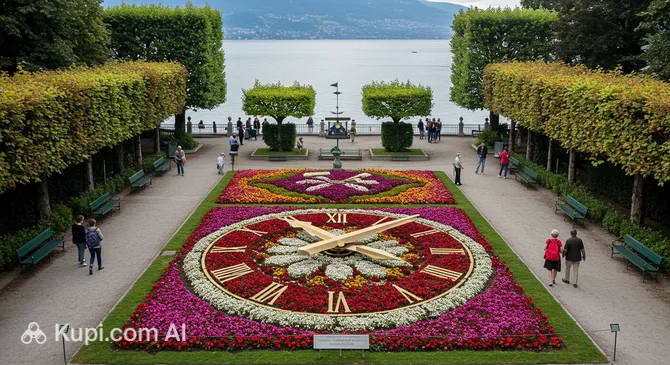
Flower Clock. Illustration.
Source: Kupi.com AI

Traveller photos:

The diameter of this amazing clock's dial reaches an impressive five meters, and more than 6,500 various flowers are used to decorate it. The clock mechanism itself, a specimen of Swiss mastery, is hidden underground and carefully maintained by specialists. This clock is not just a decoration but a fully functional instrument that tells the exact time.

One of the most remarkable features of the Flower Clock is its constantly changing appearance. Four times a year, with the arrival of a new season, the floral composition is completely updated, meaning the clock appears in a fresh, new outfit every time. The modern design includes eight concentric circles, with colors varying depending on the time of year and the plants used. The second hand deserves special attention — it is considered the largest in the world, with a length exceeding 2.5 meters, adding even more uniqueness to this floral masterpiece.

Contacts

The Flower Clock is an outdoor attraction located in the public English Garden (Jardin Anglais) in Geneva, so there are no specific contact details for it. To see this famous city symbol, you simply need to visit the park. For the most up-to-date information on park hours or events, we recommend checking Geneva’s official tourism resources or local information boards.

How to contactContact
AddressQuai du Général-Guisan 28, 1204 Genève, Switzerland
Phone+41 22 418 50 00
Websitewww.ville-geneve.ch

What to Do

Visiting the Flower Clock in Geneva is, above all, a chance to take unique photographs. This attraction is so photogenic that, in terms of the number of photos taken by tourists, it rivals even the famous Jet d'Eau fountain. Since the floral arrangements and the clock's design change with the seasons and even the time of day, every photo you take will be unique, capturing the fleeting beauty of this man-made wonder.

Beyond the aesthetic pleasure of viewing the bright colors, visitors to the Flower Clock can witness a fascinating natural phenomenon. The plants here are selected and planted in such a way that certain flowers supposedly open at specific hours, theoretically allowing one to tell the time by observing them. This transforms the clock into more than just a piece of horological art; it becomes a true botanical phenomenon demonstrating the harmony between nature and precision mechanics.

Viewing this technological and floral masterpiece is absolutely free for everyone. Don't miss the chance to walk through the picturesque English Garden, where the Flower Clock is located. Here you can enjoy beautiful views of Lake Geneva, relax on the benches, and perhaps discover other interesting corners of this part of the city while enjoying the peaceful atmosphere.

Getting There

Reaching the famous Flower Clock in Geneva is quite easy, as it is located in the heart of the city within the picturesque English Garden (Jardin Anglais) on the shores of Lake Geneva. Thanks to this central location, getting to this landmark is convenient from anywhere in the city. The Mont Blanc Bridge and the lakeside promenade serve as great landmarks — the clock is located just nearby.

Geneva is famous for its excellent public transport system. You can easily reach the English Garden by bus or tram. Many routes pass right by, so you'll only have a short walk to the clock itself.

If you are in the center of Geneva and enjoy walking, the Flower Clock is easily accessible on foot. This is a great chance to not only see one of the main attractions but also enjoy the city views, perhaps discovering something new along the way. Taxis are also a convenient option, especially if you prioritize comfort and speed.

Nearest city: Geneva

History & Facts

Surprisingly, the idea for floral clocks belongs not to watchmakers but to the famous 18th-century Swedish scientist Carl Linnaeus. He originally conceived them as a visual aid for botany students to study the circadian rhythms of plants. However, the enterprising authorities of Geneva saw different potential in this concept. For them, the Flower Clock became a brilliant opportunity to showcase the exceptional skill of local craftsmen and solidify the city's status as the undisputed world capital of watchmaking.

The Flower Clock that graces Geneva today was created in 1955, and its movement has not stopped for a single moment in nearly seven decades. Initially, the composition was simpler: a single dial decorated with more than 6,500 flowers, serving a more decorative purpose. However, with the arrival of the new millennium, the city's creative gardeners gave it a more complex and impressive look, creating the ensemble of eight concentric circles that we see today.

Throughout its existence, the complex mechanism of the Flower Clock has never failed, providing further proof of the impeccable reputation of Switzerland’s watchmakers. To maintain or repair this giant chronometer, masters must descend underground, where its modern electronic "brain" is located. There are even future plans to bring this remarkable mechanism to the surface so that everyone can admire it.

Time Needed

Visiting the famous Flower Clock in Geneva usually doesn't take much time. Most visitors spend about 15–30 minutes admiring this unique landmark, taking photos, and appreciating the craftsmanship of this living composition. This is plenty of time to see the dial's details, which change according to the season, and, of course, capture yourself against the backdrop of one of Geneva’s symbols.

However, if you want to do more than just a quick glance and fully soak in the atmosphere, your visit may last a bit longer. The Flower Clock is located in the picturesque English Garden (Jardin Anglais) on the shores of Lake Geneva. Therefore, many tourists combine seeing the clock with a leisurely stroll through the park, resting on a bench overlooking the lake, or simply enjoying the tranquility of this green space. In this case, a visit can take from 1 to 1.5 hours, especially if the weather is nice and you decide to explore other parts of the park.

Working Hours

Since the Flower Clock is located in the public English Garden, it is accessible 24/7 and completely free of charge. You don't need to book tickets or make an appointment to admire this unique piece of watchmaking and floral art in Geneva. You can come here at any time of the day or night that suits you to take photos and enjoy the view.

This attraction is open to visitors year-round. Furthermore, the floral arrangements on the clock change four times a year according to the season, so each visit can offer a new experience. Although access to the clock is free, it's always a good idea to check official Geneva tourism resources for information on any special events or temporary restrictions in the park, especially if you are planning a visit during the holidays.

Open 24/7

Nearby

After seeing the famous Flower Clock, don't rush to leave this charming area of Geneva. Exploring the surroundings can greatly enrich your trip, as other interesting places worth visiting are located very close by. A short walk will allow you to immerse yourself deeper in the city's atmosphere and discover new facets of its beauty and history.

Due to the Flower Clock's prime location, many other Geneva attractions are within walking distance. Below is a list of some of them, along with approximate distances, so you can easily plan your route and continue exploring this amazing city in Switzerland.

NameDistance
Claire Bar0.3 km
Hotel des Bergues0.4 km
Place du Bourg-de-Four0.5 km
Brunswick Monument0.5 km
Beau-Rivage Geneva Bar0.5 km
Museum of Art and History0.5 km
Reformation Wall0.6 km

Reached the bottom of the page?

Looks like you know this route inside out