Support

San Francisco–Oakland Bay Bridge

About

The San Francisco–Oakland Bay Bridge, also known as the Bay Bridge, is a majestic engineering structure connecting the cities of San Francisco and Oakland across the vast San Francisco Bay in California, USA. This impressive bridge crossing is not just a transport artery, but a true symbol of engineering thought and one of the key attractions in the region, carrying colossal flows of cars daily along Interstate 80.
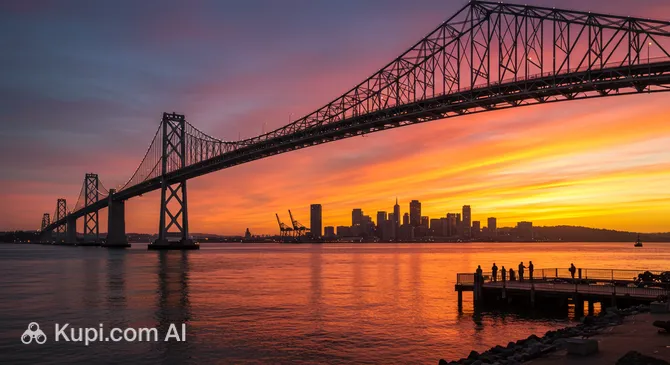
San Francisco–Oakland Bay Bridge. Illustration.
Source: Kupi.com AI

Traveler photos:

The uniqueness of the San Francisco–Oakland Bay Bridge lies in its complex and well-thought-out design. It actually consists of two main sections of different types: the western part is an elegant suspension bridge about 2,822 meters long, while the eastern part is a cantilever-style structure approximately 3,101 meters long. These two parts are connected not directly, but through a tunnel bored through Yerba Buena Island, which adds even more grandeur and engineering sophistication to this structure.

The span of this giant is impressive—the total length of the bridge is about 7.2 kilometers, and including the approach roads, it reaches nearly 13.5 kilometers, making it one of the longest bridges of its type in the world. A special feature is its double-deck structure, where traffic is organized on different levels, allowing for efficient distribution of traffic flows. Made of durable steel, the bridge rises above the water to a height of up to 160 meters, offering breathtaking views of the bay and the surrounding cities, and is a vital transport artery for the region.

Contacts

For the latest information on the San Francisco–Oakland Bay Bridge operations, including traffic updates, transit rules, and tolls, as well as for emergency contact, you can refer to the following official sources. We recommend checking for current data before your trip, especially if you plan to cross the bridge.

How to contactContact
AddressSan Francisco – Oakland Bay Brg, San Francisco, CA, USA
Websitewww.baybridgeinfo.org

What to Do

The main activity associated with the San Francisco–Oakland Bay Bridge is, of course, crossing it by car. This trip in itself is an impressive experience, allowing you to enjoy breathtaking views of San Francisco Bay. While driving across this grand engineering structure, panoramas of the cityscapes of Oakland and San Francisco will open up before you, as well as views of other famous landmarks in the region, including the legendary Alcatraz Island and the majestic Golden Gate Bridge.

While crossing the bridge, be sure to take the opportunity to stop at Yerba Buena Island, through which part of the bridge passage runs. From this island, you can easily get to the neighboring Treasure Island. Both islands offer stunning panoramic views of the bay, the bridge, and the surrounding cities, providing excellent opportunities for relaxation, walks, and, of course, photography. These are ideal places to capture the scale of the bridge and the beauty of the bay.

The San Francisco–Oakland Bay Bridge is not just an important transport artery, but also an iconic symbol of the entire San Francisco Bay Area. Its recognizable silhouette often appears in films, photographs, and works of art. Therefore, one of the popular activities for tourists and photographers is finding the best angles to shoot this engineering marvel. You can photograph the bridge from various points on the shore, from Yerba Buena and Treasure Islands, or even during a boat trip on the bay to catch it in all its glory.

Getting There

Getting to the San Francisco–Oakland Bay Bridge is quite simple, especially if you are traveling by car. The bridge is part of a major interstate highway, Interstate 80, providing convenient access. If you are coming from San Francisco, the entrance to the bridge is located in the downtown area. From the east side, from the city of Oakland, there is also direct access to the bridge. This makes it a key transportation artery connecting two major cities in the USA.

It is important to remember that crossing the San Francisco–Oakland Bay Bridge is subject to a toll. The toll is collected only when traveling in the westbound direction, towards San Francisco, on the Oakland side. The toll price can vary depending on the day of the week and time of day. While according to 2012 data, the price ranged from 4 to 6 US dollars, current rates should be verified before the trip, as they may have changed.

For those who prefer public transport or do not have a car, there is a convenient alternative. You can use the BART (Bay Area Rapid Transit) rapid transit system, whose trains pass under the bay through a specially built tunnel connecting San Francisco and Oakland. In addition, you can enjoy views of the bridge itself from various observation decks located in both San Francisco and Oakland, or by taking an exciting boat trip on the bay.

Nearest city: Oakland

History & Facts

The idea of a bridge to connect the shores of San Francisco Bay had been in the air since the Gold Rush in the mid-19th century. This period was marked by the rapid development of the region, and transport links across the bay were becoming increasingly urgent. However, despite early designs, the realization of this ambitious engineering project only began in the 20th century. Construction of the San Francisco–Oakland Bay Bridge officially began on July 9, 1933, and, remarkably, was completed in record time—just over three years—becoming a true triumph of engineering for its time.

The grand opening of the San Francisco–Oakland Bay Bridge took place on November 12, 1936. Interestingly, this happened six months before another famous bridge in the region, the Golden Gate Bridge, was put into operation. Already in its first year, the Bay Bridge demonstrated its colossal significance for transport infrastructure: it was crossed by approximately nine million cars. Behind this grand project were outstanding engineers and architects of their time, including Charles Purcell, Arthur Brown Jr., and Timothy Pflueger, whose combined efforts made it possible to bring such a complex and large-scale object to life.

In recent decades, the San Francisco–Oakland Bay Bridge has undergone significant renovation stages aimed at modernization and ensuring safety. Special attention was paid to the eastern span of the bridge, which was completely replaced while the old structure was dismantled. The cost of dismantling the old segment of the bridge was estimated at an impressive 239 million dollars and was carried out in several stages. These large-scale updates were vital for increasing the seismic stability of the structure and guaranteeing its safe operation for many decades to come, given the geological characteristics of the region.

Time Needed

The time needed to get to know the San Francisco–Oakland Bay Bridge largely depends on your plans and interests. If your goal is simply to cross the bridge by car, then under normal conditions, without heavy traffic, it will take about 10–15 minutes. This will be enough time to appreciate the scale of the structure and enjoy the quick change of views between Oakland and San Francisco.

However, to truly experience the atmosphere of this engineering marvel and take memorable photos, it's worth allocating more time. For example, if you plan to stop at Yerba Buena Island or Treasure Island, which the bridge connects, to enjoy panoramic views of the bay and the cities, then feel free to add another 1–2 hours to the crossing time. These islands offer magnificent angles for photography and quiet contemplation.

For a complete experience of the San Francisco–Oakland Bay Bridge, including visiting observation decks on both sides of the bay, as well as a possible walk or drive around its surroundings, it is recommended to set aside about half a day (3–4 hours). This will allow you to enjoy all aspects of this grand structure and its surroundings without rushing.

Working Hours

The San Francisco–Oakland Bay Bridge operates around the clock, 24 hours a day, 7 days a week, and is open to traffic year-round. This means you can cross it at any time convenient for you, day or night, regardless of the season. No special ticket booking or advance registration is required to cross the bridge, as it is an active transport highway.

However, it's worth noting that during peak hours, usually from 7:00 to 9:00 AM and from 4:00 to 7:00 PM on weekdays, there may be significant traffic accumulation and potential congestion on the bridge. If you want to avoid delays and enjoy a smoother trip, it is recommended to plan your crossing of the San Francisco–Oakland Bay Bridge during non-peak hours. For the latest traffic information, it is always helpful to check local news reports or specialized online services before your trip.

Nearby

Visiting such a grand structure as the San Francisco–Oakland Bay Bridge is an unforgettable experience in itself. However, to make your trip to Oakland even more fulfilling and interesting, it is worth taking the time to explore the surrounding area. Often, nearby sites, parks, or cultural centers can offer new discoveries and complement the overall picture of your trip, allowing you to dive deeper into the city's atmosphere.

Near the San Francisco–Oakland Bay Bridge, there are several interesting places that may catch your attention. Below is a list of some attractions and sites located nearby, with an approximate distance to them. This will help you plan your route and perhaps include something new.

NameDistance
Emeryville Marina Park7.1 km
Powell Street Plaza8.5 km
Habitot Children's Museum8.6 km
In-N-Out9 km
Pacific Pinball Museum9.3 km
Cesar Chavez Park9.7 km
The New Parkway Theater9.8 km

Have you reached the end of the page?

So the route has been studied inside and out