Support

National Gallery of Art

About

The National Gallery of Art is one of the largest and most significant art museums not only in Washington, D.C. but in the entire USA. Located on the National Mall, it is a massive complex whose main goal is to preserve, collect, and exhibit world-class works of art. The gallery was founded in 1937 with funds from financier and collector Andrew Mellon, who donated his collection to the nation and funded the construction.

The museum complex consists of two main buildings connected by an underground tunnel, as well as a sculpture garden. The West Building, designed in the Neoclassical style, draws attention with its majestic dome reminiscent of the Roman Pantheon. Its halls house a priceless collection of works by European and American masters ranging from the Middle Ages to the late 19th century. Here, you can see masterpieces by great artists such as Leonardo da Vinci, Rembrandt, Johannes Vermeer, and Claude Monet.
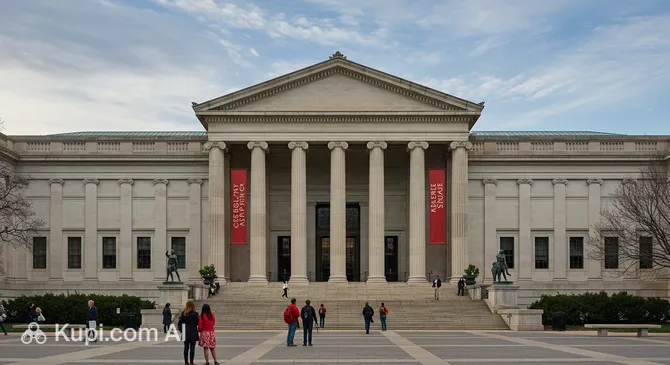
National Gallery of Art. Illustration.
Source: Kupi.com AI

Traveler photos:

The East Building, in turn, is dedicated to modern and contemporary art. Its collection includes works by Pablo Picasso, Henri Matisse, Jackson Pollock, and Andy Warhol. Adjacent to the gallery is a picturesque sculpture garden where works by famous 20th-century masters are exhibited outdoors. This oasis of art in the city center is perfect for a leisurely stroll. An important feature of the National Gallery of Art is that admission for visitors is free, making it accessible to everyone wishing to experience beauty.

Contacts

To plan your visit, confirm opening hours, or obtain information about current exhibitions, it is recommended to contact the gallery directly. All necessary details are available on the official website, and you can also reach museum representatives by phone.

How to contactContact
AddressConstitution Ave. NW, Washington, DC 20565, USA
Phone number+1 202-737-4215
Websitewww.nga.gov

What to Do

A visit to the National Gallery of Art is an opportunity to take a fascinating journey through the history of world art. One of the museum's main treasures is its rich collection, where the works of Old European Masters hold a special place. Visitors can see unique paintings that once adorned the walls of the Hermitage and were acquired by Andrew Mellon in the 1930s. Among these masterpieces are works by great artists such as Frans Hals and Rembrandt, allowing you to trace the development of European painting.

The gallery offers more than just a look at its permanent collection. Temporary exhibitions are held regularly, making every visit unique. For those who want to understand art more deeply, a variety of educational programs, lectures, and guided tours are available. Participating in these is a great way to learn more about the featured artists, their works, and the historical context in which the masterpieces were created.

Beyond the artworks themselves, the architecture of the gallery deserves special attention. The Neoclassical West Building is a work of art in its own right, impressing visitors with its majestic dome. Walking through its halls is not only an encounter with paintings but also an opportunity to enjoy monumental architecture that creates the perfect atmosphere for contemplating beauty.

Getting There

Getting to the National Gallery of Art is quite easy thanks to its central location on the National Mall in Washington, D.C. Given the limited number of parking spaces and busy traffic downtown, public transport is the most convenient and recommended way to visit the museum. This will not only save you time but also help you avoid the difficulties of finding a parking spot.

The simplest way to reach the gallery is by using the Washington Metrorail. The closest station to the museum is Archives–Navy Memorial–Penn Quarter, which is served by Green and Yellow line trains. It is only about a 7-minute leisurely walk from the metro exit to the gallery entrance. The Judiciary Square station on the Red Line is also nearby. Additionally, the DC Circulator bus runs along the National Mall, passing right by the gallery buildings and the sculpture garden, making it an excellent alternative.

If you prefer ground transportation, you can use a taxi or popular ridesharing services. A trip from central hotels or other city attractions will be quick and comfortable, though potential rush-hour traffic should be considered. For those traveling by bicycle, a Capital Bikeshare station is located near the gallery's East Building. If you do decide to arrive by car, be prepared to look for a spot in paid commercial parking lots, as the museum itself has no public parking.

Nearest city: Washington, D.C.

History & Facts

The history of the National Gallery of Art in Washington, D.C., is inextricably linked with the name of financier and collector Andrew Mellon. The gallery was officially established by a resolution of the USA Congress on March 24, 1937. It was Mellon, who began building his collection as early as the 1920s, who took the initiative to create a national museum. He not only bequeathed his priceless art collection to the nation but also donated $10 million for the construction of the building. Notably, the core of his collection consisted of 21 Old Master paintings acquired in the early 1930s from the Hermitage funds during the sale of cultural treasures by the Soviet government.

The gallery's first building, known as the West Building, was formally opened to the public by President Franklin D. Roosevelt on March 17, 1941. The project was designed by architect John Russell Pope in an elegant Neoclassical style. However, one somber historical fact is associated with the construction site: it was previously the location of the Baltimore and Potomac Railroad station, where U.S. President James Garfield was mortally wounded in 1881. Unfortunately, neither Andrew Mellon nor the architect Pope lived to see the completion of the construction, passing away in 1937 just one day apart.

Andrew Mellon's generous gift served as an example for other philanthropists, and the gallery's collections soon began to grow rapidly. Major private collections were donated to the museum by benefactors such as Joseph Widener, who gifted over two thousand sculptures, paintings, and decorative arts, as well as Samuel Kress and Lessing J. Rosenwald. Thanks to these and many other donations, the National Gallery of Art has become one of the most significant art collections in the world.

Time Needed

When planning a visit to the National Gallery of Art, keep in mind that the duration of your stay depends heavily on your interests and how deeply you wish to immerse yourself in the world of art. For a general introduction to the most famous masterpieces and the museum's atmosphere, it is recommended to set aside 2 to 3 hours. This time is usually enough to leisurely walk through the halls of one of the main buildings—the West or East Building—and see the key works. Guided tours also typically last about 2.5 hours.

If you want a more complete picture of the gallery's rich collection, you should plan for at least half a day (4-5 hours). During this time, you can explore the exhibitions in both buildings: classical European and American art in the West Building and modern art in the East Building. It is also worth spending time walking through the picturesque Sculpture Garden. True art lovers who wish to study the collections thoughtfully, read descriptions of the works, and perhaps visit a temporary exhibition may need an entire day.

Even if you only have 1-2 hours available, a visit to the National Gallery of Art is still worthwhile. During this time, you can take an express tour of the most iconic exhibits, such as the only painting by Leonardo da Vinci in the Americas, or focus on the work of one or two favorite artists. Thanks to free admission, the gallery is accessible even for a short visit to get your dose of inspiration.

Working Hours

The National Gallery of Art in Washington, D.C. is open to visitors year-round, making it accessible to tourists at any time. The gallery is open daily from 10:00 AM to 5:00 PM. The museum is closed only two days a year: December 25 and January 1. This makes it easy to include a visit in any travel itinerary for the USA capital, even the busiest ones.

One of the main advantages of the gallery is that admission is always free, and no advance booking of tickets or passes is required to visit the main collections and exhibitions. This makes the museum particularly attractive for spontaneous visits. However, free registration may be required for some special events, lectures, or film screenings. Therefore, to stay updated on all current events and potential schedule changes, it is recommended to check the information on the gallery's official website before your visit.

10:00 – 17:00

Nearby

A visit to the National Gallery of Art is just one part of what the cultural heart of Washington has to offer. The gallery is conveniently located on the National Mall, surrounded by many other iconic museums and monuments. Exploring the surrounding area will allow you to dive deeper into the history and culture of the USA, creating a rich and interesting itinerary for the whole day.

With a high concentration of attractions within walking distance, you can easily combine a visit to the gallery with a tour of other famous sites. Just a few minutes' walk away are the Smithsonian Institution museums, each offering a unique exhibition—from aviation history to the mysteries of nature. Below is a list of nearby points of interest that will help make your trip even more memorable.

NameDistance
Smithsonian National Air and Space Museum0.3 km
National Museum of Natural History0.5 km
Ford's Theatre0.8 km
National Portrait Gallery0.8 km
Museum of the Bible0.8 km
Smithsonian National Museum of American History0.9 km
United States Capitol1 km

Have you reached the end of the page?

So the route has been studied inside and out