Support

Thomas Jefferson Memorial

About

The Thomas Jefferson Memorial is a majestic monument and an iconic historical site located in Washington, D.C., the capital of the USA. It is dedicated to Thomas Jefferson, the third President of the United States and the principal author of the Declaration of Independence. The memorial is situated on the picturesque shore of the National Mall's Tidal Basin, creating a peaceful atmosphere for reflecting on the legacy of this outstanding statesman.
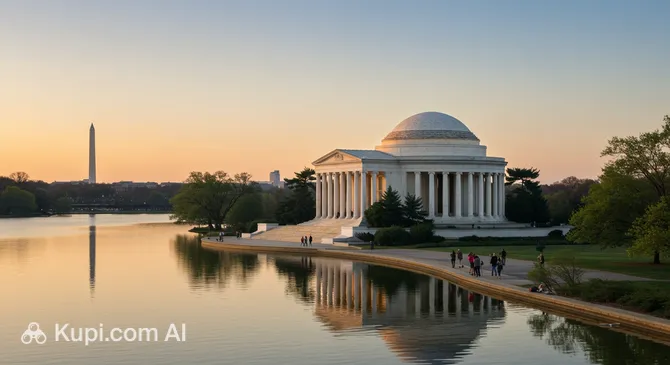
Thomas Jefferson Memorial. Illustration.
Source: Kupi.com AI

Traveler photos:

The architectural style of the memorial is Neoclassical, which Jefferson himself highly valued, drawing inspiration from ancient models. The building resembles the Roman Pantheon and includes a graceful portico with a colonnade and an impressive domed rotunda. This design reflects Jefferson's commitment to the ideals of democracy and enlightenment borrowed from classical antiquity.

At the heart of the rotunda stands an imposing bronze statue of Thomas Jefferson, created by sculptor Rudolph Evans. The statue's gaze is directed toward the White House. The interior walls of the memorial are adorned with engraved quotes from Jefferson's most significant works, including the Declaration of Independence, allowing visitors to deeply appreciate his ideas and contribution to the nation's history. A visit to the memorial offers not only aesthetic pleasure but also an opportunity to connect with the fundamental principles of American statehood.

Contacts

The Thomas Jefferson Memorial is a public national monument. For the most up-to-date information regarding operating hours, special events, or visiting regulations, it is recommended to consult the official website of the U.S. National Park Service (NPS), which manages the memorial, or visit tourist information centers in Washington, D.C.. The memorial can be reached on foot, by public transport, or by taxi, as it is centrally located in the city on the National Mall.

How to contactContact
Address16 E Basin Dr SW, Washington, DC 20242, USA
Phone number+1 202-426-6841
Websitewww.nps.gov

What to Do

Visitors to the Thomas Jefferson Memorial can first and foremost explore the historical legacy of one of the key Founding Fathers of the USA. The centerpiece is the impressive bronze statue of Jefferson himself, standing in the rotunda. Here, you can not only admire the sculptor's craftsmanship but also reflect on the multifaceted personality of Jefferson—an outstanding politician, scientist, and expert in political philosophy. Studying the quotes engraved on the walls from his most significant works will allow for a deeper understanding of his ideas and contribution to the country's development, as well as highlight his diverse achievements as a lawyer, architect, linguist, farmer, and diplomat.

A walk around the memorial and its grounds is particularly enjoyable. The memorial is especially beautiful in the evening when the lighting is turned on, creating a striking shimmering reflection on the waters of the Tidal Basin. If your visit to Washington, D.C. coincides with spring, you can witness a stunning spectacle—the blooming of the Japanese cherry trees (sakura) that frame the basin. This time is considered one of the most picturesque for a visit, offering magnificent views and photo opportunities.

Getting There

The Thomas Jefferson Memorial is located in the southern part of the National Mall in Washington, D.C., on the picturesque shore of the Tidal Basin. Thanks to its central location, this majestic monument can be reached in several convenient ways, depending on your preferences and starting point in the city.

One of the most convenient and popular options is using the Washington Metro. The nearest metro station is Smithsonian, served by the Orange, Blue, and Silver lines. From the metro exit, it is a pleasant walk of approximately 15-20 minutes to the memorial. An alternative station located slightly further away is L'Enfant Plaza, which serves the Yellow, Green, Orange, Blue, and Silver lines.

The memorial can also be reached by city buses. Several DC Circulator routes, particularly the popular National Mall route, as well as Metrobus lines, have stops within walking distance of the Tidal Basin and other National Mall attractions. Of course, you can always use taxis or popular ridesharing services, which will take you quickly and comfortably to the memorial from almost any point in Washington.

If you are already in the National Mall area exploring other iconic sites, a walk to the Thomas Jefferson Memorial can be a wonderful addition to your day. It is also an excellent place for a bike ride; Washington has a well-developed Capital Bikeshare system, and you will easily find stations near the memorial where you can pick up or drop off a bike.

Nearest city: Washington, D.C.

History & Facts

The Thomas Jefferson Memorial is not just a majestic structure, but a tribute to one of the Founding Fathers of the USA and the author of the Declaration of Independence. The idea for its creation originated back in 1925 when the renowned architect John Russell Pope presented his design. Construction of the memorial, intended to immortalize Jefferson's legacy, began on December 15, 1938, and on November 15, 1939, President Franklin D. Roosevelt himself laid the cornerstone, emphasizing the national significance of the undertaking.

Fate brought changes to the implementation of the original plan. Following the death of John Russell Pope in 1937, before active construction began, the project passed into the hands of the architectural firm Eggers & Higgins. Notably, a special commission insisted on design modifications to make it more conservative. A crucial element of the memorial was to be a statue of Jefferson himself. A competition was organized in 1939 to select a sculptor, won by Rudolph Evans, who was entrusted with creating the central figure of this iconic monument.

The formal dedication of the Thomas Jefferson Memorial took place on April 13, 1943, on the 200th anniversary of the birth of the third U.S. President. The ceremony was led by President Franklin D. Roosevelt, and from that day forward, the memorial was officially declared a national site. However, an interesting fact is that the famous bronze statue of Jefferson by Rudolph Evans, which greets visitors today, was only installed in the rotunda four years later, in 1947. This monument, which became a symbol of the ideals of liberty and democracy, was rightfully included in the U.S. National Register of Historic Places on October 15, 1966, forever securing its place in the country's history and culture.

Time Needed

Exploring the Thomas Jefferson Memorial usually takes about 1 to 2 hours. This time is generally sufficient to take a leisurely stroll through the memorial grounds, admire its majestic architecture inspired by the Roman Pantheon, and, of course, closely examine the famous bronze statue of Jefferson himself located at the center of the rotunda. You can also read the quotes from his writings engraved on the walls, reflecting his views on liberty, education, and democracy.

The duration of your visit may vary depending on your interest in history and the personality of Thomas Jefferson, as well as how much time you wish to devote to photography. Many visitors find a special charm in simply sitting on the memorial steps, enjoying the views of the Tidal Basin and reflecting on the ideals that this iconic Washington, D.C. site represents. If you plan to visit the memorial during the cherry blossom season in spring, you might want to stay longer to enjoy this breathtaking spectacle.

For a deeper immersion, some visitors prefer to read the information boards or materials that may be available on-site. In any case, even if you have limited time, a visit to the Thomas Jefferson Memorial will leave a vivid impression and allow you to touch an important chapter of American history. Plan your visit so that you have enough time for a relaxed tour without rushing.

Working Hours

The Thomas Jefferson Memorial, like most national memorials on the National Mall in Washington, D.C., is open to visitors 24 hours a day, 365 days a year. This means you can approach the memorial and enjoy the view at any time of day or night. However, it is worth noting that nighttime lighting gives it a special, solemn atmosphere, while a daytime visit allows for a better view of the architectural details and the engraved quotes.

While the memorial itself is always accessible, National Park Service rangers, who can answer your questions and provide additional information, are typically on duty during the day, generally from 9:30 AM to 10:00 PM. Interior exhibits, if available (such as a small museum or gift shop at the base), may have more limited hours. For the most accurate and up-to-date information regarding ranger program hours, any temporary closures, or special events, it is highly recommended to visit the official National Park Service website (NPS.gov) before your visit. Generally, advance ticket reservations are not required to visit the memorial itself.

Open 24 hours

Nearby

Visiting the Thomas Jefferson Memorial is, without a doubt, a landmark event during your trip to Washington, D.C.. However, to make your experience even more enriching and complete, it is worth exploring the surroundings of this majestic monument. Washington is a city with an incredible concentration of historical and cultural sites, many of which are in close proximity to each other, especially in the National Mall area.

After touring the Thomas Jefferson Memorial, you can easily continue your exploration of the history and culture of the USA by visiting other important nearby attractions. This will allow you to gain a more holistic understanding of the nation's capital and its role in American history, while also saving travel time around the city.

NameDistance
National Mall0.7 km
United States Holocaust Memorial Museum0.7 km
World War II Memorial1 km
National Museum of African American History and Culture1.1 km
Smithsonian National Museum of American History1.2 km
National Museum of Natural History1.4 km
Lincoln Memorial1.5 km

Have you reached the end of the page?

So the route has been studied inside and out