Support

World War II Memorial

About

The National World War II Memorial is a majestic complex in the heart of Washington, D.C., the capital of the USA. Located on the National Mall between the Washington Monument and the Reflecting Pool, it is one of the city's most significant and visited monuments. This memorial is dedicated to the memory of the 16 million Americans who served in the armed forces during World War II and stands as a symbol of national unity.
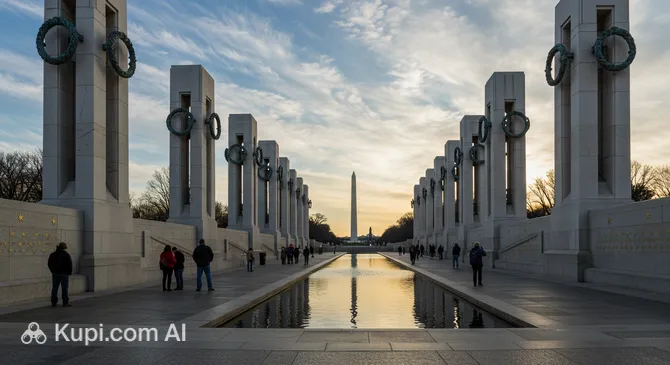
World War II Memorial. Illustration.
Source: Kupi.com AI

Traveler photos:

The architectural ensemble of the memorial is impressive in its scale and symbolism. At the center of the composition is an oval pool surrounded by granite columns arranged in a semi-circle. Two pavilion arches rise on opposite sides of the circle. One symbolizes the war in the Atlantic theater, while the other represents the Pacific.

As the "youngest" monument on the famous National Mall, which stretches from the Capitol to the Lincoln Memorial, it offers a contemporary perspective on commemorating historical memory. Visiting the memorial allows you not only to pay tribute to the past but also to better understand the scale of the events that shaped the modern world. It is a place of deep meaning and national pride that leaves a lasting impression on every visitor.

Contacts

The World War II Memorial is an open public space accessible 24 hours a day and free of charge. To obtain the most accurate and up-to-date information, such as planned events or visitor services, it is recommended to consult official sources managed by the U.S. National Park Service.

How to contactContact
AddressVXR5+4H, 1750 Independence Ave SW, Washington, DC 20024, USA
Phone number+1 202-426-6841
Websitewww.nps.gov

What to Do

A visit to the National World War II Memorial offers a deep dive into history and symbolism. The main focus of visitors is drawn to the 56 granite columns, which surround the central plaza and fountain in two semi-circles. Each column represents the U.S. states and territories that stood united during the war and is adorned with a bronze laurel wreath. The columns are joined by two massive arches on the north and south sides, symbolizing victories in the Atlantic and Pacific theaters of operations.

As you walk along the memorial, take note of the 24 bronze panels located at the base of the columns. These bas-reliefs tell the story of the era in chronological order through vivid imagery: from scenes of battles and farewells to moments of returning home and celebrating victory. Of particular interest is the panel depicting the historic meeting of American and Soviet troops at the Elbe River in the spring of 1945—a symbol of the joint efforts of the Allies.

Beyond the architectural details, the memorial offers a space for reflection. Inside each of the two pavilion arches, you can see sculptures of eagles holding victory wreaths, personifying the nation's triumph. Also within the complex is the "Freedom Wall" featuring 4,048 gold stars, where each star represents 100 Americans who gave their lives during the war. This site is not just an attraction, but an opportunity to honor memories and realize the scale of events that changed the world.

Getting There

Getting to the World War II Memorial is very easy thanks to its central location on the National Mall in Washington, D.C.. The open-air memorial is situated between the Washington Monument and the Reflecting Pool, making it highly accessible for pedestrians. If you are already exploring other iconic landmarks of the USA capital, such as the Lincoln Memorial or the Capitol, a walk to this monument will be a pleasant and logical part of your itinerary.

The most convenient way to use public transport is the Metro. The closest stations to the memorial are Smithsonian and Federal Triangle. Both are served by the Orange, Blue, and Silver lines. From either of these stations, you can reach the memorial on foot in about 15-20 minutes while enjoying views of the National Mall. Additionally, city Metrobus routes pass nearby, specifically Nos. 32, 34, and 36, which stop close to the complex.

For those who prefer comfort, taxi services or ride-sharing apps are always an option. Simply set "National World War II Memorial" as your destination. It is worth noting that parking in the immediate vicinity of the memorial is extremely limited, so driving a personal car may not be the best choice, especially during peak tourist seasons.

Nearest city: Washington, D.C.

History & Facts

Despite its monumentality, the National World War II Memorial is one of the "youngest" landmarks on the National Mall in Washington, D.C.. Its grand opening took place only in 2004, nearly 60 years after the end of the conflict. This monument was created as a tribute to the 16 million American citizens who served in the armed forces and worked in the industries during World War II. It became a long-awaited symbol of recognition for an entire generation of Americans whose contribution to the Allied victory was immense.

One of the unique features of the project is its seamless integration with the existing landscape. The central element of the memorial is the Rainbow Pool, which was reconstructed and enhanced with fountains to become the heart of the new composition. The architectural design is filled with deep symbolism: 56 granite columns represent the unity of the U.S. states and territories at that time, while two majestic triumphal arches located to the north and south are dedicated to the two main theaters of operations—the Atlantic and the Pacific.

The location of the memorial is as significant as its architecture. It holds a place of honor on the National Mall, positioned exactly between two iconic American monuments—the Washington Monument and the Lincoln Memorial. This placement symbolically weaves the memory of World War II into the country's key historical context, emphasizing its colossal significance for the American nation. Today, the memorial serves not only as a place of remembrance but also as a symbol of the American contribution to the common victory of the anti-Hitler coalition, reminding us of the price of peace and unity.

Time Needed

When planning a visit to the World War II Memorial, you should allow for a duration of 1 to 2 hours. This time is sufficient to leisurely walk through the entire complex, feel its atmosphere, and examine the key elements. You can see the 56 granite columns symbolizing the unity of states and territories, admire the central fountain, and take photos by the Atlantic and Pacific theater arches.

If you are short on time, even 20-30 minutes will allow you to get a general impression of the monument and its scale, especially if you are simply passing by on the National Mall. However, for a deeper immersion into the history, it is worth dedicating more time. To carefully examine the 24 bronze bas-reliefs depicting scenes from the war era, find the "Freedom Wall" with its thousands of gold stars, and sit peacefully by the fountain, it is better to plan for at least an hour and a half. Ultimately, the length of your visit depends entirely on your interest in the details and the history of this landmark site.

Working Hours

You can visit the World War II Memorial in Washington, D.C. at any time that is convenient for you. This open-air memorial complex is accessible to the public 24 hours a day, 365 days a year. Entry to the grounds is completely free, so no advance ticket reservations or appointments are required. You are free to come here during the day to see all the details in the sunlight, or at night when the memorial is beautifully illuminated.

While the memorial itself is always open, Park Rangers are on duty for those who would like additional information or have questions. They are at their posts and ready to assist visitors daily, typically from 9:30 AM to 10:00 PM. Various introductory programs are also available during these hours.

DayOpening hours
MondayOpen 24 hours
TuesdayOpen 24 hours
WednesdayOpen 24 hours
ThursdayOpen 24 hours
FridayOpen 24 hours
SaturdayOpen 24 hours
Sunday4:00 – 22:00

Nearby

A visit to the World War II Memorial is a profound and memorable event in itself. However, its unique location in the heart of the National Mall in Washington, D.C. offers an excellent opportunity to further explore the iconic sites of the USA capital. A walk through the surrounding area will allow you to gain a more complete understanding of the country's history and culture, as many key monuments and museums are just a few steps away.

Exploring nearby attractions will not only enrich your trip but also help you better understand the context in which the memorial was created. Each of these places tells its own chapter of American history, and their proximity creates a unique dialogue between eras and events. Below is a list of interesting sites located within walking distance.

NameDistance
National Mall0.4 km
National Museum of African American History and Culture0.7 km
United States Holocaust Memorial Museum0.7 km
Lincoln Memorial0.8 km
Smithsonian National Museum of American History0.9 km
Thomas Jefferson Memorial1 km
Old Ebbitt Grill1.1 km

Have you reached the end of the page?

So the route has been studied inside and out