Support

National Mall

About

The National Mall is a vast open space in the heart of Washington, D.C., often referred to as "America's Front Yard." The most visited national park in the USA, it is a unique complex of parks, museums, and iconic monuments. Stretching approximately three kilometers, it offers an unforgettable walk from the U.S. Capitol in the east to the Lincoln Memorial in the west.
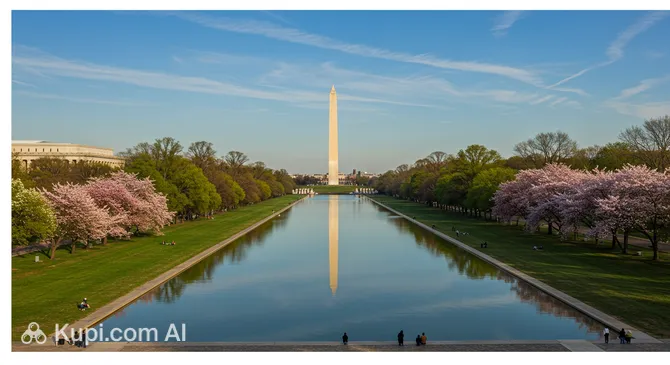
National Mall. Illustration.
Source: Kupi.com AI

Traveler photos:

When viewed from above, the Mall has a symbolic cross shape. At its center rises the famous Washington Monument, while key symbols of American statehood are located along the axes: the White House to the north, the Capitol to the east, the Thomas Jefferson Memorial to the south, and the impressive Abraham Lincoln Memorial to the west. A walk along the Mall is a journey through the country's history, captured in stone.

However, the National Mall is not just about monuments. An impressive collection of world-renowned Smithsonian Institution museums is located along its length. Here, everyone will find something for themselves: from the Natural History Museum and the National Air and Space Museum, which houses unique exhibits from the space race era, to the National Gallery of Art and the Museum of the American Indian. An important advantage for tourists is that admission to most of these museums is absolutely free.

Contacts

Since the National Mall is a vast public space with many independent sites, it does not have a single contact center. For the most accurate and up-to-date information on operating hours, special events, and visiting rules for specific memorials, it is recommended to visit the official website of the U.S. National Park Service (NPS), which manages the area. Information about the many museums located along the Mall is best found on the official Smithsonian Institution website.

How to contactContact
AddressWashington, DC, USA
Phone number+1 202-426-6841
Websitewww.nps.gov

What to Do

The National Mall offers visitors a wide choice of activities, combining cultural education and outdoor recreation. It is an ideal place to get acquainted with the history of the USA through its iconic monuments and memorials. You can see the majestic Washington Monument, visit the moving Lincoln Memorial, and admire the architecture of the Jefferson Memorial. Each of these structures is dedicated to prominent figures and events that shaped the nation.

In addition to historical monuments, the Mall is famous for its world-class museums, part of the Smithsonian Institution. Aviation and space enthusiasts will be delighted by the National Air and Space Museum, while nature and science lovers can spend hours exploring the exhibits of the Natural History Museum. Art fans will appreciate the masterpieces in the National Gallery of Art, and for those seeking tranquility, a stroll through the U.S. Botanic Garden is perfect.

The National Mall is not only museums and monuments but also a vibrant public space. Here, you can simply stroll through the well-kept park areas, enjoying the views, or have a picnic on the grass. For more active recreation, you can rent a bike—there are several Capital Bikeshare stations nearby. Additionally, the Mall regularly hosts various cultural events and festivals, making every visit unique.

Getting There

The National Mall is located in the heart of Washington, D.C., making it easily accessible for visitors. The most convenient way to reach it is by metro. The Smithsonian station, located right on the Mall, is served by the Orange, Blue, and Silver lines, allowing for quick travel to key attractions from various parts of the city. Other nearby stations, such as Federal Triangle and Archives-Navy Memorial, may also be convenient depending on your route.

For those who prefer an active lifestyle and want to explore the Mall at their own pace, cycling is an excellent choice. Numerous Capital Bikeshare stations are located throughout and near the area, making it easy to rent a bike. This is not only an eco-friendly but also a very convenient way to move between the numerous memorials and museums scattered across the park.

If you are already on the Mall and want to save time and energy while moving between sites, take advantage of the DC Circulator National Mall bus route. These buses run on a loop, stopping at all major monuments and museums, making them ideal for quick travel around the park. Driving a private car is not recommended, as parking along the National Mall is very limited, and finding a spot can be difficult.

Nearest city: Washington, D.C.

History & Facts

The idea for the National Mall was born at the end of the 18th century. Its original design was developed by the French-American architect Pierre Charles L'Enfant on behalf of the USA government. However, his grand vision was only partially realized, and for many years, this territory was destined to serve quite different functions—hosting numerous markets, for example.

The full implementation of the project began only at the start of the 20th century. The catalyst for reviving the original idea was the so-called McMillan Plan of 1902, which relied heavily on L'Enfant's designs. From that moment on, the National Mall began to transform into the symbolic center of Washington, D.C. that is known today.

Today, the National Mall is not just a park but one of the country's most important public spaces, managed by the U.S. National Park Service. It is officially listed on the National Register of Historic Places and serves as a venue for key national events: from presidential inaugurations to various festivals and civic actions. Meanwhile, the Mall continues to evolve, adding new monuments and museums that reflect the history and culture of the United States.

Time Needed

When planning a visit to the National Mall, be prepared for it to take a significant amount of time. Due to the vast territory and the large number of attractions located here, sightseeing can take more than one day. To get a full impression of this iconic place, it is recommended to set aside at least one full day, and ideally two or three, especially if you want to visit several museums. Even a simple walk along the entire length of the Mall can take several hours.

If your goal is to see the main memorials, it may take about 2.5-4 hours. This is enough time for a leisurely inspection of the key monuments and moving between them. However, if you plan to visit the famous Smithsonian museums located along the Mall, allow an additional two to four hours for each. Thus, to combine seeing the memorials with visiting at least one or two museums, you will need an entire day.

Working Hours

One of the main advantages of the National Mall is its accessibility. The park area itself is open to visitors 24 hours a day, year-round, allowing you to enjoy views of the monuments at any time of day or night. However, it is important to remember that the numerous museums and monuments located on its territory operate on their own schedules. Most Smithsonian museums welcome guests daily from 10:00 AM to 5:30 PM, except December 25th. Major memorials, such as the Lincoln Memorial or the Washington Monument, are generally accessible 24 hours a day, and National Park Service rangers are on site from 9:30 AM to 10:00 PM.

Admission to most Smithsonian museums is free, and no advance booking is required. Nevertheless, to visit some especially popular sites, such as the National Museum of African American History and Culture or the National Air and Space Museum, you must book a free timed-entry pass in advance. This helps regulate the flow of visitors. It should also be noted that tickets are required in advance for the elevator to the top of the Washington Monument observation deck. Before visiting, it is highly recommended to check current operating hours and booking rules on the official websites of specific museums and the National Park Service, as schedules are subject to change.

Open 24 hours

Nearby

Exploring the National Mall is an exciting adventure in itself, but to truly feel the spirit of Washington, D.C., it is worth paying attention to the attractions located in the immediate vicinity. The area surrounding the Mall is saturated with iconic sites that complement and enrich the experience of visiting the USA capital. A short walk from the main routes will allow you to discover even more facets of American history and culture.

Many of the key memorials and museums are located just steps away from the main promenade. This makes them easily accessible for those who want to dive deeper into specific themes—be it military history, art, or the legacy of the country's prominent figures. Below is a list of interesting places located very close by.

NameDistance
United States Holocaust Memorial Museum0.3 km
World War II Memorial0.4 km
National Museum of African American History and Culture0.5 km
Thomas Jefferson Memorial0.7 km
Smithsonian National Museum of American History0.7 km
National Museum of Natural History1 km
Lincoln Memorial1.2 km

Have you reached the end of the page?

So the route has been studied inside and out