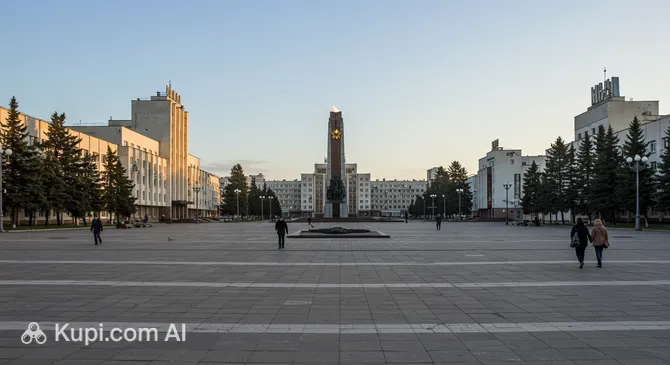
Victory Square is a grand architectural ensemble that is rightfully considered a landmark of Vitebsk. As the largest square in Belarus, it impresses with its scale: its territory covers more than 7 hectares. This site harmoniously combines a solemn memorial complex with a vibrant space for recreation and public events.
Victory Square. Illustration.
Source: Kupi.com AI
Traveler photos:
The central element of the square is the majestic memorial in honor of the liberating soldiers, partisans, and underground resistance fighters. The territory is visually divided into two parts: one is intended for commemorative ceremonies, while the second serves as a meeting and walking spot where concerts and city festivals are often held. Surrounded by modern buildings and the Western Dvina embankment, the square is a unique example of Soviet urban planning from the 1970s.
In addition to its historical significance, the site is interesting for its engineering solutions and landscape design. Thanks to the vast open space, it offers panoramic views of the city, and its thoughtful layout makes the square a convenient transport and pedestrian hub.
Contacts
To plan your route to one of the city's main attractions, it is helpful to have the exact coordinates at hand. Victory Square is located at:
A visit to this location offers guests many leisure options. First of all, it is worth paying attention to the "Three Bayonets" memorial complex—three monumental 56-meter obelisks that dominate the space. A walk along the granite pylons and an inspection of the sculptural compositions allow you to touch history and appreciate the scale of the creators' artistic vision.
For photography enthusiasts, the square provides magnificent angles: the perspective of Moskovsky Avenue and the banks of the Western Dvina are clearly visible from here. During the warm season, fountains operate here, turning the square into a pleasant place to relax. It is also interesting to look at the architecture of the residential buildings from the 1960s–1970s that frame the space, creating a unified stylistic ensemble.
If you find yourself here during national holidays or the "Slavianski Bazaar" festival, you can witness large-scale concerts and official ceremonies. The square becomes the epicenter of city life, where you can feel the true spirit of modern Vitebsk, chat with locals, and enjoy the festive atmosphere.
Getting There
Thanks to its location in the heart of the city, getting to the site is easy. Victory Square is situated at the intersection of key transport arteries, such as Moskovsky Avenue and Lenin Street. You can easily reach it by public transport: numerous bus, trolleybus, and minibus (marshrutka) routes pass through the square.
For those who prefer to travel by private car or taxi, a trip from any part of the city center will take no more than 10–15 minutes. There are dedicated parking zones in the vicinity where you can leave your car during your walk.
Travelers arriving in the city by train or bus can reach the square on foot. A walk from the railway station is a great way to start exploring the city, as the route passes through interesting urban quarters and takes about 20–30 minutes at a leisurely pace.
Nearest city: Vitebsk
History & Facts
The history of this area began back in the 19th century when the current center was the city outskirts. At various times, the square was named Puteinaya, Orshanskaya, and Chernyakhovsky Square. For a long time, low-rise buildings predominated here, and it was only by the mid-20th century that the location began to take on monumental features.
The modern architectural ensemble took shape in the 1960s and 1970s. A whole group of talented architects and engineers worked on the project, including A. Danilova and Z. Dovgyallo. Not only professional workers but also ordinary citizens—students and schoolchildren—took an active part in the construction, making it a truly national project.
The grand opening of the renovated square took place on June 30, 1974. This event was timed to coincide with two important dates: the 30th anniversary of the region's liberation and the 1000th anniversary being celebrated that year by Vitebsk. Since then, the square has remained the main symbol of remembrance and the venue for the city's most significant celebrations.
Time Needed
To leisurely explore the memorial complex, study the sculptural compositions, and take photos against the backdrop of the massive obelisks, you will typically need about 1–2 hours. This is quite enough for an introductory walk and to get acquainted with the architecture of the ensemble.
If your visit coincides with city holidays or festivals, you should plan some extra time in your schedule. In the evening, the square is transformed by striking illumination and working fountains, which invites a longer stay and relaxed rest.
Working Hours
The attraction is open to visitors daily and 24/7. You are free to walk through the memorial territory or the recreation area at any time convenient for you, whether it is early morning or late evening.
Below is the access schedule:
Monday — Sunday: 24 hours
Please note that during major city events or official ceremonies, access to certain parts of the square may be temporarily restricted.
Open 24 hours
Nearby
Exploring the surroundings of the square allows you to dive deeper into the cultural context and atmosphere of the city. Within walking distance, you will find both historical monuments and modern entertainment centers, making for a rich and varied walk.