Support

House Museum of Baba Tonka / Nicolas Obretenov

About

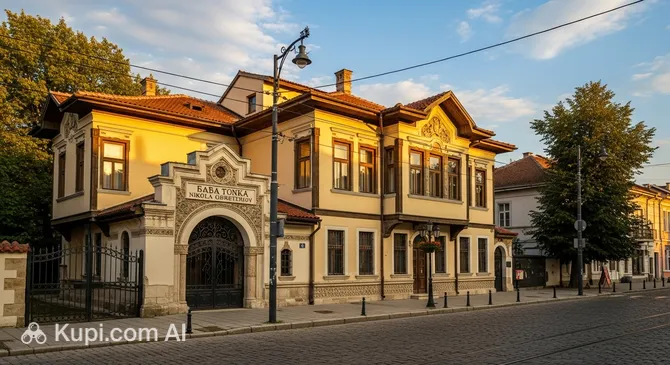
In the picturesque city of Ruse, often called the most aristocratic place where Bulgaria and the Danube meet, lies a remarkable historical monument—the Baba Tonka and Nikola Obretenov House-Museum. This two-story building, erected in 1907–1908, preserves the memory of the great heroes of the National Revival and the spirit of the early 20th century.
\n\n
Baba Tonka and Nikola Obretenov House Museum
Baba Tonka and Nikola Obretenov House Museum. Иллюстрация. Источник: Kupi.com AI
\n\n

The museum is located in the authentic house where Nikola Obretenov, a prominent figure in Bulgarian history, once lived. Visitors are welcomed by a carefully preserved interior featuring original furniture, personal items, and unique documents. The architectural details of the facade and the interior decor allow you to literally travel back in time and see how the urban elite of that period lived.

\n\n

The exhibition places special significance on Baba Tonka, a legendary woman whose contribution to the Bulgarian liberation movement became an example of courage for entire generations. Among the museum's artifacts, you can see traditional crafts and unique historical relics, including the skull of the revolutionary Stefan Karadzha, making the collection truly unforgettable and deeply symbolic.

Contacts

To plan your visit to this unique historical center, it is helpful to save its exact coordinates and contact information in advance. The museum is located in the central part of the city, making it easily accessible on foot. Below are the current contact details for the institution.

\n\n
How to contactContact
AddressРусе Център, ул. „Баба Тонка“ 38, 7000 Русе, Болгария
Phone+359 82 831 913
Websitewww.museumruse.com

What to Do

Once inside the museum, you can immerse yourself in the atmosphere of the early 20th century by walking through rooms where the original setting has been preserved. Here, you can see solid furniture, household items, and traditional Bulgarian crafts that tell the story of the Obretenov family's daily life. Be sure to look at the collection of personal items and photographs—they bring history to life and make it feel more personal.

\n\n

A major point of interest for many visitors is the exhibition dedicated to the role of women in the national liberation movement. Studying documents and artifacts, such as antique weapons and portraits of revolutionaries, provides a better understanding of the price Bulgarians paid for their freedom. One of the most emotionally powerful moments of the exhibition is seeing the skull of the hero Stefan Karadzha, which is kept here as an important historical relic.

\n\n

For those who want to get the most information, it is recommended to book a guided tour. Although some of the explanatory labels are provided in English, a professional's narrative will help reveal the hidden meanings behind every detail of the interior. Photography is allowed inside (usually without flash), so you will have the chance to capture the aesthetic of an old Ruse town house.

Getting There

The museum is located in the very heart of the city at 38 Baba Tonka St. Thanks to its central location, it is easy to reach on foot from almost any key point in the old town. For example, a walk from the Liberty Monument takes only a few minutes, and the distance to the famous Kaliopa House is less than 200 meters.

\n\n

If you are coming from further away, you can use public transport or a taxi. The State Opera building and the Regional Historical Museum, located within 700–900 meters, serve as the closest landmarks for drivers and navigators. For those traveling by car, there are parking zones available on the central streets nearby.

\n\n

For tourists arriving from other cities in Bulgaria by train or bus, the journey from Ruse's main station to the historical center by local transport takes about 10–15 minutes. The area around the museum is pedestrian-friendly and completely safe, allowing you to combine your visit with a walk to other architectural monuments on the Danube waterfront.

Ближайший город: Ruse

History & Facts

The history of this place is inextricably linked to the Obretenov family, whose contribution to the country's independence is hard to overestimate. The Baba Tonka and Nikola Obretenov House-Museum was officially opened to visitors on June 2, 1958. The two-story building itself was constructed much earlier, in 1907–1908, and belonged to Nikola Obretenov—a famous revolutionary and associate of Hristo Botev.

\n\n

The main figure of the exhibition, Tonka Obretenova (known as Baba Tonka), became a symbol of maternal heroism and self-sacrifice. She actively supported the national liberation movement during the period of Ottoman rule, helping revolutionaries and hiding them in her home. Her children also became participants in the most important historical events of 1877–1878, making this family's story a true saga of the struggle for freedom.

\n\n

The architecture of the house itself deserves special attention as an example of the Bulgarian urban style of the early 20th century. The building has undergone careful restoration several times to preserve authentic facade details and the original room layout. Today, the museum does not just store old things; it serves as a living reminder of the era when modern Bulgarian identity was being formed.

Time Needed

To leisurely explore all the exhibits and soak in the atmosphere of the historic home, an average visitor will need between 1 and 1.5 hours. This is plenty of time to look through the documents, examine the heroes' personal belongings, and take commemorative photos.

\n\n

If you decide to take a guided tour or prefer to study each information board in detail, your visit may last up to 2 hours. The museum is not very large, but the concentration of interesting artifacts is high, so it is worth taking your time.

Working Hours

The museum welcomes visitors according to the following schedule: Tuesday – Saturday from 09:30 to 12:00 and from 12:30 to 18:00. Please note that there is a lunch break in the middle of the day when access to the halls is temporarily closed.

\n\n

Monday and Sunday are days off. As the schedule may change during holidays, it is recommended to check the current information on the official website or by phone before your visit.

DayWorking hours
понедельникЗакрыто
вторник09:30–12:00, 12:30–18:00
среда09:30–12:00, 12:30–18:00
четверг09:30–12:00, 12:30–18:00
пятница09:30–12:00, 12:30–18:00
суббота09:30–12:00, 12:30–18:00
воскресеньеЗакрыто

Nearby

Exploring the central streets of the city allows you to dive deeper into the atmosphere of "Little Vienna," as this region is often called for its exquisite architecture. A walk from Baba Tonka's house leads smoothly to other iconic sites, each with its own legend.

\n\n

Many of these sites are within walking distance, allowing you to create a full-day walking route. We recommend paying attention to the following attractions:

\n\n
NameDistance
Sapiens Specialty Coffee & All Day Brunch0.3 km
Tangra Beerhouse0.4 km
Monument of Liberty0.4 km
Za RazBIRAchi Craft Beer Bar0.7 km
EcoMuseum0.8 km
Pantheon of National Revival Heroes0.8 km
Regional Historical Museum Ruse0.9 km

Reached the end of the page?

That means the route is fully explored