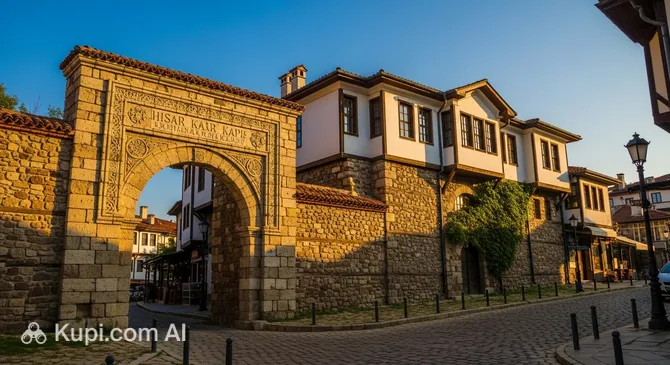
Strolling through the cobbled streets of the Old Town, it is impossible to miss one of the most recognizable symbols that Plovdiv is proud of. The Hisar Kapia Gate is a majestic medieval portal located in Bulgaria. The name comes from Turkish words meaning "Fortress Gate," and it still serves as the eastern entrance to the ancient acropolis on the Three Hills.
Hisar Kapia Gate. Illustration.
Source: Kupi.com AI
Traveler photos:
Although the current appearance of the structure was primarily formed between the 11th and 13th centuries, its history dates back to ancient times. Massive foundations of Roman gates from the 2nd century AD are hidden beneath the modern pavement. Today, Hisar Kapia is a unique architectural and historical ensemble where austere defensive walls harmoniously coexist with elegant residential houses from the Bulgarian National Revival era.
Visually, the gate stands out with masonry characteristic of the Second Bulgarian Empire: large stones alternate with rows of red brick bonded with white mortar. This spot attracts travelers with its authentic atmosphere and is a must-see on any walking tour through one of Europe's oldest cities.
Contacts
To plan your route in advance or check for additional information about visiting the Old Town, you can use the official resources. Below are the main contact details for orientation and reaching the tourist center.
Visiting this location allows you to literally touch the city's centuries-old history. The main thing to do here is to leisurely contemplate and study the details of the stone masonry preserved from the Middle Ages. The Hisar Kapia Gate provides an ideal backdrop for atmospheric photos, thanks to its striking arch and the surrounding historic buildings.
Right nearby is the famous Church of St. Constantine and Helena, whose architectural ensemble perfectly complements the fortress structures. Be sure to look for the preserved section of the southern wall with its round tower from the 5th–6th centuries—it is a great opportunity to see the topographical continuity of ancient and medieval fortifications in one place.
Since the gate is open 24/7, you can plan your visit for any time. In the evening, when the soft lighting comes on, the Old Town takes on a truly fairytale appearance. After exploring the gate, it is pleasant to wander through the pedestrian zones, browse small art galleries, or relax in one of the cozy nearby cafes.
Getting There
The site is located in the heart of the historical district, and the easiest way to reach it is on foot. If you are already in the central part of Plovdiv, simply follow the signs to the Old Town. The walk up to Hisar Kapia Square along picturesque cobblestone streets takes about 10–15 minutes from the main pedestrian zone.
For those who prefer public transport, bus lines 4, 6, 9, or 11 are suitable, dropping passengers at stops at the foot of the Three Hills. From Plovdiv International Airport, it is most convenient to take a taxi—the trip takes about 20–30 minutes. Travelers arriving from Sofia by train or bus can quickly reach the historical center by city transport or walk from the station.
Motorists should note that entry into the Old Town by private vehicle is restricted, and the streets are very narrow and steep. It is recommended to leave your car in one of the paid parking lots in the lower part of the city and continue on foot to fully enjoy the authentic atmosphere of this historical area.
Nearest city: Plovdiv
History & Facts
The history of this site dates back to the 2nd century AD, when Plovdiv was an important Roman outpost. The first gate here was part of a powerful fortification system protecting the acropolis. Later, in the 6th century under Emperor Justinian the Great, the wall system was significantly expanded and reinforced to withstand barbarian raids.
The appearance of the gate we see today was finally established during the Second Bulgarian Empire in the 11th–13th centuries. Above the outer arch, the characteristic construction technique of that era is clearly visible: large stones alternate with rows of red brick bonded with white mortar. Following the Ottoman conquest in the 14th century, Hisar Kapia lost its military function and gradually became integrated into the city's residential development.
In the 17th and 18th centuries, wealthy Plovdiv merchants began building their homes around the gate. Interestingly, the lower floors of some buildings are literally built into the remains of the ancient fortress walls, creating a unique architectural ensemble. In the early 20th century, the gate underwent a careful restoration that helped preserve this symbol of historical continuity for future generations.
Time Needed
A quick look at the arch itself and a brief photo session usually take about 20 to 30 minutes. This is enough time to appreciate the scale of the medieval masonry and observe the details of the houses built directly into the fortress wall.
However, if you plan to do more than just walk through the gate and wish to explore the surrounding architectural complex, including the Church of St. Constantine and Helena and nearby museums, you should allocate about 1–1.5 hours. Combined with a wider walk through the Old Town, a visit can easily take up half a day.
Working Hours
The main advantage of this attraction is its accessibility: the Hisar Kapia Gate is open to visitors 24 hours a day. This allows tourists to enjoy the historical atmosphere without any time restrictions, whether it is early morning or late at night.
As the site is outdoors and part of the public city area, admission is free. However, to check for special events or festivals that occasionally take place in the Old Town, it is recommended to visit Plovdiv's official tourism website.
Open 24 hours
Nearby
The Hisar Kapia Gate is located in the heart of the historical reserve, so a visit can easily be combined with many other iconic landmarks. A stroll through the surrounding area allows you to dive deeper into the rich history of this ancient city and see monuments from various eras—from antiquity to the Bulgarian National Revival.