Support

Hindliyan's House

About

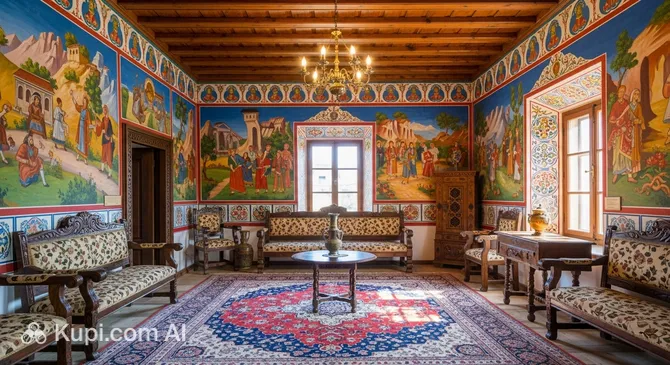
Among the cobbled streets of the Old Town rises the Hindliyan House—a true architectural masterpiece that is rightfully considered one of the most beautiful buildings of the Bulgarian National Revival era. This majestic mansion, located in the city of Plovdiv, invites guests to peek into a luxurious past where East meets West. Bulgaria carefully preserves this cultural monument, which once belonged to the wealthy Armenian merchant and philanthropist Stepan Hindliyan.
\n\n
Hindliyan House
Hindliyan House. Иллюстрация. Источник: Kupi.com AI
\n\n

The mansion impresses with its symmetrical layout and incredibly rich decor. The main feature of the interior is the exquisite wall paintings (alafrangas) depicting landscapes of Constantinople, Venice, and Alexandria, which the owner visited during his trade expeditions. Each room here is an individual work of art with carved wooden ceilings and unique furniture of that period.

\n\n

Particular attention is drawn to the marble bathroom, unique for the 19th century, with a heating system, and the fountain in the central hall, from which rose water once flowed, filling the entire house with a delicate aroma. Today, the house-museum is included in the list of the 100 National Tourist Sites of the country and is a must-visit for anyone who wants to experience the spirit of old aristocratic life.

Contacts

For up-to-date information on events or to book a group tour, you can use the museum's official contact details. Please note that the administration is usually available during the working hours of the "Old Plovdiv" cultural reserve.

How to contactContact
AddressЦентърРайон Централен, ул. „Артин Гидиков“ 4, 4000 Пловдив, Болгария
Phone+359 32 628 998
Websitewww.oldplovdiv.bg

What to Do

Upon entering the Hindliyan House, be sure to notice the spacious hall on the second floor, known as the hayat. Here you can see the famous fountain, from which the delicate scent of roses wafts once again, just as it did a century and a half ago, thanks to the circulation of rose water. The main activity for visitors is a "journey" across the walls of the house: above the doors and in the alafranga niches, masters captured detailed landscapes of Stockholm, Lisbon, and Venice, allowing guests to see the world through the eyes of a 19th-century merchant.

\n\n

Don't forget to look into the bathroom, which is a true engineering marvel of the era. It is a unique structure made of marble and plaster with a domed vault through which natural light penetrates. You can examine the remains of a unique heating system, reminiscent of Roman baths, which was an unheard-of luxury for private houses at that time.

\n\n

A walk through the courtyard will allow you to explore the utility part of the estate. Take a look at the kitchen and laundry building, and peek into the "maaza"—a storehouse with massive iron doors that served as a secure fortress for storing the family's goods and valuables. In summer, the courtyard transforms into a blooming garden, where you can take magnificent photos against the backdrop of the asymmetrical facade with its characteristic bay windows and portico.

Getting There

Finding the Hindliyan House is easy—it is located in the heart of the city's historical center, at 4 Artin Gidikov Street. Since the Old Town is primarily a pedestrian zone with picturesque cobbled streets, the walk to the museum will be a pleasant part of your route. From the famous Ancient Stadium or the Dzhumaya Mosque, you can reach the house entrance in just 5–7 minutes by following the signs to the ensemble of Revival-era houses.

If you plan to use public transport, bus routes No. 2, 4, 7, 9, 11, and 14 are suitable. The nearest stops, such as "Starinen Grad" or "Kapana," are at the foot of the hill, from where you will need to walk uphill for a short distance. For those who prefer a taxi, it is best to have the car drop you off at the nearest accessible point on the edge of the pedestrian zone, such as Shahbazyan Square.

Travelers arriving by private car should keep in mind that parking in Old Plovdiv is extremely limited and intended mainly for local residents. It is recommended to leave your car in one of the paid parking lots at the foot of the hills and enjoy a walk past the ancient facades and cozy cafes for which this area is so famous.

Ближайший город: Plovdiv

History & Facts

The history of this magnificent building began in 1834–1835, when it was erected for the wealthy Armenian merchant Stepan Hindliyan. The owner received his surname, and later the name of the house, thanks to his active trade relations with India: in those days, the prefix "Hindi" referred to a person whose business extended to far-off Eastern lands. The Hindliyan family was one of the four wealthiest Armenian dynasties in Plovdiv, which was directly reflected in the luxury of their residence.

The architecture of the house is considered the pinnacle of the Bulgarian National Revival style. Masters from Chirpan, Moko, and Mavrudi created the unique murals that have survived to this day in their original form. It is particularly noteworthy that in the 19th century, the house was equipped with the latest technology of the time: it featured a complex rainwater collection system and the region's first underfloor heating system in the bathroom, which operated on the principle of ancient hypocausts.

The fate of the house in the 20th century was quite eventful: until the restoration in 1974, 23 Armenian families who found refuge here managed to live within its walls. Despite the dense population, the main decorative elements—carved wooden ceilings and wall landscapes—remained intact. Today, the house holds the status of a cultural monument of national importance and is part of the architectural reserve, carefully preserving the atmosphere of Plovdiv's golden age.

Time Needed

To leisurely explore all the halls, study the details of the wall paintings, and peek into the cozy courtyard, it usually takes about 45–60 minutes. If you plan to book a detailed guided tour or use an audio guide, the visit time may increase to one hour.

For lovers of architectural photography and those who enjoy carefully examining interiors, we recommend setting aside about 1.5 hours for the visit. This time will be quite enough to enjoy the atmosphere of the house, look at the landscapes of distant cities on the walls of the second floor, and take impressive photos in the soft light filtering through the ancient windows.

Working Hours

The museum is open to visitors from Tuesday to Sunday. Typically, the working day begins at 09:30 and continues until 18:00, with a short technical break from 12:30 to 13:00. During the winter period, opening hours may be reduced by half an hour.

\n\n

Monday is the official day off. Since the schedule may change depending on the season or holidays, it is recommended to check the current information on the official website of the "Old Plovdiv" cultural reserve before your visit.

DayWorking hours
понедельникЗакрыто
вторник09:30–12:30, 13:00–18:00
среда09:30–12:30, 13:00–18:00
четверг09:30–12:30, 13:00–18:00
пятница09:30–12:30, 13:00–18:00
суббота09:30–12:30, 13:00–18:00
воскресенье09:30–12:30, 13:00–18:00

Nearby

Its location in the historical center makes visiting this museum an ideal starting point for a grand journey through time. The surroundings of the Hindliyan House are literally saturated with monuments from different eras, from antiquity to the late Middle Ages, allowing you to create a rich cultural itinerary in just one day.

Exploring nearby sites will help you better feel the multi-layered history of the city and see how harmoniously Thracian ruins coexist with the opulent merchant mansions of the 19th century.

NameDistance
Balabanov House0 km
Old Town of Plovdiv0.1 km
Nebet Tepe0.2 km
Regional Ethnographic Museum Plovdiv0.2 km
Aylyakria Restaurant0.2 km
Hisar Kapia Gate0.2 km
Church of the Holy Mother of God0.2 km

Reached the end of the page?

That means the route is fully explored