Support

Latomos Monastery - Holy Church of Hosios David

About

Hidden in the labyrinth of the old quarters of Thessaloniki, the Latomos Monastery (known today as the Church of Hosios David) is one of the most precious monuments of Early Byzantine architecture. This small but incredibly significant church is a UNESCO World Heritage Site, preserving the spirit of a great empire in the heart of modern-day Greece.
\n\n
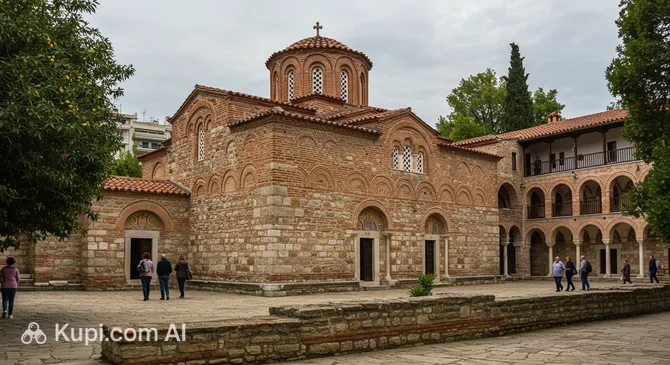
Latomos Monastery (Church of Hosios David)
Latomos Monastery (Church of Hosios David). Иллюстрация. Источник: Kupi.com AI
\n\n

Built at the turn of the 5th and 6th centuries, the church is a rare example of cross-in-square architecture. Originally dedicated to Christ the Savior, it long remained the central structure of a monastic complex, of which only this remarkable church survives today. It impresses with its simplicity and, at the same time, the depth of engineering thought of the ancient masters.

\n\n

Behind its modest facade lies an interior that has become a true treasure for historians and art lovers. The Church of Hosios David is not just a museum piece, but a living testament to the transition from ancient traditions to the Byzantine canon—a place where time seems to stand still amidst ancient vaults and sacred icons.

Contacts

For more details regarding your visit or to plan a group tour, you can use the contact information provided below. As the church is active, visitors are encouraged to maintain silence and follow the appropriate dress code.

\n\n
How to contactContact
AddressEpimenidou 17, Thessaloniki 546 33, Greece
Phone+30 231 026 1376

What to Do

The main draw for visitors to the monastery is the unique mosaic in the altar area, dating back to the late 5th century. It depicts a rare iconographic image—a young, beardless Christ surrounded by the symbols of the four evangelists and the rivers of Eden. This depiction is considered one of the most significant masterpieces of early Byzantine art in the world.

\n\n

In addition to the mosaic, it is worth paying close attention to the 12th-century frescoes, which were only discovered under a layer of plaster in the 1970s. Particularly noteworthy is the work "The Washing of the Child," which includes rare apocryphal details. These paintings are practically the only surviving examples of art from that century in the city.

\n\n

A sense of tranquility and spirituality reigns inside the church. You can see the ancient burials of monks beneath the church floor, highlighting the site's centuries-old history as an important religious center. The silence and soft light filtering through the small windows create ideal conditions for contemplating and studying the Byzantine heritage.

Getting There

Latomos Monastery is conveniently located in the historic part of the city at Epimenidou 17. This site is within walking distance of many popular routes in the Upper Town (Ano Poli), allowing you to combine your visit to the church with a stroll through the charming narrow streets.

\n\n

If you are coming from the city center, the easiest way is to take a taxi or a city bus to the nearest stops in the Ano Poli district. Walking from the central squares will take longer as the path goes uphill, but it offers a great opportunity to see the authentic architecture of the old neighborhoods.

\n\n

For those who prefer navigating by coordinates, use 40.6417° N and 22.9522° E. The monument is located in an area with well-developed infrastructure, so it is easy to find by following the signs to the Byzantine monuments.

Ближайший город: Thessaloniki

History & Facts

The history of this site dates back to the late 5th century. The church was built on the foundations of an ancient Roman building. There is a fascinating legend: Theodora, daughter of Emperor Maximian, was a secret Christian and convinced her father to build a bathhouse here, intending to turn it into a place for prayer. At her request, a magnificent mosaic was created and hidden under an oxhide to save it from persecution.

\n\n

Amazingly, the hidden image of Christ remained a secret for centuries and was only revealed to the world in the 9th century, when a protective layer of plaster fell away following a strong earthquake. This event was perceived by contemporaries as a true miracle.

\n\n

In 1430, after the Ottoman conquest of the city, the church was converted into a mosque. To comply with Islamic traditions, the unique Byzantine frescoes and mosaics were painted over or covered with plaster. Paradoxically, this decision by the conquerors helped the masterpieces survive to this day, protecting them from moisture and light.

\n\n

It was only in the 20th century, during large-scale restoration work, that the relics were freed from "captivity." Today, the Latomos Monastery stands as a priceless testament to the continuity of eras and is recognized as a UNESCO World Heritage Site.

Time Needed

Despite its intimate size, the church deserves a thoughtful visit. To appreciate the delicate Byzantine craftsmanship and feel the peaceful atmosphere of this place, most travelers find 45 minutes to an hour to be sufficient.

\n\n

This time will allow you to slowly study the mosaic in the apse, examine the fragments of ancient frescoes, and enjoy the silence of the inner courtyard. If you are an art history enthusiast, allow a little more time to study the architectural details of this transitional period.

Working Hours

When planning your visit, keep in mind that the church is mainly open in the first half of the day. According to the established schedule, the church doors are open to parishioners and tourists at the following times:

\n\n

From Monday to Saturday, the monastery receives visitors from 9:00 AM to 3:30 PM. On Sunday, the schedule changes slightly: the service starts early, and the church is open from 7:00 AM to 12:00 PM.

DayWorking hours
Понедельник9:00 – 15:30
Вторник9:00 – 15:30
Среда9:00 – 15:30
Четверг9:00 – 15:30
Пятница9:00 – 15:30
Суббота9:00 – 15:30
Воскресенье7:00 – 12:00

Nearby

A walk around the Church of Hosios David allows you to immerse yourself deeper in the atmosphere of the ancient city. The old district of Ano Poli, where the monastery is located, is an open-air museum in itself, with its cobbled paths and traditional houses.

\n\n

Nearby, you can find both historic locations and modern spots for the whole family to relax. Below are some interesting sites located in the vicinity:

\n\n
NameDistance
Vlatadon Monastery0.2 km
Church of Saint Demetrios0.5 km
Triangular Tower0.7 km
Roman Forum of Thessaloniki0.7 km
Atatürk Museum0.7 km
Heptapyrgion0.8 km
Rotunda of Galerius0.9 km

Reached the end of the page?

That means the route is fully explored