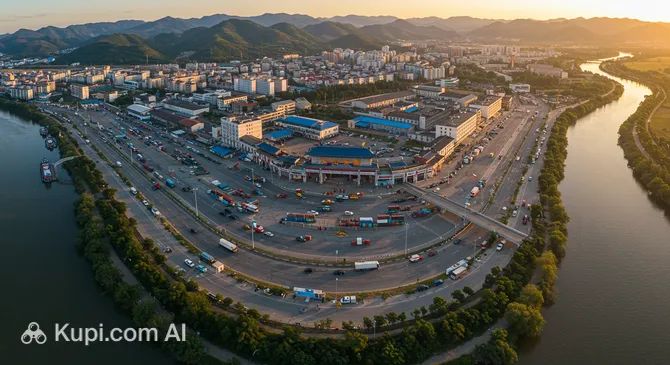
Dongning is a cozy and quiet city located in Heilongjiang Province in northeastern China. As an important border hub at the junction with the Russian Primorye region, it is imbued with an atmosphere of cultural exchange and frontier hospitality. Although the city is not a classic tourist metropolis, it attracts travelers with its measured pace and unique position as a "gateway" between two countries.
Dongning. Illustration.
Source: Kupi.com AI
Geographically, Dongning is situated in a picturesque area where hilly landscapes alternate with plains, and the Suifenhe River flows through the territory. With a population of about 210,000 people, this county-level city maintains the character of a functional logistics center where daily life is closely linked to transit trade. You can learn more about how this region was formed by exploring the historical heritage of the city.
Among the key features of the city are its historical monuments, including large-scale fortifications, and modern shopping zones. Dongning is ideal for those who want to see a "different" China—not the flashy and noisy version, but one that is practical, quiet in its own way, and focused on good-neighborly relations. We invite you to get to know this unique corner of the Middle Kingdom and feel its special character.
Weather Overview
Dongning is characterized by a pronounced sharply continental climate that determines the rhythm of life in the region. Travelers should prepare for significant seasonal temperature fluctuations: long frosty winters and warm but relatively short summers await you here. The current forecast and climatic features will help you better plan your wardrobe before the trip.
In winter, especially in January, the thermometer drops to an average of -13...-18°C, and on some nights, frosts down to -30°C can strike. Summer brings long-awaited warmth: in July and August, the average temperature is about +20...+25°C, sometimes rising to +30°C. Most of the precipitation falls in the summer months under the influence of monsoons, while winter remains predominantly dry and sunny.
The environmental situation in the city is generally favorable thanks to its proximity to forests, although air quality may temporarily decrease in winter due to the operation of coal-fired heating systems. The low-rise buildings of Dongning ensure good ventilation of the streets, and the flat-to-hilly terrain does not create sharp microclimatic changes, making the weather predictable for tourists.
Average monthly temperature
Average monthly precipitation
Interesting Facts
Strategic Crossroads: Dongning is unique in that it is located in close proximity to the meeting point of the borders of three states—China, Russia, and North Korea.
Fortress Heritage: The local Dongning Fortress Site is the largest complex of Japanese fortifications in Asia, occupying a vast territory.
County Scale: Despite its status as a county-level city, Dongning manages a territory of more than 7,000 square kilometers, which is comparable to the area of some small countries.
River Artery: The city stands on the Suifenhe River, which plays a key role in logistics and ensures the operation of the local Dongning Port.
How to Get There
The transport accessibility of Dongning is determined by its role as a border hub. The easiest way to get here is from larger hubs in Heilongjiang Province. Despite the absence of its own airport directly within the city limits, a developed network of bus and rail connections allows tourists to plan routes with transfers in neighboring cities. You can find out the best way to build your path in the section dedicated to ways to get to the city.
The nearest major air hub is located in the city of Mudanjiang, from where you can reach Dongning by bus or train in about 2–3 hours. The route through Suifenhe, which is an important national checkpoint, is also popular. Roads in this region are in good condition, although you should take into account the density of freight traffic typical of border zones.
For those who prefer the railway, the main option would be to travel to stations in Mudanjiang or Suifenhe and then transfer to local transport. From Harbin, the total travel time can be from 5 to 7 hours depending on the type of train selected. Bus service between border cities operates regularly, providing convenient logistics for trade and tourist trips.
Station
Passenger traffic
Distance
Baranovsky Station
—
72 km
Ussuriysk Railway Station
1.2 mln
80 km
Vladivostok Railway Station
3 mln
83 km
Vladivostok railway station
13
84 km
Ugolnaya Station
—
87 km
Main Attractions
The main historical pride of Dongning is the Dongning Japanese Invasion Fortress. This massive defense complex is considered the largest Japanese fortress in Asia preserved from the mid-20th century. Today, this site has been transformed into an open-air museum where visitors can see extensive underground tunnels, bunkers, and warehouses that serve as a silent reminder of past events.
For those interested in spiritual culture, the city is home to Buddhist shrines—the Jin Guang Temple and Daguangming Temple. These complexes feature traditional architecture and a peaceful atmosphere, providing an opportunity to take a break from the urban bustle and get acquainted with local religious traditions. Also worth noting are the picturesque Shen Xian Dong caves, which are shrouded in legends.
If you are interested in observing the modern life of a border city, it is worth taking a walk to Dongning Port and the central squares. You can find a special local flavor on the Longxugou Pedestrian Street (LongXuGou BuXingJie), where local trade and the daily activity of citizens are concentrated. These places allow you to feel the city's status as an important link in international transit.
Local Cuisine
The gastronomy of Dongning is a colorful combination of Heilongjiang Province traditions with a noticeable influence from neighboring countries. The basis of the local cuisine consists of hearty pork dishes, wheat noodles, and an abundance of wild forest vegetables and mushrooms. Due to the proximity to the border, variations of Russian and Korean dishes are popular here: for example, you can often find a local version of sauerkraut and various dumplings—jiaozi.
It is definitely worth trying the signature dish hongbao (succulent fried meat in red sauce) and the rich ukha fish soup, which is prepared from the fresh catch of local rivers. The character of the gastro scene in the city is practical and simple: most establishments are small family restaurants and eateries where portions are generous and prices are democratic. There are few fine dining restaurants here, but the food is always fresh and home-style delicious.
As for drinks, locals prefer traditional green tea as well as local beer. Among spirits, baijiu is popular, sometimes with characteristic "northern" notes. In border zones, you can find an interesting fusion: Korean kimchi served alongside Chinese appetizers, or salads reminiscent of Russian recipes. For the most authentic taste, head to the local markets or small establishments in the city center.
Travel Tips
Planning a trip to Dongning requires attention to details characteristic of border regions. These tips will help you feel confident and get the most out of visiting this unusual city.
Clothing and Seasonality: The climate here is sharply continental. For winter, bring very warm clothes (temperatures can drop to -30°C), and for summer—light things and comfortable shoes for walking around the hilly terrain of the fort.
Transport within the city: The optimal way to get around is by taxi or buses. To call a car, it is convenient to use Chinese apps, but be prepared to give the address in the local language.
Finances and Cards:Chinese Yuan (CNY) are used in Dongning. International Visa and Mastercard cards rarely work, so be sure to have a sufficient supply of cash or a set-up Alipay wallet.
Safety: The city is generally very safe. However, avoid walking at night in the port area and industrial zones due to heavy truck traffic and poor lighting.
Language Barrier: English is practically not spoken here. Be sure to download an offline translator and save the names of key places in Chinese characters.
Documents and Border: Always carry your passport with you. When visiting border zones, additional checks may be required, so follow the rules and do not take photos of restricted facilities.
Etiquette and Communication: Locals are friendly but reserved. Greet people with a slight nod and be prepared for the fact that bargaining is common in shops, but should be done politely.
Connectivity: Wi-Fi is available in hotels, but for navigation, it is better to buy a local SIM card or set up roaming with VPN support in advance to access your usual services.
Following these simple rules will make your stay in Dongning comfortable and your interaction with the local culture easy and pleasant. Have a great trip!
Entertainment & Nightlife
Entertainment in Dongning is geared toward lovers of quiet relaxation and walks, as the bustling nightlife is virtually non-existent here. The main activity in the evening is concentrated on pedestrian streets, such as QiZhen Jie and LongXuGou BuXingJie. Here, locals and guests of the city stroll leisurely, visit small shops, or have dinner in cozy eateries. The city falls asleep quite early, which is typical for small border counties.
For more dynamic recreation, large-scale cinemas, and theatrical performances, travelers usually head to nearby Mudanjiang or Suifenhe. In Dongning itself, daytime leisure often includes visiting historical sites and walking in park areas near the border where you can enjoy views of nature. The atmosphere in the city's establishments is as simple and casual as possible, with virtually no dress code.
Safety in the city is at a high level, so evening walks along the central illuminated streets are quite comfortable. If you need a taxi late at night, it is easy to call one through local mobile apps or catch one on the main roads. Overall, Dongning offers a slow travel style experience, where the main values are peace and the absence of vanity.
Parks & Museums
The green zones of Dongning and its surroundings allow you to enjoy the tranquility of northern nature. One of the key sites is the Suifenhe National Gate Park—a well-maintained territory near the state border where you can walk and see symbolic structures marking the boundary between countries. The picturesque Dongting Scenic Area is also popular, offering beautiful landscapes for outdoor recreation.
The cultural and historical face of the city is most clearly represented in the Dongning Japanese Invasion Fortress. This is not just a historical site, but an important memorial museum where the dramatic history of the mid-20th century is told through artifacts and preserved fortifications. Visiting this place is a must for those who want to understand the historical context of the region's development and honor the memory of the past.
Although the buildings in the very center are predominantly functional, the abundance of forests around the county creates a sense of proximity to wild nature. For local visits, temple complexes such as the Daguangming Temple are also interesting, as they are surrounded by small gardens that create an atmosphere of peace. There are enough parks within the city limits for daily relaxation, and their simplicity harmonizes with the overall quiet pace of life in Dongning.
Getting Around
The public transport system in Dongning is represented mainly by a network of bus routes and fixed-route taxis. They connect central residential neighborhoods with the port, the railway station, and the main border points. This is a convenient and very budget-friendly way to move around: a trip within the county usually takes from 20 to 40 minutes. There are no metros or trams here, which is quite typical for cities of this scale.
Taxis in the city are numerous and reasonably priced. This is the most comfortable option for tourists, especially if you need to get to remote attractions like the Japanese fortress. It is customary to pay for bus fare in cash upon boarding or via mobile apps if you have access to local services. Transport operating hours are usually limited to the early evening, so it is better to plan your trips during daylight hours.
The central part of Dongning is quite compact, which allows for comfortable movement on foot or by bicycle. Roads in the city are maintained in good condition, and serious traffic jams rarely occur, except during morning and evening peak hours when traffic is heavier due to commuter and freight vehicles. Travelers should keep in mind that during peak hours (from 7 to 9 AM and from 5 to 7 PM), transport near border zones can be crowded.
Accommodation
Accommodation options in Dongning are primarily oriented toward transit travelers and business people. Budget hotels, guesthouses, and hostels located near central shopping areas and border crossings predominate here. Such housing offers a basic level of comfort and is excellent for a short stay of one or two nights.
If you are looking for a wider range of services, you should consider modern apartments in the center or stay in neighboring Suifenhe, where the hotel infrastructure is slightly better developed. In Dongning itself, there are no luxury chain hotels; however, local hotels please with affordable prices—the average room rate ranges from 20 to 50 USD per night.
When planning a trip, it is recommended to book accommodation in advance, especially during periods of active border trade or holidays. Most accommodation facilities can be found through popular Asian booking services. For a comfortable check-in, it is advisable to have the hotel address in Chinese, as staff in small hotels may not speak foreign languages.
Nearby Cities
Dongning serves as an excellent starting point for exploring the surroundings of northeastern China and the adjacent territories of Russia. Thanks to a developed transport network, you can easily plan interesting day trips and get acquainted with the unique culture of this multinational region.
One of the most popular destinations is the neighboring Suifenhe—a dynamic border city known for its markets and active trade. Only an hour and a half away is Ussuriysk, offering a chance to get acquainted with the Russian flavor of the Primorye region. For those ready for a slightly longer journey, the road to Vladivostok is open, where you can enjoy seaside landscapes and modern urban architecture.
It is also worth paying attention to the Chinese city of Hunchun, which is famous for its hospitality and proximity to nature reserves. Exploring the surroundings of Dongning will give you a lot of new impressions and allow you to see how closely the fates of cities are intertwined in this border region.
Shopping & Souvenirs
Shopping in Dongning is primarily an introduction to border trade. There are no huge shopping and entertainment centers in the usual sense, but there are plenty of markets and specialized shopping arcades. The main attraction for shoppers is the area near the Suifenhe National Gate and QiZhen Jie street, where you can find a wide range of clothing, textiles, and household electronics at very affordable prices.
If you are looking for something special to remember your trip, pay attention to the products of local craftsmen and traditional Chinese goods. Quality local teas, calligraphy sets, and small replicas of historical artifacts found around the Japanese fort are often brought as souvenirs from Dongning. Goods from neighboring Russia are also popular and can be found in specialized shops here.
The city's shops and markets usually operate from early morning until sunset, closing earlier than in major metropolises. The main method of payment is cash Yuan or popular Chinese payment systems (Alipay, WeChat Pay). International bank cards are rarely accepted, so you should take care of currency exchange in advance. Overall, shopping in Dongning is a great opportunity to purchase practical things and souvenirs without unnecessary fuss.