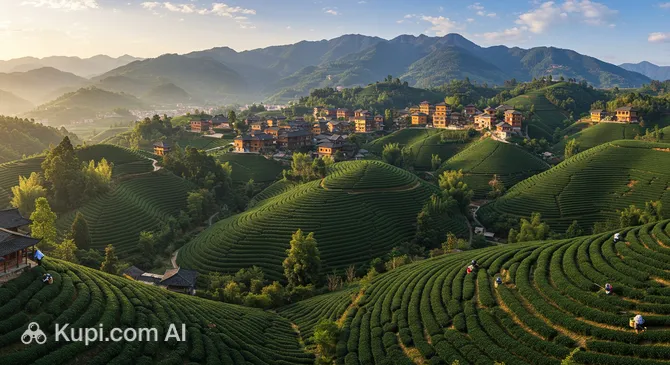
Longjing is a cozy and authentic county-level city located in the Yanbian Korean Autonomous Prefecture of Jilin Province in northeastern China. The city does not strive to become a bustling metropolis or an industrial giant, maintaining the atmosphere of a peaceful, predominantly residential and agricultural center. Its main uniqueness is the high concentration of the Korean population — more than 66% of residents — which leaves a unique mark on local life, architecture, and culture.
Longjing. Illustration.
Source: Kupi.com AI
Geographically, Longjing occupies an important position on the Tumen River, bordering North Korea directly. The city is surrounded by picturesque river valleys and plains, and its population is about 130,000 people. This place is considered the cradle of Chinese Korean folklore culture, where ancestral traditions are carefully preserved in the daily life of local communities, making it interesting for connoisseurs of the region's authentic historical heritage.
Despite the lack of typical tourist polish, Longjing attracts with its sincerity and steady pace. Here you can stroll along the embankment, visit colorful markets, and feel how two great cultures of East Asia harmoniously intertwine. It is an ideal destination for those who want to see a "different" China — quiet, ethnically rich, and far from the hustle and bustle of tourist routes.
Weather Overview
The climate in Longjing is a classic continental monsoon type, characteristic of the northeastern regions of China. Travelers should be prepared for a distinct change of seasons: winters here are harsh and dry, while summers are warm and quite rainy. You can study the detailed weather in the city to better plan your visit dates.
The winter period, especially January and December, brings frosts with average temperatures around -7°C...-15°C, sometimes dropping to even lower values. Little snow falls, making the winter dry and windy. Summer months, by contrast, delight with warmth: in July and August, the air warms up to +22°C...+27°C. However, it is precisely in the summer that the peak of precipitation occurs, so an umbrella or raincoat will be your faithful companions during this period.
The most comfortable time for a visit is considered the transition seasons — late spring (May) and early autumn (September). During these months, a moderate temperature of around +15°C...+18°C is established, and the amount of rain is not yet so great. Due to the absence of large industrial enterprises, the air in Longjing remains relatively clean, and the flat terrain contributes to good ventilation of the city streets.
Average monthly temperature
Average monthly precipitation
Interesting Facts
Longjing is located directly on the border with North Korea — the total length of the border line along the Tumen River is more than 142 kilometers.
The city is officially recognized as the cradle of Korean folklore culture in China, as more than 66% of its population are ethnic Koreans.
The name of the city is often confused with the famous variety of green tea (Longjing/Dragon Well); however, in this case, it is merely a coincidence of characters, and the region itself is more famous for agriculture than for tea plantations.
According to the 2020 census, the county's population is just over 129,000 people, making it one of the most compact and peaceful administrative centers in Jilin Province.
How to Get There
The transport accessibility of Longjing largely depends on neighboring major hubs, as the city is a quiet provincial center. Most travelers arrive here via the nearest metropolis, Yanji, which is only 30–40 kilometers away. More detailed information on routes and connections can be found in the section on how to get to this region.
For those who prefer air travel, the main point of reference is Yanji Chaoyangchuan International Airport. It accepts flights from China's largest cities, such as Beijing and Shenyang. The journey from the airport to the center of Longjing by taxi or bus takes about an hour. Larger international hubs, such as the one in Changchun, are about 4–5 hours away.
Railway service connects the city with the Jilin Province network. Longjing Railway Station receives trains from Changchun and Yanji. A train trip from the provincial capital takes about 3–5 hours. Intercity buses are also a popular way to travel, running regularly and allowing you to get from Yanji in just 1–1.5 hours via the G2011 highway.
Station
Passenger traffic
Distance
Yanjixi Railway Station
5
15 km
Hoeryong Chongnyon Station
6
44 km
Rajin Station
5
91 km
Tumangang Station
10
104 km
Khasan Railway Station
10 000
107 km
Main Attractions
Longjing is not a typical tourist center with an abundance of world monuments; however, its charm lies in its ethnographic flavor and everyday life. One of the main areas for relaxation is the Tumen River Embankment. This is a beautiful place for peaceful walks, offering views of the border landscapes. Residents often gather here for sports or evening relaxation, creating a warm, welcoming atmosphere.
An important part of the city's identity is the Korean cultural centers. In these institutions, you can get acquainted with traditional folklore, see folk costumes, and learn more about the life of ethnic Koreans in China. Although they are oriented more toward the local community, inquisitive travelers will find much of interest here regarding the preservation of unique traditions in the modern world.
For those who want to feel the rhythm of the city, local markets and central squares are a must-visit. Life is in full swing here, and the stalls are bursting with goods that are difficult to find in other regions of the country. You shouldn't look for huge shopping complexes here; it's better to focus on the authentic atmosphere of the lively market rows and the architecture of administrative buildings reflecting the provincial style of northeastern China.
Local Cuisine
The gastronomic face of Longjing is a bright and spicy symbiosis of Chinese and Korean culinary traditions. Thanks to the ethnic composition of the city, you can find establishments specializing in Korean classics at every turn. The main hit of the local cuisine is naengmyeon — cold buckwheat noodles in a sweet and sour broth, which is especially popular during the warm season. It is also impossible to imagine a local table without kimchi and various spicy vegetable appetizers.
Fans of hearty meat dishes should try samgyeopsal (grilled pork belly) or traditional soups with sauerkraut and beef. The dining culture here is very home-style: most restaurants are small family establishments where food is prepared according to old recipes. Prices in such places are very reasonable, and portions are usually impressive in size. Despite the city's name, the famous green tea is not grown here; however, Korean tea varieties and rice-based drinks are widely available.
As for drinks, locals often order soju or light Korean beer to accompany spicy dishes. Street food also deserves attention: in the markets, you can find freshly prepared rice cakes known as tteokbokki and other authentic specialties. The gastronomic scene of Longjing attracts precisely with its simplicity and honest taste, allowing tourists to take a real culinary journey without the pretense of expensive restaurants.
Travel Tips
Planning a trip to such a unique region requires considering some local specifics. These practical tips will help you make your journey to Longjing as comfortable and interesting as possible.
Clothing and Essentials: The climate here is continental, so bring seasonal clothing: very warm for the freezing winter and light, but with a raincoat for the humid summer. Comfortable shoes are a must, as the city is best explored on foot.
Transport: Install the Baidu Maps or Gaode apps for navigation, as common Western maps do not function correctly. To call a taxi, use Didi.
Finance: Be sure to have cash yuan with you. Although Alipay/WeChat mobile payments are ubiquitous, foreign UnionPay cards are accepted more often than Visa or Mastercard.
Health and Safety: The city is very safe, but the outskirts can be poorly lit in the evening. Pharmacies are easy to find in the center, but it's better to carry a basic first-aid kit with you.
Communication: English is almost not spoken here. Learn a few phrases in Chinese or Korean or download an offline translator.
Local Etiquette: Respect Korean and Chinese traditions. Friendliness and a calm tone of communication will help you quickly find common ground with local residents.
What to Avoid: Do not plan trips to remote townships at night due to the poor condition of roads in some rural areas.
Additional Tip: Try the local cold noodles specifically in small family establishments — that's where they are most authentic.
May your introduction to this unique corner of border China be filled only with pleasant discoveries and warm encounters!
Entertainment & Nightlife
Entertainment in Longjing is predominantly quiet and family-oriented. You won't find noisy nightclubs or large-scale concert venues here, as the city leads a measured way of life. The center of social activity in the evenings becomes the local parks and the Tumen River embankment, where residents gather for walks. Large events are most often associated with Korean folklore festivals, which take place in spring and autumn, turning the streets into venues for folk dances and songs.
Nightlife as such is practically non-existent in the city — most cafes and establishments close by 10:00 PM. Young people and fans of active nightlife usually head to neighboring Yanji, which is only a 30–40 minute drive away. There, cinemas, modern karaoke bars, and entertainment centers offering a wider range of leisure activities are concentrated.
Daytime entertainment in Longjing itself is limited to visiting cozy family restaurants and walking through the picturesque agricultural surroundings. If you are looking for peace and the opportunity to observe the authentic life of local residents without crowds of tourists, this city will offer you exactly that kind of meditative relaxation format.
Parks & Museums
The natural areas of Longjing are primarily oriented toward peaceful relaxation and the everyday walks of residents. The main green artery of the city is the Tumen River Valley. The river embankment serves as a natural park, equipped with paths for promenades. Although there are no large-scale botanical gardens here, the functional landscaping and proximity to the water create pleasant conditions for spending time outdoors and enjoying mountain views.
In terms of museum culture, the city emphasizes its main wealth — folk traditions. There are Korean folklore centers that serve as living museums. In them, you can get acquainted with exhibitions dedicated to the history of Korean migration to this region, their traditional crafts, and art. Such places are particularly interesting during holidays when cultural programs become most intense and illustrative.
Despite the fact that the park infrastructure is smaller in scale than in neighboring Yanji, Longjing wins you over with its ecological purity and lack of hustle. For lovers of wilder nature, the rural outskirts are always open, where endless fields and river landscapes allow you to feel the true spirit of provincial China. These are places for those who value silence and the opportunity to be alone with nature.
Getting Around
The transport system of Longjing is simple and efficient for a city of this scale. The backbone of public transport consists of buses, which connect the central part of the county with the railway station and remote villages. Intervals usually range from 15 to 30 minutes, and the fare is extremely affordable — only 1–3 yuan. It is worth considering that during morning and evening rush hours, buses can be crowded with locals commuting to work.
For more comfortable movement, tourists are recommended to use taxis. The Didi service is active in the city, through which you can call a car; a trip around the center will cost about 10–15 yuan. Thanks to the compactness of Longjing, many interesting locations and markets in the central part are easy to explore on foot, enjoying the unhurried rhythm of city life.
An alternative to public transport are electric scooters and bicycles, which are very popular among locals. However, for tourists, renting them may be difficult due to the need for registration in Chinese apps. When planning trips to neighboring cities such as Yanji, it is best to rely on regular bus services or railway connections, as the highways leading into the city can be congested during peak hours.
Accommodation
The hotel sector in Longjing is represented mainly by modest and functional options. It is difficult to find luxury five-star hotels of international chains here, but there are enough guesthouses and small mid-range hotels. Most of them are aimed at transit travelers or relatives of local residents. Prices for accommodation start at a very budget-friendly 100 yuan per night.
The center of the subdistrict committees, where the main infrastructure, banks, and transport stops are concentrated, is considered the most convenient area to stay. Apartments for long-term rent are also popular, often chosen by families coming to the region for an extended period. If you are accustomed to a higher level of service and a wide selection of chain hotels, you should consider staying in neighboring Yanji and making day trips to Longjing.
It is recommended to book accommodation in advance, especially during cultural festivals or public holidays. To find options, it is best to use Chinese booking services, as not all local accommodation facilities are represented on international aggregators. Please note that in some small guesthouses, the staff may not speak English, so it is worth preparing the address translation into Chinese beforehand.
Nearby Cities
Thanks to its location, Longjing serves as an excellent starting point for exploring the ethnic diversity of northeastern China and the border territories. Just 15 kilometers away is Yanji — the dynamic cultural and administrative center of the prefecture, where Korean influence is felt even more strongly. Here you should visit modern shopping centers, parks, and numerous fine-dining restaurants, which can be reached from Longjing by bus in less than an hour.
Another interesting destination for a trip is Tumen, located to the northeast. This city is famous for its border crossing and the opportunity to see North Korea across the eponymous river. Also within reach are Helong and Shuixi, offering quiet landscapes and a glimpse into the rural life of Jilin Province. For those interested in the history of the borderland, an intriguing object on the horizon is the North Korean city of Hoeryong, lying directly across the border.
The city's surroundings are rich in natural beauty and ethnographic finds. Day trips to neighboring counties will allow you to deeper understand the unique character of this region, where state borders and the interweaving of cultures create a unique landscape. Do not miss the opportunity to expand your horizons by exploring these hospitable lands.
Shopping & Souvenirs
Shopping in Longjing is primarily about getting to know local products and traditional goods. The city lacks giant modern shopping malls with world brands; their place is taken by lively local markets. The most interesting for a tourist will be the central market, where you can find everything: from the freshest ingredients for Korean dishes to household small items. This is precisely where you should look for authentic products such as homemade kimchi, dried seafood, and unique seasonings.
If you want to bring something memorable back from your trip, pay attention to Korean handicrafts and traditional snacks. Shops in the villages offer a large selection of tea (not to be confused with the Longjing variety!) and items made of wood or fabric executed in an ethnic style. Also, in local shops, you can find high-quality Korean cosmetic products and sweets, which are very popular with visitors to the region.
Shops usually operate from early morning until 7:00–8:00 PM, and markets are most active in the first half of the day. For payments, it is best to have cash yuan with you or use Chinese payment systems (Alipay, WeChat Pay), as international cards are not accepted everywhere. The Tax Free system is practically non-existent in this region, but low prices and the uniqueness of the goods more than compensate for its absence.