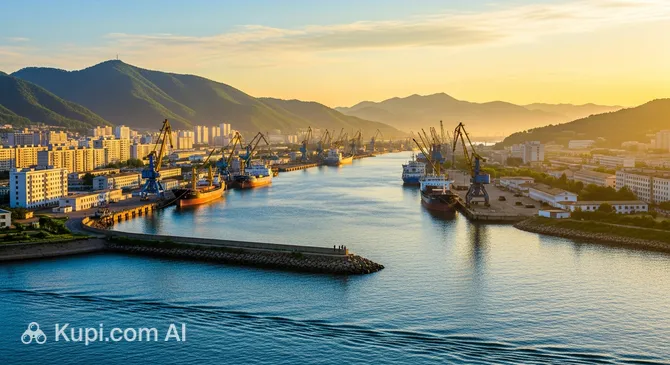
Tanchon is a major port and industrial center located in the northeastern part of South Hamgyong Province in North Korea. The city stretches along the coast of the Sea of Japan at the picturesque mouth of the Namdae River. Possessing the rugged charm of an important industrial hub, it draws attention with its scale and role in the regional economy.
Tanchon. Illustration.
Source: Kupi.com AI
The city is home to more than 345,000 people and covers an extensive territory that combines coastal lowlands and mountain ranges. The history of this region dates back to the deep past—the first mentions of a settlement called Pokchu date back to the beginning of the 12th century, which gives the modern industrial appearance of the city a special historical dimension.
Tanchon is primarily known as a "miners' city" thanks to its rich deposits of magnesite, zinc, and cobalt. For a traveler interested in industrial architecture and the daily life of port cities, Tanchon offers a unique atmosphere where the rhythm of life is set by ports and railways. A visit to this city allows you to see the unvarnished, working side of the country's life, hidden behind the austere facades of industrial giants.
Weather Overview
The climate in Tanchon has a pronounced monsoon character, typical of the coastal areas of the country's northeast. The weather here is largely determined by its proximity to the Sea of Japan, which tempers the summer heat but brings humid winds and mists.
Winters in the city are cold and mostly dry, with an average temperature in January around -6°C, although night frosts can reach -11°C. Summers are warm and humid: the hottest month is August with an average temperature of +22°C. The peak of precipitation occurs at the end of summer—up to 227 mm falls in August, so those planning a trip should study the detailed city's climate in advance and bring an umbrella.
The most comfortable time to visit Tanchon is considered to be May, June, and September, when moderately warm weather sets in with minimal rainfall. During these periods, the seascapes look most picturesque, and conditions for walking around the port areas remain most pleasant.
Average monthly temperature
Average monthly precipitation
Interesting Facts
Tanchon has a very ancient history: a settlement was founded on this site as early as 1107 and was originally named Pokchu.
The city is the "railway heart" of the region—four important railway lines pass through it at once, including the Pyongra line.
The area around Tanchon is home to a rare population of Chinese gorals, which is officially recognized as a natural monument of state importance in the DPRK.
Tanchon is considered one of the world leaders in magnesite reserves, making it a strategically important site on the industrial map of the world.
Tanchon received city status relatively recently by historical standards—in 1982.
How to Get There
Transportation access to Tanchon is directly tied to its industrial status. The city is an important hub connecting the northeastern coast with the country's central regions. The main flow of passengers and cargo is provided by a developed railway network, which remains the most reliable way to reach this region.
While there is no major international airport in Tanchon itself, the city is integrated into the national transport system. Travelers should plan for transfers at major transport hubs, from which regular trains run to Tanchon.
Railway communication is the pride of the city. Within Tanchon, there are several stations belonging to key lines such as the **Pyongra** and **Kumgol** lines. These mainlines provide connection to both the capital and remote mining areas, making the railway the main window to the world for local residents.
Station
Passenger traffic
Distance
Hamhung Station
5
131 km
Ranam Station
5
155 km
Kowon Station
5
181 km
Anbyon Station
5
198 km
Rajin Station
5
230 km
For those planning a trip, detailed information on routes is available in the section how to get to Tanchon. It is worth considering that roads connect the city with neighboring counties, but due to the terrain and the priority of rail transport, traveling by train often proves to be more convenient and predictable.
Main Attractions
Since Tanchon is primarily a large industrial and port hub, there are few traditional tourist sites in the classic sense. However, the city's appearance itself, focused on production and the sea, is of interest to fans of industrial aesthetics. One of the main landmarks is **Tanchon Port**, located at the mouth of the Namdae River, where you can observe the work of fishing vessels and trade caravans.
An important part of the urban environment is the **railway stations** serving several major lines. These transport hubs reflect the city's dynamics and its importance as a link between the inland mining areas and the coast. Walking through the residential areas, you can get acquainted with the life of local residents and the administrative building architecture typical of the DPRK.
For nature lovers, the surroundings of the city are of interest. The Sea of Japan coast here is used mainly for fishing, but its rugged landscapes have a special appeal. In the surrounding mountains, patches of wild nature have been preserved, where rare animal species live, highlighting the contrast between the powerful production complex and the pristine ecology of the region.
Local Cuisine
The culinary scene in Tanchon is inextricably linked to its geographical location. Proximity to the Sea of Japan dictates an abundance of seafood in the local diet. Here you should try fresh fish, shellfish, and seaweed, which are prepared according to traditional Korean recipes—steamed, as spicy soups, or dried snacks.
The food culture in the city is utilitarian: most establishments are oriented toward workers and locals. In small canteens and street food stalls, you can find classic dishes such as kimchi and rice, prepared with local flair. The city's markets are the best place to get acquainted with the authentic ingredients and snacks favored by the residents.
Popular beverages include various types of tea and traditional Korean alcohol, such as soju. Despite the lack of fine-dining restaurants, the simple and honest cuisine of Tanchon allows you to experience the true taste of life in the coastal region of North Korea, where every ingredient is harvested by the labor of local fishermen.
Travel Tips
A trip to Tanchon is a unique experience visiting one of the region's most closed industrial centers. To make your journey comfortable and leave only positive impressions, use our practical tips.
Clothing and Footwear: Choose the most comfortable closed shoes with a sturdy sole, as the terrain in the city and at the port can be uneven. Clothing should be practical and inconspicuous; for the off-season, be sure to bring a windbreaker, as cold winds often blow from the sea.
Transport: The main way to get around is by train. Within the city, it is best to move on foot or using transport provided by your guide, as the public bus network can be unpredictable for a foreigner.
Finance: International bank cards are practically not accepted in Tanchon, and there are no ATMs for tourists. Carry a sufficient supply of cash (Euro, US Dollars, or Chinese Yuan), as currency exchange can be difficult.
Health: There are pharmacies in the city, but the selection is specific. Be sure to bring a personal first-aid kit with all necessary medications.
Communication: English is practically not spoken here. Learn a few basic phrases in Korean—this will earn respect from the locals. Wi-Fi access is extremely limited or non-existent.
Local Etiquette: Maintain politeness and restraint. Always ask for permission before taking a photo of local residents or administrative buildings.
Safety: The city is generally safe, but due to its industrial status, it is worth avoiding walks in unlit parts of the port or industrial zones after dark.
Ecology: Keep in mind that due to active ore mining, the air in some areas can be dusty, which should be taken into account by people with allergies or respiratory diseases.
Following these simple rules will help you focus on exploring this fascinating port city and feeling its unique industrial spirit.
Entertainment & Nightlife
Entertainment in Tanchon is predominantly quiet and traditional in nature. The city lacks a vibrant nightlife in the form of clubs or bars, and night lighting is minimized, creating an atmosphere of seclusion. The main place of rest for locals is the coast, where fishing and seaside walks during daylight hours are popular.
Cultural leisure here is closely linked to national holidays and events held in local community centers or in the squares in front of administrative buildings. Daytime entertainment can include visiting markets, which are centers of social activity where you can feel the authentic rhythm of life of the northerners.
For more active recreation and modern entertainment, such as theaters or large parks, residents and visitors usually head to larger centers of South Hamgyong Province, such as Hamhung. Tanchon remains a place for those who appreciate silence and the opportunity to observe the utilitarian beauty of a working port city.
Parks & Museums
There are almost no classic museums or art galleries in Tanchon, which is explained by its strictly industrial profile. The city itself is a kind of "open-air museum," demonstrating the development of North Korean industry and port infrastructure over decades.
There are also few park zones with the usual alleys and attractions here. The main open spaces for relaxation are concentrated along the banks of the Namdae River, where residents spend their free time. These areas lack lush decor but offer a calm atmosphere and views of the river landscapes surrounded by urban blocks.
The main natural asset of Tanchon is its surroundings. The mountain ranges surrounding the city serve as natural recreation areas. This is where the protected area is located, home to the Chinese gorals. For nature lovers, a visit to these places will be a wonderful alternative to city walks, allowing you to enjoy the rugged beauty of the Korean mountains.
Getting Around
The transportation system in Tanchon is entirely subordinate to the needs of its industry and the terrain. The main means of travel between districts and outside the city remains the railway. For the residents of the city's 39 districts, having stations within walking distance is a critical factor for mobility.
Intra-city transport is represented mainly by infrequent bus routes, but a significant portion of residents prefer to move on foot or by bicycle. The bicycle is the most popular and efficient type of personal transport here, allowing for easy maneuvering through the streets of the port city.
Taxis are extremely rare in Tanchon, and car-sharing services are absent. Tourists are advised to plan their movements in advance, relying on organized transport or walking through the central blocks. Given the low population density and the lack of a large number of private cars, traffic jams in Tanchon are virtually impossible.
Accommodation
Accommodation options for tourists in Tanchon are quite limited due to its industrial nature. The city is not a mass tourist destination, so there are virtually no international-class hotels or typical hostels. Most places to stay are geared toward specialists arriving on business trips to local enterprises.
As a rule, housing is represented by departmental hotels or dormitories for workers. For those planning to visit the city as part of an organized tour, accommodation options are usually offered in the most developed areas located near the administrative center or main transport hubs, such as railway stations.
It is worth planning an overnight stay in Tanchon in advance, coordinating it with the host party. If you are looking for a wider choice of hotels with modern service, it is recommended to consider staying in nearby major cities of South Hamgyong Province, making day trips to Tanchon to see its industrial and natural attractions.
Nearby Cities
Tanchon serves as an excellent starting point for exploring the east coast and the mountainous regions of South Hamgyong Province. The city's surroundings are rich in both industrial giants and quiet settlements that have preserved their traditional way of life.
For a day trip, Sinpho is perfect—another important port city known for its fishing industry and research facilities. It is also worth paying attention to Hamhung, which is the country's second-largest city. There, travelers will find more developed infrastructure, theaters, and historical monuments, such as old estates.
For lovers of more secluded routes, a trip to Pungsan is recommended, which is famous for its mountain landscapes and the famous dog breed that is a national treasure.
Exploring the surroundings of Tanchon allows you to see all the diversity of the region: from powerful industrial ports to quiet mountain villages hidden deep in the interior.
Shopping & Souvenirs
Shopping in Tanchon is primarily about getting to know the local way of life at the city markets. There are no large shopping centers with international brands in the city, but there are numerous markets in various districts selling essential goods, food, and fishing gear.
For the tourist, the greatest interest lies in local products and crafts. As souvenirs, you can consider items made from local minerals—magnesite or zinc—which are sometimes found in the form of souvenir crafts. It is also worth paying attention to the dried seafood for which this coastal region is famous.
Shops usually operate on a strict schedule, and payment is made primarily in cash in local currency. A stroll through Tanchon's market stalls allows you to see the city's daily economy and purchase unique goods that are difficult to find outside of this industrial hub.