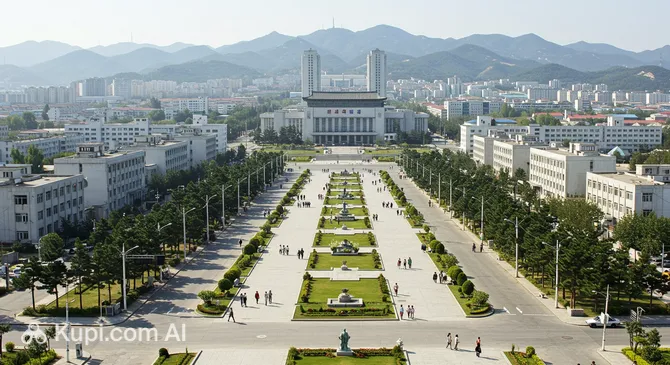
Hamhung is the second largest city in North Korea, representing a unique combination of a powerful industrial center and carefully preserved historical heritage. Located on the east coast of the Korean Peninsula in South Hamgyong Province, this city with a population of about 768,000 is a key port and industrial hub of the region, where the rhythm of life is dictated by large chemical and engineering enterprises.
Hamhung. Illustration.
Source: Kupi.com AI
Despite its stark industrial appearance, Hamhung can surprise travelers with its monumental architecture and deep connection to the past. Exploring the historical past of the city, one can find traces of the great Koryo and Yi dynasties alongside Soviet-style buildings and wide socialist avenues. The atmosphere here is more everyday and restrained than in the capital, allowing for a better sense of the country's daily life.
Among the main architectural landmarks, the Hamhung Grand Theatre stands out—a colossal structure that has become a symbol of the city's cultural life. For those seeking seclusion, the surroundings offer picturesque views from Mount Tonghun and the long sandy beaches of Majon. A visit to this city is an important step for any tourist seeking to see different facets of life in the DPRK and experience its authentic industrial character.
Weather Overview
The climate in Hamhung is classified as a continental monsoon, which is significantly influenced by its proximity to the Sea of Japan. This neighborhood makes winter frosts slightly less severe than in the interior of the peninsula, and the summer more humid and refreshing. Winters here are usually dry and sunny, and the average January temperature fluctuates around -5.4°C, although nighttime figures can drop significantly lower.
The summer period is characterized by heavy rainfall and warmth: in July and August, the average temperature is about +23°C. This is the monsoon season, when most of the annual rainfall occurs, which is important to consider when planning trips to the coast. If you want to know more about what weather in Hamhung awaits you in a specific month, it is worth remembering that late spring and early autumn are considered the most comfortable times for a visit.
Spring in the city arrives gradually, with the air warming up rapidly in April and May, when nature comes alive and city parks are covered with greenery. Autumn is the most stable season with clear skies and moderate temperatures, which is ideal for viewing historical monuments and walking along Mount Tonghun without the exhausting summer humidity.
Average monthly temperature
Average monthly precipitation
Interesting Facts
Hamhung is a city full of hidden details and surprising records that reveal themselves only to the attentive traveler. Here are a few facts that highlight its uniqueness:
Theatrical Giant: The Hamhung Grand Theatre is considered the largest in the country; the building contains about 800 rooms, including rehearsal halls and art workshops.
Royal Heritage: In the local residence of the founder of the Joseon Dynasty grows the famous "prostrate pine"—a tree over 450 years old, which is considered a national treasure and protected by the state.
Ancient Shrines: Ryangchon Temple, located in the vicinity, was built in the 8th century and still retains elements of its original layout, making it one of the oldest functioning cultural sites in the region.
Maritime Expanses: Majon Beach, located near the city, stretches for 25 kilometers, offering a wide strip of pure white sand, which is a rarity for such large industrial ports.
Command Post Mountain: At the top of Mount Tonghun, remains of ancient city walls and pavilions that were used as observation posts more than nine centuries ago have been preserved.
How to Get There
Hamhung is an important transport hub in the eastern part of the country, although the options for getting here for foreign tourists are strictly regulated. As a rule, visits to the city are carried out as part of organized tours starting from Pyongyang. The distance between the capital and Hamhung is about 315 kilometers, and it can be covered by a special tourist bus or train, which takes from 5 to 8 hours depending on road conditions and schedules.
There is no direct air service for regular passenger flights in the city. The nearest airport is in Pyongyang, from where groups are transported by land. For more detailed information on entry rules and logistics, it is recommended to study the section on how to get to Hamhung to plan your route in advance through official tour operators.
Rail communication plays a key role in the life of the city. Hamhung Railway Station receives trains connecting the east coast with the center of the country. A train trip is a great way to see the changing landscapes: from rice fields to rugged mountain ranges. However, it is worth remembering that travel time may be longer than stated due to technical stops and the specifics of track operation in mountainous terrain.
Station
Passenger traffic
Distance
Hamhung Station
5
10 km
Kowon Station
5
68 km
Anbyon Station
5
104 km
Sunchon Station
5
158 km
Pyongsong Station
6
170 km
Sinanju Chongnyon Station
6
177 km
Main Attractions
Although Hamhung is primarily known as an industrial giant, it hides several outstanding monuments of great importance to national culture. One of the most impressive sites is the Hamhung Grand Theatre—a majestic building constructed in 1984. It is the largest theatrical structure in the country, striking in its scale and serving as the main venue for large-scale opera and dance performances.
The Residence of Yi Seong-gye holds particular historical value. This complex of traditional Korean buildings served as the home for the founder of the Joseon Dynasty after his abdication. Here, you can see not only classical architecture but also a unique natural monument—a 450-year-old pine tree whose branches spread right along the ground, creating an amazing natural ensemble.
For lovers of panoramic views, Mount Tonghun is a must-visit. Historical objects have been preserved at its summit, such as the Kunchon Pavilion, built back in 1108, which served as a command post in ancient times. The mountain offers breathtaking views of city blocks, industrial zones, and the sea coast.
If you are looking for tranquility and traditional aesthetics, it is worth heading to the Ryangchon Temple at the foot of Mount Panryong. Founded in 753, this ancient Buddhist complex stands out for its architectural harmony and allows you to touch the spiritual heritage of the Koryo era. You can conclude your sightseeing at Majon Beach, which is famous for its white sand and is a popular vacation spot for both locals and foreign guests.
Local Cuisine
A gastronomic journey to Hamhung is impossible to imagine without its most famous dish—Hamhung Naengmyeon. This is a local variety of cold noodles made from potato or buckwheat starch, served in an icy broth or with a spicy sauce. Unlike the Pyongyang version, the local noodles have a chewier texture and are often supplemented with fresh seafood, highlighting the city's status as a major port.
Proximity to the Sea of Japan determines the abundance of fish and seafood in the diet. Tourists are often offered a variety of shellfish soups, fried fish, and traditional Korean side dishes—banchan, among which kimchi with regional preparation characteristics is always present. You should also try pajeon—savory pancakes with plenty of green onions and seafood, which are prepared with particular skill here.
The food culture in the city is centered around large restaurants in hotels and specialized establishments in the city center. Meals are usually communal and accompanied by traditional tea or local drinks such as rice wine (makgeolli) or soju. Street food is rare, so the main delicacies should be sought in the menus of organized lunches, where chefs try to demonstrate all the richness of the culinary traditions of the east coast.
Travel Tips
A trip to Hamhung is a unique experience that requires some preparation and knowledge of local rules. Here are some useful tips to help make your trip comfortable and interesting:
Trip Organization: Remember that visiting the city is only possible as part of an organized group with official guides. Independent planning of the route within the country is prohibited.
Clothing by Season: In summer, take light cotton clothing, but don't forget sunscreen for relaxing on Majon Beach. In winter, Hamhung can be quite frosty, so a warm jacket and comfortable shoes for walking in parks are necessary.
Finances: For payments, bring small cash bills in Euros, US Dollars, or Chinese Yuan. International bank cards are not accepted here, and there are no ATMs.
Photography: Always ask your guide for permission before taking a photo. There are strict rules for filming military sites, industrial zones, and monuments to leaders (they must be photographed in their entirety).
Etiquette: Show respect for local traditions and monuments. When visiting memorials, it is customary to behave with restraint. Bowing before statues of leaders is a mandatory part of the protocol.
Communication and Internet: Access to Wi-Fi is extremely limited, and international roaming does not work. You can purchase a local SIM card at Pyongyang airport, but communication will be expensive.
Health: Drink only bottled water, which is always provided in hotels and during lunches. It is better to bring a first-aid kit with basic medicines with you.
Gifts: Small souvenirs from your country (pins, sweets, or postcards) can be a pleasant gesture of courtesy for your guides and drivers.
Observing these simple rules will allow you to focus on exploring the amazing culture and architecture of South Hamgyong, making your visit to this closed city truly unforgettable.
Entertainment & Nightlife
The entertainment program in Hamhung is predominantly cultural and organized. The center of attraction for residents and visitors is the Hamhung Grand Theatre, which regularly hosts large-scale concerts, theatrical productions, and performances by national ensembles. Attending such an event allows you to immerse yourself in the atmosphere of formal art, which is highly valued in the DPRK.
Evening life in the city quietens down quite early, which is typical for the country's large industrial centers. There are no conventional Western-style bars or nightclubs, and the streets are moderately lit, creating a calm and slightly mysterious environment. The main place for leisurely evening walks is Hamhung City Park, where memorial monuments are installed, and the area is well-maintained and conducive to relaxation after a busy day.
In the summer season, Majon Beach becomes the center of daytime and evening activities. Here, you can meet locals playing sports or relaxing by the water. For tourists, picnics or cultural evenings in coastal recreation areas are often organized in this area, providing a rare opportunity to chat with guides in a less formal setting against the backdrop of the seascape.
Parks & Museums
Green zones and cultural institutions in Hamhung play an important role in shaping the city's image, softening its industrial character. The main place for relaxation for citizens is Hamhung City Park. In its center is the monumental Liberation Memorial with a high stele and a square where official ceremonies take place. The park is well-maintained, decorated with ornamental shrubs, and serves as an excellent place to see how locals spend their leisure time.
For those interested in the ideology and history of the modern development of the region, the Hamhung Revolutionary Museum is open. The exhibition tells in detail about industrial construction, the feats of local factory workers, and visits by the country's leaders to this important economic center. Another interesting site is the Koryo Museum, whose collections are dedicated to the ancient history of the region, archaeological finds, and traditional art, allowing you to see the city in the context of Korea's centuries-old history.
Natural parks in the vicinity of the city are represented primarily by the slopes of Mount Tonghun and the coastal strip of Majon Beach. Mount Tonghun combines the functions of a historical reserve and a landscape park with convenient trails and observation platforms, while Majon offers relaxation in the shade of pine trees bordering a wide sandy strip. These places demonstrate that even in a large industrial hub, there is a place for harmony with nature.
Getting Around
The transport system of Hamhung reflects its status as an important industrial center. The backbone of public transport consists of buses and trolleybuses that run along wide avenues, connecting residential blocks with large factories and the port of Hungnam. Routes cover all key points of the city, and during peak hours, transport is actively used by labor collectives. There is also a tram line operating in the city, which has become one of the few in the country outside of Pyongyang.
For foreign tourists, movement around the city is organized differently: groups usually move in comfortable minibuses or cars accompanied by guides. This ensures strict adherence to the program and allows for quick access to remote sites, such as Majon Beach or historical monuments in the mountains. Independent use of city buses by tourists is generally not practiced.
Bicycles are less common in Hamhung than in rural areas, but remain an important means of transport for part of the population. Traffic here is organized and orderly; traffic jams are practically non-existent. For those who want to feel the rhythm of the city, it is recommended to take a walking tour of the central squares under the guidance of a guide—this is the best way to see the architecture and monumental paintings decorating transport interchanges.
Accommodation
Accommodation in Hamhung is fully controlled by state structures, so the choice of hotels is limited to a list of officially permitted properties. Most tourist groups stay at the Hamhung Hotel, located in the city center, or in specialized hotel complexes in the Mount Tonghun area. These establishments offer a basic level of comfort, which includes necessary amenities, restaurants with local cuisine, and sometimes souvenir shops.
The Majon Resort Zone on the coast is particularly popular, featuring guest houses and cottage-style hotels. This place is ideal for those who want to combine sightseeing with a holiday by the sea. Conditions here can vary from modest to quite modern, meeting international standards for DPRK state resorts.
It is important to note that independent booking of accommodation through common online services is impossible—all accommodation issues are resolved by the host party during the tour formation stage. It is recommended to choose tours with accommodation in the city center for better access to the main monuments, or on the coast if the trip takes place during the warm season. Meals in hotels are usually included in the price and are oriented toward the preferences of foreign guests.
Nearby Cities
Hamhung is an excellent starting point for exploring the east coast and neighboring regions of South Hamgyong Province. Although moving between cities requires special permission, organized excursions allow you to see the diversity of landscapes and key centers of the region.
One of the most popular destinations for a trip from Hamhung is Wonsan—the country's main port and resort city, located about 113 kilometers to the south. It is famous for its picturesque bays, international-level children's camps, and the opportunity to walk along the embankment, enjoying the sea breeze. The road between the cities takes about three hours and passes through flat coastal areas.
Also of interest are small towns such as Sinpo, known for its fishing industry, and Chaedok. Trips to these settlements allow for a deeper understanding of the economic life of the province and a look at how the industrial hubs of the DPRK function outside of major metropolises.
Exploring the surroundings of Hamhung provides a unique opportunity to compare the stark architecture of an industrial center with the natural charm of coastal zones and the traditional way of life in smaller towns on the east coast.
Shopping & Souvenirs
Shopping in Hamhung is primarily an introduction to the state trade system and the products of local craftsmen. There are no large shopping and entertainment centers in the usual sense, however, central department stores and specialized shops in hotels offer a wide range of goods. The main retail outlets are concentrated in the area of the central squares and the Hamhung Grand Theatre.
You should bring back unique local souvenirs from the city. Pay attention to folk crafts: embroidery, ceramics, and traditional fans. Hamhung is also known for its food products—here you can buy high-quality local tea, spices for making naengmyeon, and sets of traditional Korean sweets. For collectors, stamps, postcards, and books in foreign languages published by local publishing houses may be of interest.
Market trade is concentrated in the area of the Hungnam port, where you can sometimes see the sale of fresh seafood and basic necessities, although tourist access to such sites may be limited. Payment in shops for foreigners is usually made in cash—Euros, Dollars, or Chinese Yuan are accepted. Shop opening hours are standard: from morning until early evening, so it is better to plan purchases for the first half of the day.