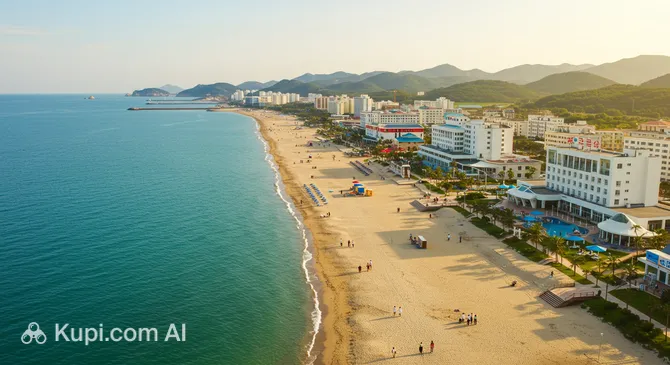
Wonsan is a picturesque port city located on the east coast of North Korea. Serving as the administrative center of Kangwon Province, it harmoniously combines its status as an important industrial hub with that of a developing seaside resort. The city stretches along the shores of Yonghung Bay, and its ice-free harbor has provided year-round navigation and fishing for decades.
The city's geographical location is impressive: to the west, it is protected by a mighty mountain range, and the bay's waters are dotted with about 20 small islands, creating a unique natural landscape. The population of Wonsan is approximately 363,127 people. Thanks to the sea breeze and an abundance of greenery, a calm and clean atmosphere is maintained here, which noticeably distinguishes it from the more formal districts of the capital.
Wonsan. Illustration.
Source: Kupi.com AI
The city is known for its recreational opportunities. It is home to the famous Songdowon International Children's Union Camp and the ambitious Wonsan-Kalma coastal tourist zone, focused on beach vacations. If you are interested in the region's heritage, it is worth learning more about the city's history, which is closely linked to the development of sea routes and the country's industrialization.
Visiting this coastal center allows you to see North Korea from a different perspective — as a place for relaxation by the Sea of Japan, where industrial giants coexist with sandy beaches and pine groves. It is an invitation to discover one of the most dynamically changing cities in the republic.
Weather Overview
The climate of Wonsan is classified as a humid continental/temperate monsoon climate with a distinct maritime influence. The city is protected from harsh westerly winds by a mountain range, creating milder conditions compared to the country's inland regions. Summers in the city are warm and humid, while winters are cold but relatively dry, with the ice-free harbor softening coastal temperatures.
During the summer months, especially in July and August, the average daytime temperature is around +27°C. This time is considered the peak tourist season for beach holidays, although the bulk of precipitation (up to 318 mm in August) falls during this same period. In winter, specifically in January, the thermometer can drop to -9°C at night, but daytime temperatures often hover around zero. For more detailed planning, it is worth checking the weather in the city by month.
Spring and autumn in the region are brief but very picturesque. April and May please visitors with a gradual warming to +15...+20°C, while September brings a pleasant coolness and clear skies, ideal for excursions and walks through Pine Tree Alley. Air quality in the city remains high thanks to sea breezes and the forested mountains surrounding the coast.
Average monthly temperature
Average monthly precipitation
Interesting Facts
Wonsan is a city with a fascinating character and many interesting details that often remain outside the scope of standard guidebooks.
Tramway Innovation: In 2025, a modern tram system was launched in the city, significantly improving eco-friendly mobility for residents and becoming a new landmark of urban transport.
World-Class Camp: The famous Songdowon camp hosts children not only from the DPRK but also from other countries, serving as an important platform for international youth exchange.
Sea Gates: Thanks to warm currents, the city's harbor never freezes, making it a unique strategic asset on the east coast of the Korean Peninsula.
Beer Traditions: Wonsan is famous for its local beer, which many consider some of the best in the country, largely due to the pure water from the mountain springs of Kangwon Province.
Road to the Capital: The city is connected to Pyongyang by a direct, modern highway only 130 kilometers long, allowing for quick travel between the east coast and the center of the country.
How to Get There
Transport accessibility to Wonsan has significantly improved in recent years, making it an important hub in eastern North Korea. The primary way for foreign guests to reach the city is by participating in an organized tour. Flights are usually operated through the local Kalma Airport (WOS), which, after recent reconstruction, is capable of receiving modern airliners. Transfers from Pyongyang by bus along a scenic highway are also widely practiced, taking about 2–3 hours.
To plan a route, it is useful for tourists to familiarize themselves in advance with detailed information on how to get to the city and the specifics of internal travel.
Railway services connect Wonsan with all key regions of the country. The city's main station is a junction for several important lines, providing reliable links to the capital and northern provinces. Traveling by train allows you to see the natural beauty of Kangwon Province, although it takes longer than traveling by road.
Station
Passenger traffic
Distance
Anbyon Station
5
13 km
Kowon Station
5
36 km
Hamhung Station
5
85 km
Sunchon Station
5
134 km
Pyongsong Station
6
136 km
Jihaeng Station
12
144 km
A promising direction is sea travel. Possibilities for regular ferry services from Vladivostok are being discussed, which could make the city even more accessible to tourists. However, at the moment, all travel within the country is strictly regulated and carried out under the control of the host party.
Main Attractions
The main points of attraction in Wonsan today are inextricably linked to its coastal status. The jewel of local tourism is the new Wonsan-Kalma complex — a large-scale recreation zone stretching along the coast. This project is impressive in its scope: it is designed to accommodate thousands of guests at once, offering modern beaches, sports grounds, and a developed infrastructure for a comfortable seaside holiday.
For those traveling with children or wishing to see legendary sites from the era of socialist construction, the Songdowon International Children's Camp is a must-visit. It is not just a youth holiday destination, but an entire entertainment town featuring a modern water park, a zoo, and even an aquarium. The "Mirror Maze" is particularly popular, becoming a favorite attraction for visitors of all ages.
The city's cultural program is complemented by a visit to the Wonsan History Museum, where you can trace the transformation of a small port into a major administrative center. Nature lovers will enjoy Chando Island, which offers panoramic views of the bay, and a stroll through Pine Tree Alley (Alley of a Thousand Pines), which fills the air with the healing scent of pine needles. The evening can be spent at the Kalma fishing pier, observing the daily life of local sailors.
Local Cuisine
The gastronomic face of Wonsan is defined by its proximity to the Sea of Japan. The main delicacy that attracts gourmets here is the freshest seafood. Thanks to the ice-free harbor, fishing continues year-round. At local markets and hotel restaurants, you can try various types of fish, crabs, squid, and shellfish, prepared both in the traditional Korean way with hot spices and in more neutral versions.
A special place in the city's food culture is occupied by the Kalma fishing pier area. This is a favorite spot for locals, where the atmosphere is permeated with the smell of the sea and the fresh catch. Here you can find establishments specializing in Korean seafood barbecue. You should also definitely try the local beer, which is brewed in Kangwon Province and is considered a pride of the region for its smooth taste and high quality.
For tourists, meals are usually organized in hotel restaurants or as part of excursion programs. The menu often includes classic Korean dishes: kimchi, hearty noodle soups, and traditional rice. The city's gastronomic scene is constantly evolving along with the expansion of the Wonsan-Kalma resort, where guests are offered breakfasts and dinners adapted to international standards but with a vibrant local accent.
Travel Tips
A trip to Wonsan requires some preparation to ensure your journey to the east coast is as comfortable and interesting as possible. These tips will help you navigate local specifics and rules.
Trip Organization: Remember that visiting the city is only possible as part of an official tour group with a guide; independent entry is prohibited.
Finances: Bring cash in euros, US dollars, or yuan. ATMs for international cards do not work here, and card payments are practically impossible.
Clothing: For a summer beach holiday in Wonsan-Kalma, bring light clothing and swimwear. For city walks and museum visits, choose modest, neat clothing and comfortable shoes.
Etiquette and Photos: Always ask your guide's permission before taking photos of local residents or strategic sites. Show respect to local monuments and the country's leaders.
Connectivity: Wi-Fi access is extremely limited. You can purchase a local SIM card at the airport or major hotels for international calls, but internet access on them will be restricted.
Health: It is recommended to bring a first-aid kit with basic medications. Do not drink tap water — always use bottled water.
Weather: It can be humid in summer, so sunscreen and a raincoat will be useful. In winter, piercing winds blow along the coast.
Souvenirs: The best purchases are vacuum-packed seafood, local beer, and Kangwon folk crafts.
Following these simple rules will allow you to fully enjoy the hospitality and unique atmosphere of the country's sea gates.
Entertainment & Nightlife
Entertainment in Wonsan is calm and organized, which is typical for cities in this country. The main leisure center for guests is the Wonsan-Kalma tourist zone, where opportunities for active recreation, sports, and dining are concentrated. Unlike metropolises in other countries, you won't find noisy nightclubs with discos until dawn here, but you can enjoy evening strolls along the embankment overlooking the harbor lights.
Daytime entertainment is largely focused on family vacations and water attractions. The infrastructure of the Songdowon camp is of great interest: the water park and aquarium serve not only children but also adult tourist groups. For those who prefer cultural leisure, there are theaters and squares with fountains, such as Chosun Square, where public events and festive performances are often held.
Those seeking evening tranquility should head to the Kalma fishing pier. This place has its own unique atmosphere, where you can watch ships docking and feel the true rhythm of a port city. Security in the city is at the highest level, making guided walks as comfortable as possible, although it should be noted that most establishments close quite early.
Parks & Museums
Despite its port and industrial status, Wonsan boasts pleasant green zones and interesting cultural sites. One of the most famous natural attractions is Pine Tree Alley (Alley of a Thousand Pines). This is a picturesque spot by the sea, where slender, centuries-old trees provide thick shade and the air is filled with the scent of pine. The park is ideal for quiet walks and a break from the city noise.
The region's cultural heritage is concentrated in the Wonsan History Museum. The museum's exhibition tells of the ancient past of Kangwon Province, the development of fishing, and the heroic pages of the city's history in the 20th century. Visiting the museum helps to gain a deeper understanding of the context in which the modern port's appearance was formed and its significance for the country.
Additional interest is provided by the recreational zones around the Songdowon camp. Here, landscape architecture is combined with entertainment facilities: a zoo where you can see exotic animals and a botanical garden. The landscaping in these areas is executed with great attention to detail, making walks here aesthetically pleasing and educational for tourists.
Getting Around
Public transport in Wonsan is undergoing an active modernization phase. The most notable event of recent years was the launch of a tram system in 2025. Modern and comfortable cars run between key districts, connecting residential quarters with tourist zones and the port. This is not only a convenient way to get around but also a great opportunity for tourists to take a sightseeing trip through the city.
In addition to trams, the city has a developed network of bus routes. Buses are the primary means of transport for most residents, connecting the center with the industrial outskirts. Transport runs quite regularly, and the number of vehicles increases during peak hours to avoid overcrowding. Traffic in the city is organized, and traffic jams are extremely rare.
For tourists, movement around the city is usually organized via tour buses or taxis assigned to the host party. Independent use of public transport may be restricted by stay regulations, so any trips should be coordinated with a guide. The cost of travel on city transport is extremely low, and payment is made at fixed rates through conductors or ticket offices.
Accommodation
Accommodation in Wonsan is primarily geared towards members of tourist groups, and the choice of lodging is closely tied to the purpose of the trip. The main place for relaxation is the massive Wonsan-Kalma tourist cluster. High-class modern hotels have been built here overlooking the sea, offering comfortable rooms, restaurants, and proximity to well-equipped beaches. This area is ideal for those who want to enjoy a resort holiday.
Within the city itself, there are also mid-range hotels that have preserved the aesthetics of past decades but are maintained in good condition. Some of them are located near the embankment and the port, allowing guests to be at the center of city life. It is worth noting that independent booking via international aggregators is not available here — all accommodation issues are resolved through the state travel agency when arranging the tour.
The price range for accommodation is usually included in the total cost of the tour package, which varies depending on the chosen hotel category. If you plan to travel during the peak summer season when the beaches are most popular, it is recommended to book your tour in advance. Despite the absence of a traditional private apartment rental market, the city's hotel stock is capable of accommodating tens of thousands of guests simultaneously.
Nearby Cities
Wonsan is an excellent starting point for exploring the east coast and central regions of the republic. Thanks to a developed road network and railways, you can take short trips from here to interesting locations in Kangwon Province.
Just 15 kilometers away is the small city of Munchon, which is interesting for its industrial history and fishing traditions. For those ready for a longer journey, 93 kilometers to the north lies Hamhung — the second largest city in the country, known for its architectural monuments and cultural life. A trip there will allow you to compare the rhythm of life in the two largest industrial centers on the coast.
Exploring the city's surroundings with a guide provides access to unique natural sites, such as the Masikryong Ski Resort, located an hour's drive away. We recommend not limiting yourself to the beaches and taking the time to explore neighboring regions to better understand the many facets of this fascinating country.
Shopping & Souvenirs
Shopping opportunities in Wonsan have their own specifics and are primarily focused on purchasing local goods and souvenirs. The main shopping hub for locals and tourists is the recreation area near the Kalma fishing pier. Here you can find the freshest seafood and processed products, which are considered the best on the entire east coast.
In the city itself, shopping is most often done in department stores and specialized shops around Chosun Square. Foreign guests are offered a wide range of traditional Korean products: ceramics, embroidery, ginseng, and ginseng-based cosmetics. It is also worth paying attention to local philately and printed materials — North Korean stamps and posters are in great demand among collectors.
Shops are usually open from morning until early evening. Payments are made in cash, and tourists are recommended to carry euros, dollars, or Chinese yuan. In the Wonsan-Kalma resort area, there are modern souvenir boutiques where you can purchase mementos with city and Kangwon Province symbols. The Tax-Free system is not practiced in the country, but prices in state stores are fixed.