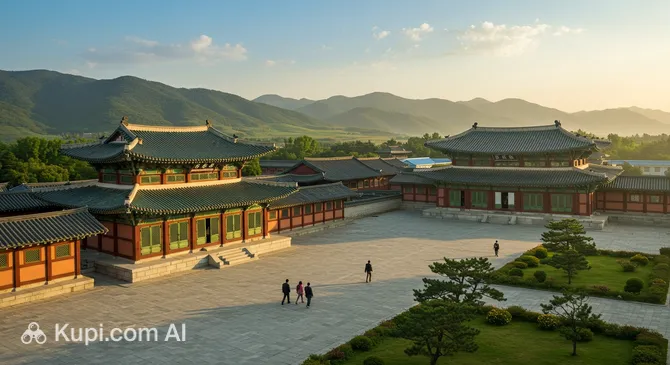
Kaesong is an amazing reserve city in North Korea that has preserved the spirit of ancient Korea. Once the capital of the great Goryeo state, it is still considered the cradle of national culture, Confucianism, and traditions. Here, amidst the hilly terrain, modern industrial life is closely interwoven with authentic neighborhoods that seem frozen in time.
Located in the southern part of the country, not far from the demarcation line, Kaesong is home to more than 338,000 people. Its geography defines its special status as an important cultural and industrial hub. Travelers are met here by a calm and measured atmosphere, contrasting sharply with energetic Pyongyang.
Kaesong. Illustration.
Source: Kupi.com AI
The city's main value lies in its centuries-old history, reflected in the architecture of the old districts. Traditional "hanok" houses with their characteristic curved roofs and the narrow streets of the old city create a unique flavor. Kaesong is included in the UNESCO World Heritage List, making it a must-visit for everyone who wants to touch the origins of Korean civilization.
Visiting Kaesong is a rare opportunity to see authentic daily life and get acquainted with the heritage of the Goryeo era in its original form. We invite you on this journey to see firsthand the grandeur of ancient temples and enjoy the silence of the historical parks of one of the country's most hospitable cities.
Weather Overview
Kaesong is located in a temperate continental climate zone, which ensures a clear change of seasons. Winters here are cold and quite dry: in January, the average temperature drops to -2.6°C, and night frosts can reach -15°C. During this period, the city is often shrouded in a frosty haze, and rare snow gives the old "hanok" roofs a special charm. Before your trip, we recommend checking the current weather in Kaesong.
Summer in the city is warm and humid, influenced by monsoons. The peak temperatures occur in July and August when the air warms up to +26°C...+29°C. This is also the rainiest time of the year—most of the annual precipitation falls in mid-summer. Autumn in Kaesong is considered the most favorable time for tourism: the heat subsides, and the hills turn bright gold and crimson with moderately comfortable temperatures.
Average monthly temperature
Average monthly precipitation
Interesting Facts
Kaesong was the capital of Korea during the Goryeo dynasty for nearly five hundred years (918–1392), making it the center of the peninsula's political and cultural life.
The city concentrates 12 UNESCO World Heritage sites, including ancient academies, royal tombs, and fragments of city walls.
Kaesong is considered the birthplace of the world's best Korean ginseng (insam); local climatic conditions and cultivation traditions allow for the production of an exceptional quality product.
The old city has preserved a unique layout with traditional clay and wood houses called "hanok," many of which are still inhabited.
For a long time, the Kaesong Industrial Complex operated here—a unique project of economic cooperation between the DPRK and South Korea.
How to Get There
Transportation to Kaesong has its own peculiarities characteristic of travel in this part of the peninsula. The city is located about 160 kilometers south of the capital, and the main way to get here is by organized transfer. For trip planning, it's useful to check the general information on how to get to the city in advance.
There is no airport in Kaesong, so most tourists arrive via Pyongyang International Airport. Highway No. 1 leads from the capital to Kaesong; the bus journey takes about 3–4 hours. The trip is accompanied by picturesque views of agricultural land and mountain landscapes.
Railway service also connects Kaesong with other regions of the country. Trains from Pyongyang along the Gyeongui line run several times a week, with a travel time of 4 to 5 hours. Kaesong Railway Station is an important transport hub; however, individual train travel for foreign citizens is limited and requires coordination with a guide.
Station
Passenger traffic
Distance
Kaesong Station
7
5 km
Panmun Station
6
5 km
Sonha Station
6
2 km
Ryohyon Station
5
15 km
Kyejong Station
5
18 km
Dorasan Station
13
12 km
Jihaeng Station
12
41 km
Gyeyang Station
13
43 km
Deokgye Station
12
43 km
Uijeongbu Station
13
46 km
Main Attractions
Kaesong's main treasures are its architectural monuments included in the UNESCO World Heritage List. One of the most recognizable landmarks is Namdaemun (South Gate), built at the end of the 14th century. These majestic gates once served as the main entrance to the city and still impress with their monumentality and the skill of ancient architects.
The heart of the historical heritage is the ancient Confucian academy, Songgyungwan. Founded in 982, it was the country's main educational center for centuries. Today, it houses a museum where visitors can see a unique library and rare artifacts telling the story of the formation of Korean philosophical thought and the education system.
Special attention is deserved by the Manwoldae palace complex (or Cheonyonnyeon), which served as the residence of the Goryeo dynasty rulers. Although mostly foundations and terraces remain today, the scale of the complex allows one to imagine the former grandeur of royal power. Walking among these ruins, you can feel the deep connection across time and the greatness of Korean history.
An equally interesting site is the world's largest kimchi field, covering an area of about 3,000 square meters. This site is used for the traditional process of fermenting vegetables in huge earthenware jars. For tourists, this is a rare chance to see the "kitchen" of Korea's national heritage on an industrial yet deeply traditional scale.
Local Cuisine
A gastronomic journey through Kaesong is primarily an introduction to the royal cuisine of the Goryeo dynasty. Local culinary traditions are famous for their refinement and the use of natural ingredients. Be sure to try a traditional "pansangi" meal—many small bronze cups with various snacks served with rice and soup.
The city is rightfully considered the capital of Korean kimchi. A unique type of this dish is prepared here—baek-kimchi (white kimchi), made without adding hot pepper, which highlights the natural taste of the vegetables. Kaesong is also famous for its tteok rice cakes and nutritious soups like kong-guksu (cold noodles in soy milk), which are especially popular during the warm season.
Among drinks, the local rice wine makgeolli and medicinal herbal teas hold the lead. The food culture here is conservative: most meals take place in state-run restaurants specializing in set lunches. Tastings are often organized for tourists, where you can not only try the dishes but also learn about their historical significance and preparation methods.
Travel Tips
A trip to Kaesong is a unique experience that requires certain preparation and an understanding of local rules. These tips will help you feel confident and enjoy your journey to this historical city.
Clothing and Essentials: Choose clothing according to the season: summers here are humid and hot, while winters are dry and freezing (down to -15°C). Be sure to bring comfortable shoes for walking tours of the old city. When visiting memorials and official monuments, a business or neat style is recommended.
Transport: Movement around Kaesong is carried out only by tourist bus with a group or on foot accompanied by a guide. Independent car rental or using public transport without an escort is not available for foreigners.
Finances: Bring cash in Euros, Dollars, or Yuan. International banking cards do not work in Kaesong, and there are no ATMs for tourists. Tipping is not officially accepted, but small souvenirs for guides will be received with gratitude.
Health and Safety: Kaesong is a very safe city with a low crime rate. Pharmacies in the Western sense are rare, so pack a personal first aid kit in advance. If necessary, medical assistance will be provided through your guide.
Communication: The main language is Korean. English is not widely spoken, so your guide will be your main link. Learn a couple of phrases for politeness: "kamsahamnida" (thank you) always brings a smile. Wi-Fi is practically unavailable, and international roaming works intermittently.
Local Etiquette: Greet locals with a slight bow. Always ask your guide's permission before taking photos of people or official buildings. Show respect for monuments and national symbols.
What to Avoid: Never photograph military objects, checkpoints, or construction sites. Avoid independent walks outside the hotel or the established route without coordination with your escorts.
Additional Tip: Try the local ginseng specifically in Kaesong—it is considered the highest quality here. It makes an excellent gift and a healthy product.
Following these simple rules will make your visit to Kaesong peaceful and informative. Remember that you are a guest in a place with very deep traditions, and openness to new experiences will be rewarded with vivid impressions.
Entertainment & Nightlife
Entertainment in Kaesong is quiet and traditional, reflecting the city's cultural lifestyle. Here you won't find noisy nightclubs or bars in the usual sense, as local life follows a strict rhythm. Night walks are limited, and main public spaces fall silent in the evening, inviting contemplation of the illuminated historical monuments.
Leisure activities for city guests are usually centered around cultural events. For foreign groups, folklore performances are often organized, where one can hear traditional music and see classical Korean dances in historical settings. Such evenings allow for a deeper immersion into the atmosphere of the Goryeo era and a feeling for the aesthetics of ancient art.
Daytime entertainment includes visiting central squares and local markets, which serve as the main social points for citizens. For larger-scale spectacles, such as circus shows or world-class theatrical productions, residents and guests usually head to Pyongyang, located a few hours' drive away.
Parks & Museums
The cultural program in Kaesong is impossible without a visit to the Koryo History Museum, located within the walls of the ancient Songgyungwan academy. This place is a real treasury of artifacts, including ancient ceramics, Buddhist relics, and unique documents that help trace the city's path from a royal capital to a modern cultural center.
For connoisseurs of applied arts, the Ceramics Museum is open. Kaesong has long been famous for the production of exquisite porcelain and earthenware, and the museum's collection features both historical samples and modern works by local masters. This is an excellent opportunity to see the continuity of traditions in the artistic processing of clay.
The city's green zones are represented by the small but cozy Yangnyu Park, located on the riverbank. Although there are few large-scale park complexes in the city, Yangnyu Park serves as a popular spot for residents' leisurely strolls. Greenery here is concentrated around the historical gardens at temples and palaces, where landscape design harmoniously complements ancient architecture, creating an atmosphere of peace and tranquility.
Getting Around
The transport system of Kaesong is quite simple and effectively serves the city's needs. The basis of public transport consists of buses and trolleybuses, which connect the central districts with the outskirts and industrial zones. Routes cover all key points of the city; however, service intervals can be significant, so local residents often rely on a clear transport schedule.
One of the characteristic features of Kaesong is its compactness. The historical center and main attractions are located within a radius of 2–3 kilometers, making walking the most convenient way for tourists to get around. City streets are not overloaded with cars, and the absence of traffic jams makes moving by tourist buses or taxis fast and predictable.
For travel between cities, the railway connecting Kaesong with Pyongyang is used. Tickets for transport for foreign guests are usually included in the tour price and arranged by guides. If you plan to use local transport, it is worth considering that during peak hours buses can be crowded, but thanks to regulated traffic, the journeys remain fairly comfortable.
Accommodation
Accommodation options in Kaesong are primarily geared towards tourist groups visiting the city as part of cultural tours. The main place of residence for foreign guests is the Janamsan Hotel, which is classified as three-star. It offers a standard set of amenities and traditional service typical of the country's hotel industry.
For those who want a deeper immersion into Korean culture, there are traditional guesthouses in the historical center. Staying in them allows you to experience the layout of a classic Korean "hanok" house, where guests sleep on special mattresses on a heated floor (ondol system). This is a unique experience that is especially valued by lovers of authenticity.
Booking accommodation in Kaesong is done exclusively in advance through travel agencies, as there is no free rental market or possibility for independent "walk-in" check-ins for foreigners. Prices are usually included in the total cost of the tour, and the level of comfort at all available accommodation points is maintained at a stable, decent level.
Nearby Cities
Kaesong is an ideal point for exploring the southern reaches of the peninsula, offering travelers access to unique historical and natural sites. Despite the proximity to the border, every destination here requires clear planning and accompaniment, while opening up views of some of the most protected territories in the world.
Just 10 kilometers from the city is the famous Panmunjom—a checkpoint in the demarcation zone where the armistice agreement was signed. A visit to this place allows one to feel the scale of history and see the famous "blue houses." Another popular destination is the Dme area, known for its hot springs, where you can relax after intensive tours of ancient monuments.
Although major centers like Paju and Gimpo are very close in a straight line, there is currently no direct connection with them. Nevertheless, Kaesong remains an important link in the region, allowing tourists to feel the proximity of two cultures.
Exploring the surroundings of Kaesong is an opportunity to see Korea from an unusual perspective, combining visits to ancient shrines with views of modern landscapes. We recommend taking time for excursions to get a full impression of this unique region.
Shopping & Souvenirs
Shopping in Kaesong is primarily a search for unique items of arts and crafts and traditional products. Unlike megacities with their endless shopping malls, purchases here are made in small shops at museums or in specialized stores for tourists. The city is famous for its Goryeo-style ceramics, which can be purchased as an exquisite souvenir.
The main place to experience local flavor is the Kaesong Central Market. Here you can see rows of fresh vegetables, the famous Kaesong kimchi, and traditional soy sauces prepared according to ancient recipes. For tourists, it's an opportunity to buy authentic Korean fabrics or wooden products that will serve as a great reminder of the trip.
Special attention should be paid to ginseng products—the region's main brand. Local shops offer a wide range: from dried root and tea to cosmetics and tinctures. It is important to remember that payment for goods in tourist zones is made in cash (usually Euro, Dollars, or Chinese Yuan are accepted), and the Tax Free system does not operate in the city.