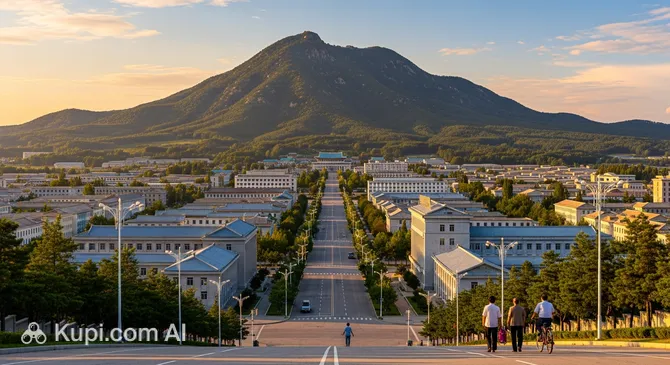
Haeju is a significant port and industrial center located on the western coast of North Korea. Perched on the shores of the Yellow Sea, the city serves as the administrative capital of South Hwanghae Province and is home to over 240,000 residents. Despite its industrial status, Haeju maintains the atmosphere of a traditional Korean city, where modern neighborhoods sit alongside elements of ancient architecture.
Haeju's rich history has roots in the deep past, reaching its peak during the Goryeo dynasty. Today, the city attracts the occasional traveler with its authenticity: here, you can observe the daily life of the port, explore bustling local markets, and touch the heritage of Confucian thought. The urban landscape of the city gently transitions into a hilly terrain, creating interesting perspectives for walks.
Haeju. Illustration.
Source: Kupi.com AI
Among the city's key features are its educational traditions and proximity to significant historical monuments, such as ancient temples and tombs. Haeju is a place for those who want to see the "other" side of the DPRK—far from the capital's glitz, but filled with the quiet rhythm of provincial life. We invite you to discover this unique maritime hub that has preserved the spirit of Korean traditions.
Weather Overview
Haeju is characterized by a temperate monsoon climate, which dictates a clear change of seasons. Winter in this region is quite harsh and dry: in January, the average temperature drops to -2.8°C, and nighttime frosts can reach -6.7°C. During this time of year, cold winds blow from the continent, bringing clear but freezing weather.
In contrast, summer in the city is warm and very humid, which is typical for the west coast. The hottest months are July and August, with average temperatures around +25°C. Most of the precipitation falls during this period, and sea mists often occur, enveloping the port area and creating a special atmosphere. Air humidity increases significantly, making the heat more palpable.
The most favorable times for a visit are considered to be spring and autumn, when the weather is mild and comfortable. To better plan your visit, we recommend studying the city's climate in advance. In spring, the air warms up gradually, while autumn delights with dry and sunny days, ideal for viewing historical monuments and walking by the Yellow Sea.
Average monthly temperature
Average monthly precipitation
Interesting Facts
Haeju is a city with a rich past and unique traits that set it apart on the map of the Korean Peninsula. Here are a few facts to help you get to know this region better:
Ancient Roots: The history of Haeju is inextricably linked to the Goryeo period (10th–14th centuries), making it one of the oldest cities in the country with preserved monuments from that era.
Cradle of Education: The city is home to Gyodong Hyanggyo, an ancient Confucian academy that served as a center of enlightenment and philosophy for centuries.
Maritime Gateway: The Port of Haeju is a strategically important hub on the Yellow Sea, playing a key role not only in trade but also in the region's fishing industry.
Birthplace of Greats: The city and its surroundings are known as the birthplace of prominent historical figures and scholars who contributed to the development of Korean culture.
Trade Center: Gyodong Daeryong Market is considered one of the most active trading spots in the province, where you can find unique local goods and fresh seafood.
How to Get There
Transport accessibility to Haeju has its own specifics due to the rules for visiting the DPRK. For foreign tourists, the only legal way to get here is as part of an organized group. The journey usually begins in the capital, and the route to Haeju is planned in advance by the host party.
Haeju does not have its own airport serving regular civilian flights. The nearest air gateway is located in Pyongyang. After arriving in the capital, tourists are offered transfers by specially chartered buses or trains. Traveling by rail is considered the most reliable and comfortable option: the train covers the 170-kilometer distance in about 3–4 hours.
The railway network connects Haeju with the country's key hubs, and the city's central station is an important transport link. Bus services are also developed, but travel time can vary depending on road conditions and weather. It is worth noting that the sea route through the port of Haeju is available only in exceptional cases and for specialized groups.
Station
Passenger traffic
Distance
Haeju Chongnyon Station
6
2 km
Pongsan Station
5
50 km
Chonggye Station
5
51 km
Sariwon Chongnyon Station
5
52 km
Hungsu Station
5
54 km
Chongbang Station
5
58 km
Main Attractions
Despite its status as an industrial center, Haeju can surprise history buffs with its ancient monuments. One of the most significant attractions is the Gyodong Hyanggyo Confucian Academy. This educational institution, preserved from times past, allows visitors to feel the austere and elevated atmosphere of traditional Korean education and philosophy.
Fans of spiritual architecture should head to the city's outskirts to visit Bomunsa Temple. Located in a picturesque spot, this temple attracts with its serenity and elegant forms, typical of the region's Buddhist architecture. Another important historical site nearby is the Tomb of King Gongmin, the great ruler of the Goryeo dynasty, whose legacy is still honored in the country.
The center of modern urban life in Haeju is the Gyodong Daeryong Market. It is not just a marketplace but a place where you can observe the authentic rhythm of the citizens' lives and see a variety of local goods. The city's port area also deserves attention: the view of the Yellow Sea and the working piers create a characteristic industrial landscape that has become an integral part of Haeju's identity.
Local Cuisine
A culinary journey to Haeju will introduce you to the authentic flavors of the DPRK's west coast. Due to its proximity to the Yellow Sea, the basis of local cuisine is fresh seafood and fish. Be sure to try the rich soups with seafood delicacies, which local chefs prepare with traditional spices that give the dishes a unique aroma.
As in all of Korea, a meal here is unthinkable without kimchi—a spicy fermented vegetable side dish that every family and restaurant prepares according to its own unique recipe. Rice is the staple element of any meal, often served with various side dishes of pork and seasonal vegetables. For those looking for colorful street food, the Gyodong Daeryong Market is a great place to taste fresh noodles and charcoal-grilled fish.
The food culture in Haeju is simple and democratic. Locals prefer to dine in small establishments near the market or in canteens at factories. Among the drinks, look out for traditional Korean tea, locally produced soy sauce, and the beer brewed in the region. Despite the lack of fine dining frills, the food in Haeju is always hearty and reflects the true character of this port region.
Travel Tips
A trip to Haeju requires some preparation and adherence to local rules to ensure your journey goes smoothly and leaves only pleasant impressions.
Trip Organization: Remember that visiting the city is only possible through an official travel agency as part of a group; independent travel is strictly limited.
Clothing and Comfort: Summer in the region is humid and warm, so bring light clothing made of natural fabrics and be sure to have an umbrella or raincoat. For visiting temples and monuments, choose modest clothing that covers shoulders and knees.
Transportation: You will move around the city on a tour group bus. Walking tours are allowed only when accompanied by a guide along approved routes.
Finances: Payments are made in cash. Tourists are usually recommended to carry Euros, Dollars, or Chinese Yuan; the use of international bank cards and ATMs is not available.
Photography: Always ask the guide for permission before taking a photo, especially if local residents or infrastructure objects are in the frame.
Connectivity: Access to Wi-Fi is practically non-existent, and international roaming may not work. You should consult your tour operator in advance about the possibility of purchasing a local SIM card.
Local Etiquette: Greeting with a slight bow is a sign of respect. Be polite and show reverence toward monuments and national symbols of the country.
What to Avoid: Do not engage in political discussions and do not attempt to enter areas not included in your excursion route.
Following these simple rules will allow you to fully enjoy the unique atmosphere of Haeju and get to know its rich cultural heritage.
Entertainment & Nightlife
Leisure in Haeju is largely determined by its status as an industrial and port city in the DPRK, where life follows a clear schedule. There are virtually no traditional entertainment venues in the Western sense, such as nightclubs or bars. The main pastimes for locals and the few tourists are concentrated on walking in public spaces and visiting cultural sites during the daytime.
The Gyodong Daeryong Market serves as a hub of activity in the city, with life buzzing from early morning. In the evening, residents often gather in city parks or central squares to socialize. If you are looking for a more intensive cultural program or vibrant evening events, it is worth noting that most such activities are concentrated in Pyongyang, which can be reached from Haeju in a few hours by train.
For daytime relaxation, walks near the port area or visits to historical monuments like ancient academies and temples are excellent options. The city's atmosphere encourages quiet contemplation and the study of everyday life. Safety in the city is maintained at a very high level, and walks along the central streets accompanied by a guide will allow you to see Haeju from its most hospitable side.
Parks & Museums
The park zones of Haeju reflect the calm and utilitarian character of the city. You won't find massive landscaped parks here, but you can enjoy peaceful green corners. One such place is the area surrounding Bomunsa Temple. The temple's natural setting creates a natural recreational zone where the hilly terrain and old trees are perfect for leisurely walks and reflection.
While there are few museums in the classical sense in Haeju, their role is successfully fulfilled by open-air historical sites. For example, the Gyodong Hyanggyo Confucian Academy serves as a kind of museum of architecture and philosophy, where you can study the layout of traditional Korean educational institutions. Every building and courtyard here is steeped in history and holds the memory of many generations of scholars.
City residents often use the coastal areas and small squares near the port for relaxation after the workday. The city's greenery is concentrated along main roads and near residential blocks, providing basic comfort for the citizens. For tourists, such walks are an opportunity to see Haeju from its most natural side, away from the ceremonial facades, amidst the everyday rhythm of a port city.
Getting Around
The public transport system in Haeju is organized simply and effectively for the needs of its residents. The main means of transportation around the city are buses. The route network covers the main streets and connects residential areas with industrial zones and the port. It is worth noting that the transport schedule is strictly regulated, and the intervals between services can be quite significant.
For tourists visiting the city as part of delegations or tour groups, the issue of transportation is usually resolved in advance: special comfortable buses with a guide are allocated for them. Independent use of city buses by foreigners can be difficult, so the primary method of movement remains the host party's transport.
Local residents also actively use bicycles—this is one of the most popular and affordable ways to get around Haeju, especially given the compactness of the central part of the city. The railway station provides links to Pyongyang and other cities, serving as an important hub for intercity travel. Walking in the city center is also convenient, as major administrative and commercial facilities are located in relative proximity to each other.
Accommodation
The choice of accommodation in Haeju for foreign visitors is strictly regulated and carried out through travel agencies. Usually, tourists are placed in hotels specifically prepared to receive foreign guests. These hotels offer a basic level of comfort and all the necessary services for a proper rest after excursions.
Accommodation options are most often functional mid-range hotels. You won't find luxury five-star complexes or private apartments for rent here. Rooms are usually furnished simply but cleanly, and the hotels themselves feature restaurants serving breakfasts and dinners adapted to tourist tastes or consisting of local cuisine.
Since all trips to Haeju are part of tours, the issue of booking accommodation falls to the organizers. Searching for hotels independently through international booking systems is not possible. It is recommended to plan your trip in advance, as the number of places in hotels authorized to accept foreigners is limited, especially during national holidays and festivals.
Nearby Cities
The location of Haeju makes it a convenient point for exploring the southern regions of North Korea, although any travel here is only possible with a guide. The city's surroundings are rich in both natural beauty and historical monuments that can be explored in a single day.
One of the most interesting destinations is the city of Kaesong, located about 78 kilometers away. This place is famous for its UNESCO World Heritage sites, including ancient bridges, tombs, and old walls. Also noteworthy is Sariwon, known for its "Folk Street," which recreates the atmosphere of old Korea, and its picturesque views of Mount Jongbang.
If you are interested in the life of smaller towns, you can head to Ongjin or Changyon, which are nearby. These trips will allow you to see the agricultural lands of the province and the quiet pace of life in the Korean hinterland. Also within reach is Songnim—another important industrial hub of the region.
Exploring nearby cities is a great way to gain a deeper understanding of the country's history and culture. Each of these destinations offers its own unique views and stories, turning even a short trip into a rich adventure.
Shopping & Souvenirs
Shopping in Haeju is primarily an introduction to the everyday life of residents and the traditional crafts of the region. There are no huge shopping malls with glass storefronts in the city; instead, market trade flourishes. The main place for shopping is the Gyodong Daeryong Market. This is where you can find the freshest seafood, vegetables, and fruits grown in South Hwanghae Province.
If you are looking for what to bring back from Haeju as a souvenir, pay attention to textile products and traditional Korean fabrics. The city is also famous for its tea and local soy-based products. Collectors might be interested in stamps, postcards, or folk crafts, which are sometimes found in specialized souvenir shops at hotels or major tourist sites.
Shops in the city usually operate on a standard schedule, and payment for goods by foreign tourists is most often made in cash. It is worth considering that the markets are oriented primarily toward the needs of the locals, so shopping here is more of a cultural experience than a typical hunt for brands. Don't forget to check the seafood stalls: dried fish from Haeju is considered an excellent local delicacy.