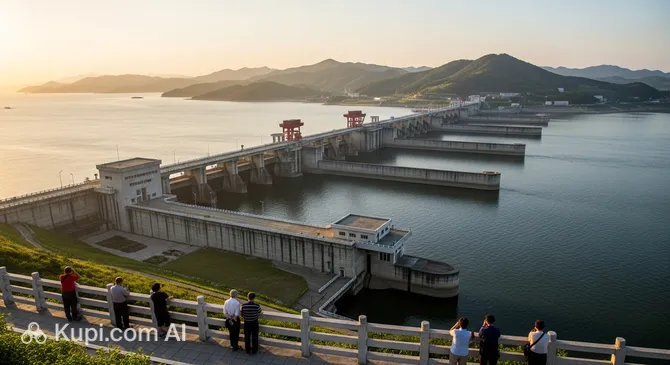
Nampo is not just a city, but a strategic maritime gateway to North Korea. Located on the west coast of the Korean Peninsula, right at the mouth of the Taedong River, this city plays the role of a key industrial and transport hub for the country. With a population of over 700,000, it greets guests with an atmosphere of businesslike efficiency, where functional architecture stands alongside massive engineering structures.
The city's geographical position defines its character: a flat landscape with small hills and proximity to the Yellow Sea make it an ideal location for a port. Although Nampo is not a classic tourist center in the conventional sense, it attracts travelers with its monumentality. By exploring the city's rich industrial heritage, one can better understand the economic rhythm of the region.
Nampo. Illustration.
Source: Kupi.com AI
Among the city's key features, the famous West Sea Barrage—a colossal hydro-technical structure—and the model Chongsan-ri cooperative farm stand out. These sites demonstrate the country's achievements in land reclamation and agriculture. Despite its utilitarian buildings, the city possesses its own rugged charm as a port hub.
A visit to Nampo is an excellent choice for those who want to see Korean life beyond the capital, get acquainted with its industrial power, and enjoy views of the endless sea. This is a place for the thoughtful traveler who appreciates scale and authenticity.
Weather Overview
The climate of Nampo is a temperate monsoon type, which makes the change of seasons very distinct. Winters here are dry and quite cold: in January, the average temperature drops to -3.3°C, and strong winds from the sea can heighten the sensation of frost. There is little precipitation at this time, and the city often looks austere and monochrome.
In contrast, summer in the city is warm and very humid. August is considered the hottest month with an average temperature of about +25.5°C, but due to high humidity, the heat can feel more intense. The peak of the rains occurs in July and August, and the city's coastal position often causes thick sea mists, which give the port landscapes a special atmosphere.
Typical weather in Nampo is characterized by warm summers with occasional downpours and sunny, frosty winters. Spring and autumn are transitional periods when the air temperature is most comfortable for walks and excursions, although sudden changes in wind direction are possible during these times. The city's terrain and the proximity of the port can affect air quality during calm periods, but overall, the sea breeze refreshes the city well.
Average monthly temperature
Average monthly precipitation
Interesting Facts
Nampo is one of the largest ports on the Korean Peninsula, through which the bulk of the country's maritime exports and imports pass.
The famous West Sea Barrage was built over five years and is considered one of the most outstanding engineering achievements in the state's history.
The city has the status of a "Special City," emphasizing its administrative and economic significance on par with the capital.
The Chongsan-ri cooperative farm in Nampo was the birthplace of the famous "Chongsan-ri method," which formed the basis of the country's agricultural management system.
In the vicinity of Nampo are the unique Ryonggang thermal springs, whose water is rich in minerals and used to treat various ailments.
How to Get There
Transport accessibility to Nampo largely depends on organized tourist routes. The main way for travelers to reach the city remains bus excursions departing from Pyongyang. The modern highway connecting these two cities allows for the 50-kilometer distance to be covered in about an hour or an hour and a half. The road passes through picturesque agricultural lands, making the trip pleasant.
Nampo does not have its own airport, so all international and domestic flights are operated through the country's main gateway—Sunan Airport in Pyongyang. This is where most tourists' journeys to this port region begin. Transport links to Nampo also include a railway line connecting the city with the capital, although the train journey can take a bit longer—about two hours.
Within the city itself, the Nampo Railway Station is a key transport hub. It serves both freight trains heading to the port and local passenger trains. The city's seaport, while the largest in the country, is primarily focused on cargo shipping, so regular passenger water transport is practically non-existent.
Station
Passenger traffic
Distance
Chimchon Station
5
38 km
Hwangju Station
5
38 km
Kindŭng Station
5
39 km
Hŭkkyo Station
5
41 km
Chongbang Station
5
41 km
Main Attractions
The main attractions of Nampo are inextricably linked to its status as an important economic center. The most impressive site is undoubtedly the West Sea Barrage. This eight-kilometer hydro-technical structure, separating the Taedong River from the Yellow Sea, is striking in its scale. Tourists are shown not only the dam itself but also the system of locks that allows large vessels to pass through.
Another important point on the city map is the Chongsan-ri cooperative farm. It is considered a model example and is often included in excursion routes to demonstrate the successes of North Korean agriculture. Here, you can see neat fields, farmers' houses, and public buildings constructed in a characteristic style.
For those seeking more relaxed recreation, the Ryonggang Resort is located on the outskirts of the city. It is famous for its hot springs, whose thermal waters are considered healing. This is one of the few places in the region where the emphasis is on wellness and relaxation surrounded by nature rather than production.
You can complete your acquaintance with the city by visiting the Kwangbok street market. Although it is primarily intended for local residents, here you can feel the true pulse of Nampo, see the daily life of the citizens, and find simple locally produced goods. The city's infrastructure remains functional and austere, making every visit here a unique experience of immersion into a working environment.
Local Cuisine
Nampo's culinary scene is largely defined by its coastal location. The main emphasis here is on seafood: fresh fish, shellfish, and crabs often form the basis of a festive or guest table. Traditional North Korean cuisine is represented in the city in all its diversity—from classic steamed rice to spicy vegetable soups.
It is definitely worth trying the local version of kimchi—fermented vegetables are prepared here with special care, sometimes adding seafood for a richer flavor. Another signature dish is cold noodles (kuksu), which is especially popular during the warmer months. Restaurants catering to tourists often offer tasting sets that include several types of appetizers and a main meat dish.
Regarding drinks, Korean tea made from various herbs and grains is popular in Nampo, as is local beer, which is renowned for its quality. For a stronger gathering, locals choose soju—a traditional Korean alcoholic beverage. Street food, such as fried pies or stuffed flatbreads, can be found at the Kwangbok market, which is always bustling and where you can see what citizens prefer in their daily lives.
The food culture in Nampo is simple and functional. Hotel restaurants or specialized establishments for groups offer quality products and traditional presentation. There is no place for pretension here, but the freshness of ingredients and adherence to national recipes are valued, making each dish unique in its own way.
Travel Tips
Traveling to Nampo is a unique experience that requires some preparation and knowledge of local rules. These tips will help you feel confident and enjoy your trip to this important port city.
Trip Organization: Remember that visiting the city is only possible as part of organized groups with an escort. Independent walks outside the approved route are not allowed.
Clothing: Depending on the season, bring warm clothes for the winter months (it can be very windy due to proximity to the sea) and light items made from natural fabrics for the humid summer. Comfortable shoes are essential for walks near the barrage.
Finances: Foreign cards do not work in the city. Bring cash in euros, dollars, or yuan in small denominations. Tourists are usually not allowed to use local currency.
Photography: Always ask your guide before taking a photo. Photographing military objects, port facilities, and certain industrial zones may be prohibited.
Communication: The main language is Korean. English is practically not spoken among locals, so rely entirely on your translator-guide.
Etiquette: Show respect to local monuments and the country's leaders. Behave with restraint in public places; this will help avoid misunderstandings.
Connectivity: Wi-Fi access is practically non-existent, and international roaming works intermittently. Prepare for a digital detox during your visit.
Safety: The city is very safe for tourists as long as you follow the guide's instructions and do not enter restricted industrial zones of the port.
Following these simple rules will make your visit to Nampo comfortable and allow you to bring home only positive impressions of this rugged but majestic port city.
Entertainment & Nightlife
In Nampo, as in many industrial cities of the region, the concept of nightlife differs greatly from European standards. Here, you will not find neon signs of nightclubs or noisy bars open until dawn. The city lives at a labor rhythm, and after sunset, the streets become quiet and calm. The main evening activity of local residents is focused on family circles or small public gatherings.
Daytime entertainment in the city is more organized. Tourists can visit local cultural centers or cinemas, where national films are shown and performances by creative groups take place. The audience here behaves with restraint, and establishments often maintain a strict but neat dress code. Safety on the city streets is at a very high level, allowing for peaceful evening walks in the central districts.
For those looking for rest and recuperation, the best option is the Ryonggang hot springs. This resort facility offers mineral water baths, which are an excellent alternative to conventional entertainment. If you are looking for a more intensive cultural program with world-class theaters and museums, you should plan a trip to nearby Pyongyang, which is only an hour's drive away.
Parks & Museums
Park culture in Nampo is moderately developed, as the city was primarily built as an industrial giant. Nevertheless, there are green zones where you can take a break from the industrial noise. One of the most pleasant locations is the area around the West Sea Barrage, where observation decks and small squares are equipped, allowing you to enjoy the sea breeze and panoramic views of the Taedong River.
The city's museum component is represented by small exhibitions dedicated to the history of the dam's construction and the development of the port. These sites are primarily interesting for those who want to gain a deeper understanding of the engineering genius and labor heroism of the local population. It is also worth mentioning the memorial complexes established in honor of important state figures, which are traditionally surrounded by well-kept gardens and alleys.
For a larger-scale immersion into nature, residents and guests of the city head to the outskirts, for example, to the area of the Ryonggang resort. Here, the natural landscape is more diverse, and the presence of thermal springs creates an atmosphere of peace and tranquility. Although there are few full-scale world-class art galleries in the city itself, aesthetic pleasure can be derived from the architecture of the great construction projects, which is an open-air museum in itself.
Getting Around
Nampo's public transport is primarily oriented towards serving the needs of port and factory workers. The basis of urban communication consists of buses and trams, whose routes connect residential areas with large industrial zones. The public transport network is quite simple and clear, although during peak hours, transport can be very overcrowded. There is no metro in the city, making surface transport the only way for locals to get around.
For foreign tourists, movement around Nampo is organized differently. Travel is mainly carried out on special tourist buses accompanied by a guide. This is the most comfortable and safe way to see the city and its main sites. Independent use of city buses or trams for foreigners is usually not practiced, as tour logistics are clearly scheduled in advance.
Taxis exist in the city, but their number is limited, and they are more often used for official trips or transfers. Bicycles are a popular means of transport among citizens, but there are no rental services for tourists in Nampo. The fare payment system for locals is based on paper tickets or passes, but for travelers, all transport costs are usually already included in the tour price.
Accommodation
Accommodation options directly in Nampo for foreign tourists are extremely limited. The city is primarily oriented towards industry and logistics, so an extensive network of hotels is not provided. Most travelers visit this region as part of one-day trips, preferring to return to the capital for the night, where the choice of hotels is significantly wider.
Nevertheless, for those planning to stay in the region for health purposes, the Ryonggang hot springs resort is an excellent option. This specialized facility offers comfortable living conditions and therapeutic procedures in a quiet setting. Here, you can find mid-range rooms designed to accommodate both local delegations and foreign guests.
If your trip involves an overnight stay in Nampo, it is recommended to book through official travel agencies long before arrival. The cost of accommodation is usually fixed for foreign tourists and includes meals. It is important to remember that independent apartment rentals or searching for housing through standard international booking services is not possible in this region.
Nearby Cities
Nampo can serve as an interesting starting point for exploring the central part of the country's west coast. Proximity to the capital and convenient road locations allow tourists to easily plan trips to neighboring regions, each of which has its own unique atmosphere and attractions.
The absolute favorite for trips from Nampo is Pyongyang. The capital is only an hour's drive away and offers a vast number of museums, majestic monuments, and theaters. It is also worth paying attention to the city of Sariwon, known for its folk village and the opportunity to get acquainted with the traditional Korean way of life. If you are interested in industrial heritage, you can look into the city of Sonnim, where important metallurgical facilities are concentrated.
The surrounding areas of the region are rich not only in cities but also in agricultural landscapes, which are particularly picturesque in spring and autumn. Exploring nearby territories will allow you to see the diversity of the country's life—from port cranes to neat peasant farms and cozy provincial centers.
Shopping & Souvenirs
Shopping in Nampo is an experience far from visiting massive malls, but fascinating in its own way. The city's main shopping destination is the Kwangbok market. This is a typical street market where citizens buy food, clothing, and household items. For a tourist, this is a great opportunity to see the local color and purchase simple souvenirs, such as textile products or traditional ceramics.
There are no major shopping centers with international brands in the city, but state department stores are in operation. In them, you can find locally produced goods: from ginseng-based cosmetics to confectionery. It is worth paying attention to North Korean alcohol and tea, which make excellent gifts from the trip.
Shops at tourist sites, such as those near the West Sea Barrage, offer souvenir products with city and national symbols: postcards, badges, books, and traditional Korean fans. Shop opening hours are usually standard—from morning until early evening. Payment is most often made in cash; foreign tourists are advised to have small bills of major world currencies with them, as cashless payments are practically not used here.