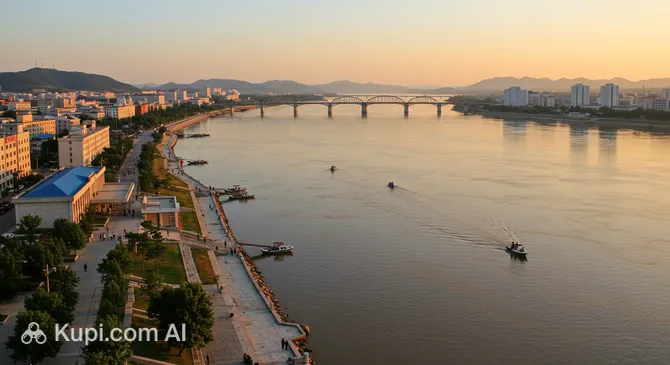
Sinuiju is more than just the administrative center of North Pyongan Province; it is the most important "gateway" to North Korea. Located on the banks of the Amnok (Yalu) River, the city is separated from the Chinese city of Dandong only by the river's waters and a bridge. This place possesses a unique atmosphere of a border hub, where the austerity of Korean architecture meets the brisk rhythm of international logistics.
Sinuiju. Illustration.
Source: Kupi.com AI
Geographically, the city sits almost at sea level, four kilometers from the river mouth. The population of Sinuiju is approximately 352,000 people. The region's rich heritage is closely tied to its strategic location, and in 2002, a Special Administrative Region was even established here for economic experiments.
Despite its industrial status, the city attracts visitors with its authenticity and the opportunity to see life in the DPRK from an unusual perspective. Visiting Sinuiju is a chance to touch the history and modernity of one of the world's most closed countries through the lens of its primary trade hub.
Weather Overview
The climate of Sinuiju is characterized as temperate continental. The weather in the city follows seasonal rhythms typical of the northern part of the Korean Peninsula: summers are warm and humid, while winters are cold and dry. The proximity of the Amnok River adds humidity to the air, which is especially noticeable during transitional periods.
In winter, especially in January, the temperature often drops to -11°C, and precipitation is minimal. Summer brings abundant rain, peaking in July and August, when the thermometer can rise to +28°C. If you are planning a trip, the best time is late spring or early autumn, when the most pleasant temperature for walking is established.
Average monthly temperature
Average monthly precipitation
Interesting Facts
Sinuiju is connected to China by the famous Sino-Korean Friendship Bridge, through which the majority of trade between the two countries passes.
In 2002, part of the city's territory was designated as a Special Administrative Region, where elements of a market economy were introduced as an experiment.
The "Liberation Monument" is located in the city center—a grand memorial dedicated to Soviet soldiers who fell during the liberation of Korea in 1945.
The city is situated at an elevation of only 1 meter above sea level, making it one of the lowest points in the region.
How to Get There
The primary way to enter Sinuiju is by crossing the border with China. Most travelers arrive here from the Chinese city of Dandong via the Sino-Korean Friendship Bridge. This transit route is considered the most predictable, although customs clearance times can vary. Detailed information on routes can be found in the section on how to get to the city.
Air service in the region is provided by Uiju Airport (IATA: UJU), located just 9 kilometers from the city. Despite its proximity, scheduled passenger flights here are limited, and the facility is more often used for special purposes or charter transport.
Railway services connect Sinuiju with Pyongyang. Trains cover the 220-kilometer distance in about 4–6 hours, offering passengers views of rural landscapes. Sinuiju Railway Station is a key point for international trains heading toward Beijing.
Since Sinuiju is primarily an industrial and transit hub, its attractions are closely linked to its history and border status. One of the most recognizable locations is the Bridge over the Amnok River (also known as the Yalu). Next to the functioning bridge is the "Broken Bridge," partially destroyed in the middle of the last century and now transformed into a historical monument offering a panorama of the opposite shore.
In the city itself, the Liberation Monument is well worth a visit. It is an important memorial dedicated to the Soviet soldiers who fell during the liberation of Korea. Among cultural sites, the Tonggun Pavilion stands out, representing traditional Korean architecture. Nature lovers may be interested in the picturesque waterfalls and hot springs located in the city's immediate surroundings.
For those who want to see the modern daily life of the city, a visit to the park on the banks of the Yalu River is a must. Here, locals spend their leisure time, and tourists can observe life on both sides of the border. The city also features the New Mart shopping center, which reflects the economic changes of recent years and is popular among local residents.
Local Cuisine
The gastronomy of Sinuiju relies on the classic traditions of the DPRK, where rice and fermented vegetables always take center stage. You must try the local cold noodles (naengmyeon)—this dish is considered the pride of the northern region. Various versions of Korean barbecue and hearty soups with spicy seasonings and the mandatory serving of kimchi are also popular.
In the city, you can find both state-run restaurants in the central part and small canteens. The food culture here is simple and satisfying, oriented toward locals and transit visitors. Regarding drinks, pay attention to the local beer, which is famous for its quality, as well as traditional Korean soju and various herbal teas.
Dishes made from fish hold a special place in the diet, given the city's proximity to the river mouth and the Yellow Sea. Despite the lack of a "haute cuisine" culture, the food in Sinuiju will delight fans of authentic flavors and natural products prepared according to ancient recipes.
Travel Tips
Visiting Sinuiju is a unique experience that requires some preparation. The following tips will help make your trip comfortable and avoid misunderstandings.
Clothing and Essentials: Choose clothing according to the season: light, breathable fabrics are useful in summer, while a reliable warm jacket is needed in winter as frosts can be severe. Comfortable shoes for walking along the embankment are essential.
Transport: Within the city, it is most convenient to move on foot or by taxi. Remember that for tourists, movement is usually carried out accompanied by a guide.
Finance: Bring cash with you (Euros, Yuan, or Dollars). International bank cards are not accepted in the city, and there are no ATMs for foreign cards.
Health and Safety: The city is very safe, but always carry a basic first-aid kit. If necessary, contact your guide to arrange medical assistance.
Communication: The primary language is Korean. English is not widely spoken, so the services of a guide-interpreter are mandatory for full communication.
Local Etiquette: Show respect for local traditions and monuments. Greet people with a slight bow—this is appreciated as a sign of politeness.
What to Avoid: Do not photograph military installations or people in uniform without permission. Also, avoid attempting independent (unauthorized) border crossings.
Photography: Always check with your escort which objects are permitted for filming to avoid problems at checkpoints.
By following these simple rules, you can fully enjoy the hospitality of the city and bring home only pleasant memories!
Entertainment & Nightlife
Entertainment in Sinuiju is understated and traditional. You won't find the night clubs or bars with loud music typical for Western tourists here. The city's evening life is centered around quiet walks in Yalu River Park, where you can enjoy the silence and the lights of neighboring Dandong reflecting in the waters of the Yalu River.
During the day, leisure activities can include visiting local markets or cinemas showing patriotic films and stage productions. For more active recreation, locals sometimes travel to border zones or Pyongyang, as the entertainment infrastructure in industrial Sinuiju itself is minimal.
Safety in the city is at a very high level, and walks in central areas accompanied by a guide are perfectly comfortable. If you need transport late at night, it is best to arrange it in advance through the hotel administration, as taxis are rarely found on the streets after sunset, and public life winds down quite early.
Parks & Museums
Despite its industrial appearance, Sinuiju offers several areas for outdoor relaxation. The main attraction is Yalu River Park. This green strip along the embankment is an ideal place for leisurely strolls, offering the best views of the border and river landscapes.
The city's cultural program includes visits to memorial complexes. Although Sinuiju does not have major world-class art galleries, the Liberation Monument and its adjacent squares serve as important historical sites. Here, you can learn more about the role of Soviet troops in the region's history and see examples of the country's monumental art.
The city's green zones are mainly concentrated in its central part and along the shoreline. For tourists, such places are primarily an opportunity to see the daily life of citizens in a calm environment, away from the noise of transit trucks and industrial plants.
Getting Around
Public transport in Sinuiju consists of buses and trolleybuses that connect residential neighborhoods with industrial zones and the railway station. The rolling stock often has a characteristic vintage look, which adds a special flavor to the trips. For moving around the central part of the city, walking is best, as the main administrative buildings and the embankment are located compactly.
Taxis are present in the city, but they are primarily oriented toward official delegations and transit passengers. Fares on public transport are paid in cash and are extremely affordable. Tourists are recommended to use organized transport or taxis ordered through the hosting party to avoid navigation difficulties.
The railway plays a key role in the life of Sinuiju, connecting it with Pyongyang and international destinations. Trains run on schedule, and this is the most reliable way to travel long distances. Traffic jams are virtually unknown in the city, making movement through the streets fast and predictable.
Accommodation
Accommodation options in Sinuiju are primarily geared toward transit travelers and business guests from neighboring China. Most hotels are located in the immediate vicinity of the border or the railway station. These are practical, mid-range hotels offering a basic set of amenities without excessive luxury.
For tourists, the choice of lodging is usually limited to a few state-run hotels that meet the country's accepted hospitality standards. Apartments or private sectors for short-term rent are not developed here, so bookings are always made in advance through official travel channels.
We recommend planning your stay well in advance, as the number of hotel rooms in the city is limited, especially during trade fairs. The price range is fixed, and the service is focused on providing a comfortable short-term stay for business travelers and tour groups.
Nearby Cities
Sinuiju serves as an excellent starting point for exploring the surrounding areas and getting to know the border region. Proximity to international transport routes and the railway allows travelers to expand the geography of their trip.
The most accessible destination is the Chinese city of Dandong, located just 12 kilometers away. It offers a bright contrast, featuring modern shopping centers and lively embankments. Also of interest is the city of Kusong, located about 68 kilometers to the east, which is known for its industrial enterprises. If you travel a bit further, you can visit Chongju—an important historical and agricultural center of the province.
Exploring the adjacent territories allows for a deeper understanding of the way of life in northern Korea and showcases a variety of landscapes: from the flat riverbanks to the hilly inland areas.
Shopping & Souvenirs
Shopping in Sinuiju is focused on border trade and meeting the daily needs of residents. The New Mart shopping center is considered the main place for purchases, offering a wide range of goods—from food to household appliances. Also of interest are the markets near the Yalu River, where goods from China can often be found, making the selection more diverse.
As souvenirs from Sinuiju, it is worth bringing back folk crafts: Korean embroidery, porcelain, or traditional dolls in national costumes. Local products such as ginseng, herbal blends, and high-quality Korean alcohol, which is considered a good gift, are also popular.
Shops and markets typically operate from morning until early evening. For payments, tourists are recommended to have cash currency on hand, as terminals for international cards do not function here. The shopping process in Sinuiju is not just about acquiring things, but also an opportunity to see the real economic interaction between neighboring countries.