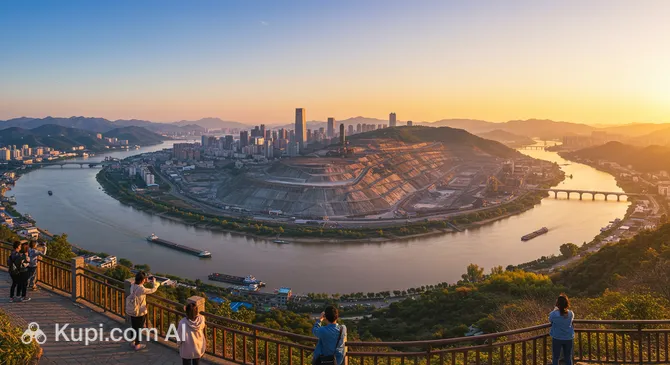
Located in Liaoning Province in northeast China, the industrial and historical hub of Fushun offers a fascinating blend of ancient traditions and industrial power. Stretching along the scenic Hun River, the city is often called the "Coal Capital" due to its rich deposits, the development of which has shaped its identity and economic significance for decades.
Founded back in 1384 as a military outpost of the Ming Dynasty, Fushun holds a deep historical heritage. With a population of over 2 million people, it is today a modern metropolis that remains an important link connecting the past of the Manchu dynasties with the technological future of the region. Geographically, the city is just 45 kilometers from Shenyang, making it accessible and attractive for travelers.
Fushun. Illustration.
Source: Kupi.com AI
The main symbols of the city include the ancient Gaoershan Pagoda, towering on a hill, and the futuristic "Ring of Life"—a giant steel monument that has become a new architectural wonder of China. A visit to Fushun is an opportunity to see the real, non-tourist China, where cozy parks and a rich cultural history are hidden behind the facades of industrial giants.
Weather Overview
Fushun is characterized by a moderate continental climate with distinct seasonality. Winters here are long, frosty, and predominantly dry; the average temperature in January drops to -10°C, while night minimums can reach -16°C. Summer, by contrast, is warm and humid, with peak temperatures in July when the air warms up to +25...+30°C.
Most precipitation falls during the summer months, especially in July and August, when the region is influenced by monsoons. The transitional periods—spring and autumn—are quite short, but they are considered the most comfortable for walking tours. When planning a visit, keep in mind that the weather in Fushun can be changeable, so layering your clothes is the best solution.
Average monthly temperature
Average monthly precipitation
Interesting Facts
Fushun is officially known as the "Coal Capital of China": coal was mined here by hand as early as 2,000 years ago, and industrial development of the deposits has been underway since 1902.
The city has a unique linear shape: due to geographical features, it stretches along the Hun River for almost 30 kilometers, while its width in some places does not exceed 4 kilometers.
In the early 17th century, Fushun was the capital of the first Manchu state, Later Jin, making it the cradle of the Qing Dynasty, China's last imperial dynasty.
The futuristic "Ring of Life" was built using 3,000 tons of stainless steel and is decorated with more than 12,000 LEDs for nighttime illumination.
The city's name translates to "to maintain peace on the border," recalling its original status as a military outpost during the Ming Dynasty.
How to Get There
Thanks to its location in the developed northeastern region, Fushun enjoys good transport accessibility. Despite the lack of its own civilian airport, travelers can easily reach the city through neighboring transport hubs. You can find all available routes and travel nuances on the how to get to Fushun page.
The nearest air harbor is Shenyang Taoxian International Airport (SHE), located about 45 kilometers away. Intercity buses, shuttles, and taxis run regularly from here to Fushun. A car trip usually takes about an hour, making this the most convenient way for those arriving from afar.
Railway communication is a key way to move around the region. Fushun Railway Station (FUS) is located almost in the city center and receives trains from Beijing, Shenyang, and other major cities in Liaoning Province. High-speed trains allow you to cover the distance from Shenyang in just 30-40 minutes, making Fushun a great option for a weekend trip.
One of the most recognizable and impressive landmarks of the city is the modern architectural wonder—the "Ring of Life". This giant ring-shaped skyscraper, 50 stories high, symbolizes harmony and endless progress. The structure looks especially spectacular in the evening when multi-level LED lighting is turned on, reflecting in the waters of the nearby lake.
For those who prefer historical monuments, the Gaoershan Pagoda is a must-see. Located on the hill of the same name, this ancient tower is not only an important cultural heritage site but also serves as an excellent observation deck. From the top of the hill, panoramic views of the Hun River and city blocks open up, allowing you to appreciate the scale and structure of Fushun.
The Fushun City Museum will help you dive into the region's past. Its halls house unique exhibits telling the story of Manchu rule, archaeological finds, and, of course, the history of the coal industry that gave the city its status. The museum's exhibition clearly demonstrates the transformation of a small outpost into a major industrial center.
The natural landscapes around the Hun River also deserve attention. The shoreline is designed for walking, where industrial landscapes harmoniously coexist with green areas. This is an ideal place for those who want to feel the rhythm of local life and take atmospheric photos at the intersection of nature and urbanism.
Local Cuisine
Fushun's culinary traditions are closely linked to the gastronomy of Liaoning Province and the characteristics of Northeast China. Local cuisine is famous for its hearty and aromatic dishes, which often use the gifts of the Hun River. Be sure to try the fried river fish and thick, rich soups that warm you up on cool evenings.
Among meat dishes, mutton and beef prepared in spicy or sweet-and-sour sauces are particularly popular. As elsewhere in northern China, people here love jiaozi (dumplings) with a wide variety of fillings and long wheat noodles. An interesting feature of the local food scene is the barbecue, often cooked over an open fire using charcoal, which gives the meat a unique smoky aroma.
The dining culture in Fushun is concentrated in the bustling street markets and small family restaurants in the Xinfu and Dongzhou districts. It is customary to wash down a meal with strong green tea or local varieties of light beer. The city's gastronomic atmosphere is devoid of pretension, offering tourists authentic flavors and generous portions that emphasize the hospitable nature of the region.
Travel Tips
Fushun is a hospitable but specific city, so a little preparation will make your trip much more pleasant and predictable.
Clothing and Season: The best time to visit is spring or autumn. Summer here can be humid and hot, and winter—harsh and windy (down to -20°C). Be sure to bring comfortable shoes for walking in parks and on hills.
Transport: Install the Didi app—it's the most reliable way to get around. English is not common among drivers, so have the names of your hotel and attractions in Chinese.
Finances: Cashless payments dominate in China. Link your card to Alipay or WeChat Pay in advance. International cards (Visa/Mastercard) are only accepted in large hotels; ATMs for cash withdrawals are available in district centers.
Communication: English is not widely spoken in Fushun. Download an offline translator (such as Baidu Translate or Google Translate with a data pack) and save your hotel card with the address in Chinese characters.
Connectivity: To access your usual social networks and services, you will need a VPN or a travel eSIM. You can buy a local SIM card at China Unicom or China Mobile offices by presenting your passport.
Etiquette: Chinese people value politeness. Avoid loud conversations in public transport and always give/receive business cards or money with both hands—it is a sign of respect.
What to Avoid: Do not engage in discussions on political topics and try not to photograph military sites or people in uniform without permission to avoid unnecessary attention from authorities.
Weather: Be sure to check the weather forecast in Fushun before you leave, as temperature fluctuations between day and night can be significant.
Following these simple rules will help you focus on exploring the city's unique atmosphere and get the most out of your trip!
Entertainment & Nightlife
Entertainment in Fushun is predominantly calm and cultural, reflecting the measured pace of life in Liaoning Province. The center of attraction for evening strolls is the Hun River embankment and the area around the "Ring of Life" skyscraper. Here you can enjoy an impressive light show and see how modern buildings are transformed by decorative illumination.
Although Fushun does not claim the status of a nightlife capital, in the central districts of Xinfu and Dongzhou, you can find cozy bars and karaoke clubs (KTV), which are very popular with locals. These venues have a relaxed atmosphere, and the crowd mostly consists of young people and office workers relaxing after a day's work. Prices here are significantly lower than in Shanghai or Beijing, and for calling a taxi at night, it is best to use the Didi app.
Daytime leisure is often associated with visiting parks and observation decks. For families, the surrounding hills where locals have picnics or the City Museum, which offers educational tours, are excellent choices. For active holiday enthusiasts, a walk to the Gaoershan Pagoda will be a pleasant physical activity rewarded with magnificent views of the sunset over the city.
Parks & Museums
The city's main cultural treasure is the Fushun City Museum. This is a place where history comes alive in exhibits dedicated not only to ancient archaeological finds but also to the industrial feat of the region. The museum tells in detail about the development of coal mines, which at one time were the largest in Asia, and offers a look at the life of Manchu rulers.
For outdoor recreation, the area around the Gaoershan Pagoda is ideal. It is not just a historical site, but a full-fledged park area with green alleys and shady paths. Climbing to the pagoda through the park allows you to enjoy silence and fresh air, while numerous benches along the way invite you to relax, admiring the panorama of the city and the curves of the river.
The banks of the Hun River have also been turned into extensive park areas, which are especially popular in the warm season. Embankments have been built in the Xinfu and Dongzhou districts, where locals practice gymnastics or take evening strolls. These natural oases amidst the industrial landscape create a necessary balance and offer tourists places for quiet contemplation and photos against the backdrop of the city's modern symbol—the "Ring of Life."
Getting Around
Fushun's transport system is represented by an extensive network of buses and trolleybuses, which are the main way of getting around for locals. Routes cover all key areas, from industrial outskirts to central blocks. Despite the absence of a subway system, the bus service operates quite efficiently, and intervals during peak hours are minimal.
For fare payment, it is most convenient to use mobile applications or transport cards, but you can also pay in cash on buses (usually the exact change is required). The fare is very low, making public transport an extremely budget-friendly option. Operating hours for most routes are from early morning until 21:00–22:00.
Tourists are advised to actively use taxis or the Didi service (the Chinese equivalent of Uber). Trips around the city are inexpensive, and cars are dispatched quickly. In the warm season, electric bikes and scooters, which can be rented via apps, are popular. The city's railway stations are well integrated into the urban transport network, making it easy to reach the desired platform from anywhere in the center.
Accommodation
Accommodation options in Fushun are primarily geared toward business travelers and domestic tourists, which guarantees an excellent price-quality ratio. Most hotels are concentrated in central districts such as Xinfu and Dongzhou. Here you can find both modern four-star hotels and comfortable apartments for long-term stays.
For those who prefer proven options, popular Chinese hotel chains such as Hanting and Jinjiang Inn are widely represented in the city. These hotels offer a standard set of services and clean rooms at very affordable prices. If you want to enjoy beautiful views, you should look at establishments located along the Hun River embankment.
It is recommended to book accommodation in advance, especially if your trip coincides with Chinese public holidays. For searching and booking, it is best to use the Trip.com platform, as international services may offer a limited choice. The price range in Fushun remains very attractive, allowing you to find a decent option even on a modest budget.
Nearby Cities
Fushun is an excellent base for exploring the sights of Liaoning Province, as several large and interesting cities are within an hour's drive. Proximity to transport arteries makes it easy to plan short trips, returning to the hotel by evening.
The most obvious destination for a trip would be Shenyang, located just 44 kilometers away. This is a huge metropolis with a rich history, where you can visit the Mukden Imperial Palace, reminiscent of the Forbidden City in Beijing. It is also worth paying attention to the city of Tieling, famous for its natural landscapes, and Benxi, famous for its unique water caves.
Exploring the surroundings of Fushun will allow you to see the diversity of Northeast China—from ultra-modern neighborhoods to protected natural corners. A developed network of bus and rail links makes such travel simple and comfortable for any tourist.
Shopping & Souvenirs
Shopping in Fushun is primarily an opportunity to purchase unique souvenirs related to the history and resources of the region. The most original gift would be coal products and decorative crafts reflecting the city's status as the coal capital. Reproductions of items from the Manchu Dynasty era and traditional Chinese goods: tea, silk, and jade products are also popular.
The main shopping areas are concentrated in the central districts of Xinfu and Dongzhou. Both large shopping centers with familiar clothing and electronics brands and traditional markets where you can find everything—from fresh local nuts to household items—are located here. Fushun's markets allow you to feel the local flavor and bargain with sellers, which is an integral part of Chinese shopping.
Shops usually operate from 9:00 to 20:00 or 21:00. Large shopping complexes accept bank cards, but for small purchases and payments at markets, it is highly recommended to use mobile payment systems Alipay or WeChat Pay, as cash is accepted less and less often. Keep in mind that Tax-Free systems are practically non-existent in small Chinese cities, so you should not count on a tax refund.