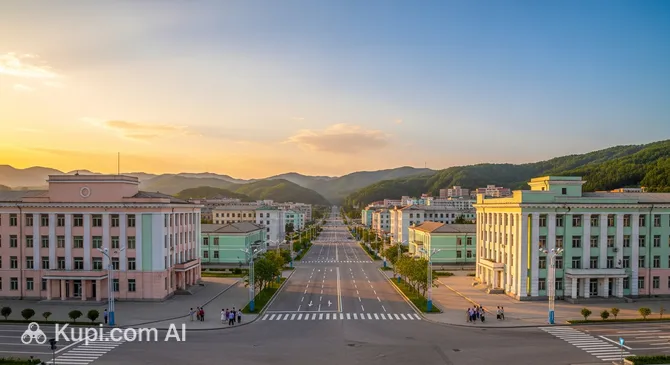
Located in the heart of South Pyongan Province, Kaechon is a fascinating blend of rugged industrial aesthetics and pristine nature. This city in North Korea is nestled among the majestic Myohyangsan and Changangsan mountain ranges, which gives it a particularly monumental appearance. With a population of over 319,000, it serves as a major industrial and agricultural hub while retaining a unique provincial charm.
Kaechon. Illustration.
Source: Kupi.com AI
The city's character is largely defined by its geography: about 61% of the territory is covered by dense forests, and the Chongchon and Taedong rivers flow through its lands. Studying the historical path of Kaechon offers a better understanding of how the region evolved from a mountain settlement into a significant center for production and resource extraction.
For the traveler seeking authenticity, Kaechon is primarily interesting for its natural wealth and ancient monuments, such as the pagoda of the Taeryipsa Temple or its mysterious caves. Despite its industrial status, the city maintains a calm atmosphere and invites visitors to experience provincial Korean life surrounded by picturesque valleys and forested peaks.
Weather Overview
The climate in Kaechon is distinctly continental, typical for the central mountain regions of the country. Winters here are severe and dry, with the average air temperature in January dropping to -6.6°C, while nighttime frosts can reach -12°C or lower. Summer, on the other hand, is quite warm and humid: in August, the thermometer averages around 24.4°C, often rising to +30°C.
An important feature of the local weather is the rainy season, which occurs in July and August—this period accounts for most of the annual precipitation. If you are planning a visit, it is useful to check in advance what weather in Kaechon is expected in the near future to choose your wardrobe correctly. Thanks to the abundance of forests, the air in the city feels fresher than in lowland industrial centers, although thick fogs are common in the Taedong and Chongchon river valleys in the mornings.
Average monthly temperature
Average monthly precipitation
Interesting Facts
Kaechon is a city where industry is closely intertwined with rugged northern nature. Here are some interesting facts about the region:
Forest Land: Over 61% of the city's territory is covered by dense forests, making it one of the greenest industrial centers in the region.
Mountain Peaks: The city is surrounded by four major ranges—Myohyangsan, Changangsan, Chonsonsan, and Chonryonsan—and its highest point is the picturesque Paektabsan Peak.
River Borders: Kaechon is crossed by two of the country's most important waterways—the Chongchon and Taedong rivers—which form the city's natural landscape boundaries.
Ancient Stones: Unique monuments of the megalithic era—dolmens—have been preserved in the city's outskirts, including a group of burials on Mount Mukpansan.
Man-made Sea: Nearby Lake Yonphung was created in 1956 and has since been a vital source of water for agriculture and a favorite vacation spot.
How to Get There
The accessibility of Kaechon largely relies on the country's developed railway network. The city is a major junction on the line connecting Pyongyang and Chongjin, making the train the most reliable and popular way to travel. The journey from the capital by train usually takes about 3–4 hours, allowing you to enjoy views of mountain ranges and river valleys along the way.
If you are planning a trip, it's worth researching all available route options to Kaechon in advance. Road links are also established: regular buses connect the city with other settlements in South Pyongan Province. However, keep in mind that due to the mountainous terrain, travel time by car or bus from Pyongyang can take up to 5 hours.
The Kaechon Railway Station receives regular trains and serves as the city's main gateway. The station building is designed in a classic functional style and is conveniently located for reaching the central districts quickly. There is no direct air service to the city, so the closest arrival point by air remains Pyongyang International Airport, which requires a ground transfer.
Station
Passenger traffic
Distance
Sinanju Chongnyon Station
6
27 km
Taegyo Station
5
31 km
Unjon Station
5
32 km
Sunchon Station
5
32 km
Pyongsong Station
6
51 km
Main Attractions
While Kaechon is not a typical tourist hub, it hides several unique sites in its surroundings that are well worth a visit. One of the region's main natural gems is Songam Cave—an underground kingdom of stalactites and stalagmites in bizarre shapes that astounds with its silence and grandeur. Equally interesting is Yongwon Cave, recognized as a natural monument, where researchers and rare guests can touch the secrets of the region's geological past.
For history buffs, the Taeryipsa Temple is a must-see. Its main pride is an elegant nine-story stone pagoda, a testament to the high skill of ancient builders. Fans of fortification art will find it interesting to explore the remains of the Changhamsong, Toson, and Kosasansong fortresses, which once served as important defensive lines in the mountain valleys.
You can conclude your sightseeing at Lake Yonphung. This man-made reservoir, created in the mid-1950s, now blends harmoniously into the landscape and is a popular spot for walks by the water. In the vicinity, you can also find ancient dolmens, such as those in Namsa, which add a touch of mystery and deep antiquity to this industrial area.
Local Cuisine
The gastronomic face of Kaechon is firmly rooted in the traditions of North Korean cuisine, where seasonal products and local natural gifts play the leading role. The local diet is based on rice, rich broths, and the famous kimchi, which is prepared here with special care. Thanks to the proximity of the Chongchon and Taedong rivers, fresh river fish dishes—steamed or baked with hot spices—frequently appear on the local menu.
A feature of the cuisine in this mountainous region is the active use of forest mushrooms and medicinal herbs gathered from the slopes of the surrounding ranges. These ingredients give everyday dishes a unique aroma and health benefits. As for drinks, it's worth trying the local barley tea or traditional rice wine, which is often served at the festive table.
The dining culture in the city is centered around departmental canteens and small, cozy eateries where workers from local enterprises have lunch. For tourists, meals are usually organized in specialized halls at hotels or in state restaurants where classic Korean sets can be ordered. The simplicity of the ingredients and loyalty to ancient recipes make the local food truly honest and memorable.
Travel Tips
A trip to Kaechon will be a unique experience of getting to know the industrial heart of Korea, and these tips will help make your journey as comfortable as possible.
Clothing and Gear: Given the mountainous landscape and forested terrain, be sure to bring comfortable shoes with a stiff sole for walks to the caves. The climate here is continental, so even in summer it can be cool in the evenings—a light windbreaker will not be out of place.
Transport: It is best to plan movement around the city and its surroundings as part of organized groups. Independent trips on public transport can be difficult due to the language barrier and specific schedules.
Finances: Cash is used in the city. It is recommended to have small bills with you. International bank cards are not accepted in local shops, and there are no ATMs for foreign tourists.
Health and Safety: The street crime rate is extremely low, so walking along the main streets is safe. However, when hiking in mountain areas and caves, always follow the instructions of your guide and do not stray from the established trails.
Communication: The primary language is Korean. English is not widely spoken, so it is useful to learn a few basic phrases for greeting and gratitude. Wi-Fi is virtually non-existent in the city, and mobile communication for tourists is limited.
Local Etiquette: When visiting monuments and memorials, maintain a reserved and respectful tone. Politeness and punctuality are highly valued here.
What to Avoid: Do not photograph industrial facilities or official zones without explicit permission from your guide. This will help avoid unnecessary questions and misunderstandings.
Additional Tip: Be sure to visit local markets to see the real life of the city, but always ask permission before taking photos of people at work.
Observing these simple rules will allow you to enjoy the hospitality of Kaechon and discover this amazing region from its best side.
Entertainment & Nightlife
The entertainment scene in Kaechon reflects its status as an industrial city where life moves at a measured and functional pace. There are no nightclubs or noisy bars in the traditional sense, as social life is centered around labor collectives and family recreation. The main leisure activities for locals include walking in the picturesque surroundings, relaxing on the banks of the Chongchon and Taedong rivers, or visiting city parks.
During the day, trips to natural sites like the shores of Lake Yonphung or excursions to caves are popular. The city's cultural life is represented by local community centers and cinemas showing domestic films and hosting ceremonial events. The atmosphere in these establishments is very calm and regulated, allowing visitors to fully immerse themselves in the local way of life without unnecessary bustle.
For more active entertainment and vibrant cultural events, locals and occasional tourists usually head to Pyongyang, which is a few hours' drive away. In Kaechon itself, safety is at a high level, and evening walks along the main streets are pleasant due to the abundance of greenery and clean mountain air, though it's worth noting that city life settles down quite early.
Parks & Museums
The park infrastructure of Kaechon is inextricably linked to the surrounding natural landscape. The city is literally submerged in greenery, as forests cover most of its territory. Instead of classic manicured gardens, forested recreation areas in the foothills predominate, where locals enjoy spending time in the quiet, clean air. Walking trails along the Chongchon and Taedong rivers take the place of city embankments, offering natural routes for hiking.
The surroundings of Lake Yonphung and the areas around Songam and Yongwon caves are of particular importance as natural parks. These locations are developed for visitors and allow one to appreciate the beauty of North Korean nature. The city's museum component is represented by small exhibitions at enterprises and schools dedicated to the history of industrial development and local achievements, though there are few specialized art galleries.
For tourists, open-air archaeological monuments are of primary interest. Groups of ancient dolmens and the ruins of fortresses, such as Kosasansong, serve as unique open-air history museums. This combination of natural grandeur and traces of ancient history creates an atmosphere in Kaechon that encourages thoughtful and quiet contemplation.
Getting Around
The public transport system in Kaechon is oriented towards meeting the needs of a large industrial center. The main means of transportation within the city are buses, with routes connecting residential quarters with industrial zones and the railway station. During rush hours, when factory shifts begin or end, transport can be quite crowded, creating the characteristic rhythm of a working city.
The railway plays a key role not only for external connections but also for moving between nearby districts. Commuter trains are often used by workers to travel to neighboring cities in the province. For tourists, movement around the city is most often organized by special vehicles or taxis, which can be ordered through the hotel.
Fares on public transport are paid in cash or with special coupons. Despite the availability of buses, the central part of Kaechon is compact enough to explore the main streets and monuments on foot. Private cars are rare here, so road traffic is calm, and the air remains relatively clean despite the region's industrial status.
Accommodation
The choice of accommodation in Kaechon is quite specific and differs significantly from typical tourist destinations. There are virtually no classic international-level hotels; the main housing stock consists of state-owned hotels and guesthouses primarily aimed at specialists arriving for industrial business and official delegations.
Most available accommodation options are concentrated in the city center or near the railway station, which is convenient for logistics. Living conditions are usually simple and functional, without luxuries, but maintaining necessary standards of cleanliness and order. Since the city is not a mass tourist destination, booking accommodation is most often done through specialized agencies or the host party as part of an organized tour.
Those planning a visit are advised to coordinate their accommodation in advance, as there is no open apartment rental market in the city. The price range is usually fixed, and payment is made in cash according to the rules for foreign citizens. Despite the modest choice, the hospitality of the staff and the authentic atmosphere allow guests to feel the rhythm of life in a real Korean industrial center.
Nearby Cities
Kaechon enjoys a favorable position in South Pyongan Province, making it an excellent starting point for exploring neighboring industrial and cultural centers. The city's surroundings offer travelers the chance to see the diverse life of the country's northern region, from large industrial giants to quiet agricultural valleys.
Just 22 kilometers away is the city of Anju, known for its historical monuments and important transport significance. Another interesting destination for a trip is Sunchon, located about 30 kilometers away, which impresses with its scale. Also within reach is Pyongsong—a city famous for its scientific institutions and modern neighborhoods.
Exploring these cities provides a better understanding of the structure and rhythm of life in the central part of the country. Regular rail and bus services are established between these settlements, making day trips quite comfortable for those who want to broaden their horizons and see Korea beyond a single city.
Shopping & Souvenirs
Shopping in Kaechon is primarily about getting to know the daily lives of local residents and the products of local enterprises. You won't find large shopping centers with global brands here, but the city offers an authentic experience visiting state department stores and cooperative shops. Trade is concentrated on the streets in the city center, where you can find basic necessities, clothing, and household items produced locally.
Special attention should be paid to the local markets. These are lively and colorful places where you can see the fruits of Korean farmers' labor: fresh vegetables, mountain herbs, and roots that are highly valued in traditional medicine. Markets operate mainly in the morning and afternoon hours, and payment is accepted in cash in the local currency.
Common souvenirs from Kaechon include folk crafts, high-quality mountain teas, or products from local textile factories. Sometimes, decorative items made from stone mined in the nearby mountains are available for sale. Although shopping opportunities may seem limited, buying simple and high-quality local goods will be a pleasant reminder of your visit to this industrial region.