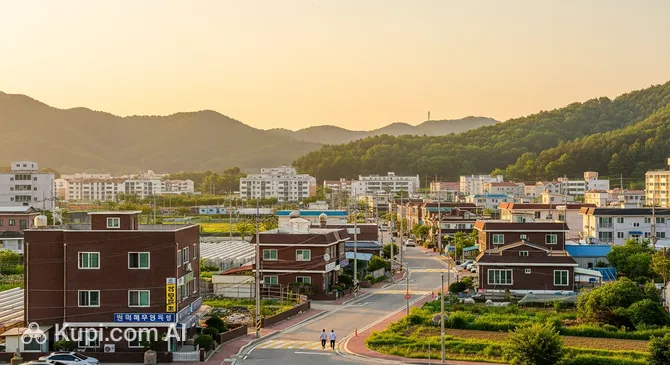
Yangok is a cozy and peaceful corner located in Gyeonggi Province, South Korea. The city is a typical suburban area where modern residential development harmoniously coexists with elements of traditional rural life. This place is ideal for those who want to see the daily life of Koreans away from the hustle and bustle of huge metropolises.
Yanggok. Illustration.
Source: Kupi.com AI
Geographically, Yangok is situated in a strategically convenient location, providing easy access to the capital and other important centers in the region. Although official population data may vary, the city maintains an intimate and peaceful atmosphere. If you are interested in the modern historical heritage of provincial Korea, a walk through the local neighborhoods will allow you to feel the local flavor more deeply.
Key features of Yangok include its quiet park areas and developed local infrastructure focused on comfortable living. The city often serves as a transit point for travelers heading to Seoul; however, it deserves attention as an example of an environmentally clean and safe area with high air quality. We invite you to visit Yangok to enjoy its leisurely pace and authentic Korean hospitality.
Weather Overview
The climate in Yangok is of a moderate monsoon character with four distinct seasons, typical for Gyeonggi Province. Summers in the city are hot and humid: in July and August, the average temperature stays around +26°C, often reaching +30°C. Most of the precipitation falls during this period, so tourists should be prepared for frequent rain.
Winter, on the other hand, features dry and frosty weather. In January, the average temperature drops to -2°C, and night frosts down to -6°C are possible. Spring and autumn in Yangok are considered the most comfortable seasons to visit: the weather becomes mild, and the air is clean and clear. To better plan your wardrobe, we recommend checking more detailed information about the weather in Yangok by month.
Special attention should be paid to air quality, which is considered very favorable in this area compared to major cities. However, the "yellow dust" phenomenon sometimes occurs in spring, when desert winds increase the concentration of suspended particles in the air. For the rest of the year, moderate greenery and the terrain help maintain fresh and comfortable conditions for walking.
Average monthly temperature
Average monthly precipitation
Interesting Facts
Environmental advantage: Air quality in Yangok is significantly better than the global average—the AQI index here is 2.2 times lower, making it one of the cleanest areas in the vicinity of the capital.
Coordinate mystery: In various geographical references, data on the city's location sometimes differs, which can cause confusion for travelers seeking this quiet suburb.
Unique density: Despite its proximity to densely populated Seoul, the population density in some parts of the district is only about 30 people per square kilometer, creating a sense of spaciousness.
Connection to Gyeonggi: The city is officially part of the country's most populous province, which rings the capital, providing Yangok with excellent transport connectivity.
How to Get There
The transport accessibility of Yangok makes it a convenient point to visit during a trip through Gyeonggi Province. The country's main transport hubs provide stable connections to this area, allowing tourists to easily plan their route. Detailed information about routes and tickets can be found in the section on how to get to Yangok.
The nearest major air hub is Incheon International Airport (ICN), located approximately 60–90 kilometers away. From the airport, it is most convenient to use the AREX express trains, which will take you to one of the transfer stations in Gyeonggi-do, from where you can continue your journey to Yangok by bus or taxi. On average, the trip from the airport takes about one and a half to two hours depending on the traffic situation.
Rail links also play an important role. You can use KTX trains or the metropolitan subway to reach a station in Namyangju and then transfer to local transport. By car, the journey from Seoul via expressways such as the Gyeongbu Expressway takes just over an hour, though you should allow extra time during peak hours due to potential congestion.
Station
Passenger traffic
Distance
Gyeyang Station
13
14 km
Incheon Station
13
20 km
Bupyeong Station
15
21 km
Bugae Station
14
21 km
Dohwa Station
13
22 km
Main Attractions
Yangok is primarily a residential and suburban area, so you won't find grand historical palaces or world-famous monuments here. However, the city attracts tourists with its authentic atmosphere of the "real" Korea. A walk through the local residential neighborhoods allows you to see the everyday life of Gyeonggi Province residents, which is often hidden from the eyes of visitors in major metropolises.
One of the city's interesting features is its local markets. Here, you can not only buy fresh produce but also try traditional street food prepared using home recipes. These markets serve as centers of social life, where there is always a bustle and you can feel the hospitable spirit of the local community.
For those seeking larger cultural sites, Yangok serves as a convenient base for trips to neighboring Namyangju or Seoul. Within the city itself, it's worth spending time visiting small temples and cozy squares scattered among modern buildings. These quiet spots are perfect for a short rest and observing the leisurely rhythm of provincial life.
Local Cuisine
The culinary scene in Yangok offers a classic Korean experience aimed primarily at locals. You won't find Michelin-starred restaurants here, but you can enjoy truly home-cooked meals in cozy establishments called ippongi. These are traditional taverns serving simple and hearty dishes at very affordable prices—a full meal will cost around 5,000–10,000 won.
Be sure to try traditional bibimbap with fresh seasonal vegetables, which are often sourced from nearby farms in Gyeonggi Province. In street stalls and small cafes, tteokbokki (spicy rice cakes) and the famous Korean fried chicken, which locals love to order with cold beer in the "chimaek" format, are popular. You will also always find several types of kimchi and rich ramen-based soups on the menu of any establishment.
As for drinks, soju and local beer from popular brands lead the way in Yangok, as in the rest of Korea. During the day, residents prefer green tea or various coffee drinks, which can be bought at almost every turn. The general character of the local cuisine can be described as honest and traditional, without unnecessary frills but maintaining high-quality ingredients and authentic taste.
Travel Tips
Planning a visit to Yangok? These practical tips will help you feel confident and make the most of your trip to this quiet corner of South Korea.
Clothing and Gear: The climate here has four seasons. In summer, bring light clothes made of natural fabrics; in winter, a warm jacket, as temperatures can drop below zero. Be sure to wear comfortable shoes for walking. In spring, protective masks may come in handy due to seasonal dust.
Transport: Be sure to buy a T-money card to pay for buses and the subway. To plan routes, it's best to use the Naver Maps or KakaoMaps apps, as Google Maps does not always work correctly in Korea.
Finances: The official currency is the South Korean won (KRW). Cards are accepted almost everywhere, but it's better to have cash on hand for small shops and markets in Yangok. There is no tipping culture in Korea, so you don't need to leave them in restaurants.
Connectivity: There are many free Wi-Fi zones in the city, but for navigation, it's better to purchase a local SIM card or rent a portable router. To communicate with locals, install the Papago translation app—it handles the Korean language excellently.
Safety: Yangok is a very safe area even after dark. Pharmacies can be found near shopping areas; they are marked with the symbol "약" (Yak).
Local Etiquette: Greet people with a slight bow. It is customary to hand money or items to elders with two hands—this is a sign of special respect.
What to Avoid: Try not to speak loudly on public transport, especially during peak hours. Also, avoid traveling to and from Seoul from 7 to 9 AM and 5 to 7 PM due to extreme crowding.
Extra Tip: Check out local bakeries—Korean pastries often have unusual flavor combinations that will pleasantly surprise you.
We wish you a pleasant and fulfilling stay! May your introduction to Yangok leave only the warmest memories.
Entertainment & Nightlife
Entertainment in Yangok is of a quiet, family nature, as the city is primarily a residential area. Here you won't encounter loud nightclubs or large-scale concert venues, but you can enjoy the silence and safety of evening walks. Modern PC bangs (internet cafes), where virtual life is in full swing, and small cozy coffee shops often become hubs for local youth.
If you are looking for classic nightlife with bars and karaoke, locals usually head to neighboring Namyangju or Seoul, which is a 30 to 60-minute journey. Major entertainment venues, pubs, and cinemas are concentrated there. In Yangok itself, popular evening leisure activities remain visits to noraebangs (karaoke rooms), which can be found near the central shopping areas.
During the day, recreation in the city is focused on local parks and shopping centers. Well-maintained green zones are excellent for family walks, and sports grounds are available in the district for active recreation enthusiasts. Overall, the atmosphere in Yangok is conducive to a relaxed holiday and recovery after busy trips to Korea's major cities.
Parks & Museums
Yangok is a place for those who value peace and simple walks in the fresh air. While there are no large state museums or world-famous galleries in the city itself, its green zones create a pleasant environment for relaxation. Local parks are cozy squares within residential areas where you can see how Korean families spend their time or simply enjoy well-kept alleys and traditional landscaping.
Special attention should be paid to the landscape design of courtyards and small plazas: Koreans are very passionate about plants, so even in small Yangok, you will find neatly trimmed trees and seasonal flowers. The level of improvement here allows for comfortable walking at any time of year, and the area's good ecology makes such walks not only pleasant but also beneficial.
For those longing for deep immersion in culture and art, the best solution would be trips to neighboring cities. The nearest major cultural centers and parks are located in Namyangju, where you can find themed museums and extensive nature reserves. Nevertheless, Yangok remains a fine example of how a modern Korean suburb maintains a balance between urbanization and care for the natural world.
Getting Around
The public transport system in Yangok allows residents and visitors to stay mobile and easily reach key points in Gyeonggi Province. The backbone of movement is the bus network: the district operates both local routes connecting different parts of Yangok and suburban expresses to Seoul and Namyangju. Buses run regularly, usually every 15–30 minutes, but it's worth noting that they can be crowded during morning and evening peak hours.
For paying fares, it is most convenient to use a T-money unified transport card. It can be purchased and topped up at any 24-hour convenience store (such as 7-Eleven or CU). The fare is fixed, but a discount applies when transferring from one bus to another or to the subway within a certain time, making travel very economical. Don't forget to tap your card against the validator not only when entering but also when exiting the vehicle.
As an alternative to public transport, you can always use a taxi. In Yangok, it is available and relatively inexpensive; the Kakao T app is convenient for calling a car. For short distances within the district, many prefer bicycles or walking, as the network of paths is gradually developing. However, due to possible traffic jams at exits toward the capital, suburban trains remain the most reliable way to plan longer trips.
Accommodation
The choice of accommodation in Yangok is specific to a suburban area of Korea. There are practically no large chain hotels aimed at foreign tourists, but local motels, often referred to as "love hotels," are widely represented. These are quite affordable and comfortable options for a short stay, offering a basic set of amenities at a reasonable price—averaging from 30,000 to 50,000 won per night.
For those planning to stay in the city for a long period, such as expats or students, goshiwons or small rental apartments are popular choices. Most such properties are concentrated near major transport hubs and stations, which significantly simplifies travel around the region. This allows guests of the city to remain mobile and easily reach Seoul.
If you are planning a trip during national Korean holidays such as Chuseok or Seollal, it is recommended to book accommodation in advance through popular online services. For the rest of the year, vacancies in local motels are usually available without prior preparation. For maximum comfort and a wider selection of high-class hotels, travelers sometimes prefer to stay in neighboring Namyangju, using Yangok for day trips.
Nearby Cities
Yangok serves as an excellent starting point for exploring the surroundings, allowing travelers to reach major cultural and economic centers of the region in a short time. Thanks to the developed transport network, you can easily plan day trips to diversify your vacation and see more interesting places.
Just a few kilometers away is the city of Gimpo, known for its historical monuments and proximity to a major airport. Another attractive destination is Goyang, where large-scale exhibition centers and beautiful parks are located. It is also worth paying attention to Paju—a city famous for its "Book City" and unique atmosphere near the border zone.
The region around Yangok is rich in attractions: from modern shopping giants to quiet nature reserves. We recommend not limiting yourself to just one area and venturing out to explore neighboring cities, each of which has its own unique character and history.
Shopping & Souvenirs
Shopping in Yangok is focused on the daily needs of residents, making it a great place to buy authentic Korean goods without tourist markups. Most commercial activity is concentrated along the main roads, where small shops, pharmacies, and fresh produce stalls are located. Here you can find high-quality Korean cosmetics, which are very popular among visitors to the country.
For more large-scale shopping, locals usually head to neighboring major centers like E-Mart or Lotte Mart in Namyangju. These hypermarkets offer a huge selection—from electronics to clothing and traditional souvenirs. On the way to Seoul, you can also find modern outlets and shopping complexes where sales of branded items are frequently held.
If you want to bring back something unique, look at the local food markets. It's worth buying farm-made kimchi, dried seafood, or traditional sweets. Shops in Yangok typically operate from early morning until late evening, and cards from international systems are accepted almost everywhere, although a little cash won may be useful in the smallest shops.