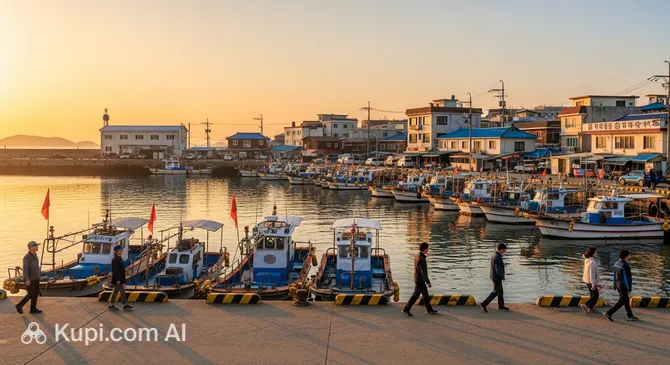
Hwasu-dong is a colorful residential neighborhood located in the northwestern part of South Korea. As part of the large metropolis of Incheon, this district represents the quintessence of Korean urban life, where dense modern development coexists with a traditional way of life. Although it is primarily a residential area, it attracts travelers with its authentic atmosphere, far from standard tourist routes.
Hwasu-dong. Illustration.
Source: Kupi.com AI
Geographically, the district covers a small area but is characterized by an incredibly high population density, which creates a unique rhythm of life. The history of Hwasu-dong is inextricably linked with the development of Incheon as a strategic port, and the district itself is administratively divided into two parts, reflecting the stages of its gradual expansion and modernization.
The main point of attraction here is the local traditional market, where you can see the daily life of citizens without any filters. Hwasu-dong is ideal for those who want to study the ethnographic features of a Korean suburb and feel the real pulse of the metropolis. We invite you to take a look at this corner of Korea to see the country through the eyes of its residents.
Weather Overview
The climate in Hwasu-dong is typical for the northwestern part of the peninsula and is characterized by distinct seasonality. Summers here are hot and humid—in July and August, the average temperature reaches +26°C...+28°C, and the bulk of the precipitation falls during this period due to the East Asian monsoons. Winters, conversely, are cold and dry, with temperatures often dropping below freezing in January.
The most favorable time to visit is spring (April-May) and autumn (September-October). During these months, comfortable temperatures of around +15...+22°C are established, and nature delights with bright colors: spring blossoms or autumn crimsons. Detailed weather in Hwasu-dong will help you choose the ideal dates for your trip.
The proximity of the Yellow Sea somewhat softens sharp temperature fluctuations; however, the high building density of the district can create a "heat island" effect in the summer months. Travelers should keep in mind that air humidity in the summer can be quite high, so light clothing made from natural fabrics will be most appropriate.
Average monthly temperature
Average monthly precipitation
Interesting Facts
Incredible Density: Hwasu-dong is one of the most densely populated places in Incheon—there are more than 13,000 people per square kilometer here, which is nearly 20 times higher than the global average for cities.
Administrative Duo: The district is officially divided into two parts—Hwasu 1-dong and Hwasu 2-dong, each with its own management and planning characteristics.
Traditional Center: The local Hwasu-dong Traditional Market is not just a marketplace, but a historical center of commercial activity that has supplied residents with everything they need for decades.
Time Zone: Hwasu-dong, like the rest of the country, operates on Korean Standard Time (KST, UTC+9), which is important to consider when planning calls and travel.
Strategic Neighborhood: The district is part of Incheon—the country's third-largest metropolis and the republic's main seaport.
How to Get There
Thanks to its location within a major metropolis, Hwasu-dong boasts excellent transport accessibility. The district is located in Dong-gu and is integrated into an extensive public transport network. Current information on how to get to Hwasu-dong will help you learn more details and plan your route.
Travelers arriving from abroad most often use Incheon International Airport (ICN)—the country's main air gateway, located in close proximity to the district. This makes Hwasu-dong a convenient place for a first stop after a long flight.
From Seoul, the most convenient way to reach the district is by subway (Line 1) or by express bus. Travel time is usually around 45–60 minutes. If you prefer a car, the trip from the capital's center will take about 30–40 minutes, though you should allow for extra time during peak hours due to heavy traffic on the highways.
Station
Passenger traffic
Distance
Incheon Station
13
2 km
Dohwa Station
13
4 km
Bupyeong Station
15
8 km
Bugae Station
14
10 km
Songnae Station
13
11 km
Main Attractions
Hwasu-dong is primarily a residential area, so you won't find pompous palaces or huge monuments here. However, the main local attraction and the heart of social life is the Hwasu-dong Traditional Market. This is a place where time seems to slow down: here you can watch the bustling trade, see stalls with the freshest seafood, and feel the true spirit of old Korea.
For those who appreciate urban aesthetics, the district is interesting for its architectural layering. Walking through its streets, you can notice how typical Korean high-rises give way to cozy, low-rise buildings. It is an excellent location for photographers looking for "unpolished" shots of Korean life and interesting details of everyday infrastructure.
Since the district is compact, many tourists use it as a starting point to explore larger Incheon landmarks. Nearby port areas and modern entertainment complexes complement the impression of the quiet and measured life of Hwasu-dong itself. A visit to this district provides a rare opportunity to see the genuine life of an ordinary Korean suburb.
Local Cuisine
The gastronomic scene of Hwasu-dong is a celebration of authenticity. You won't find Michelin-starred restaurants here, but on every corner, there are establishments where they cook "just like home." The main place for foodies remains the local traditional market. Be sure to try bibimbap—a bowl of rice with vegetables, meat, and spicy sauce, as well as hearty soups like tteok-guk or doenjang-jjigae.
Thanks to the proximity to the sea, the menus of local restaurants always feature the freshest seafood. Various fried dishes and banchan side dishes, which are served free with every meal, are particularly popular. Street food is a chapter of its own: here you can snack on spicy tteokbokki rice cakes or hot Korean jeon pancakes with various fillings.
The dining culture in the area is very democratic. Local residents often eat in small "sikdang" eateries, where portions are huge and prices are pleasantly surprising. Among beverages, you should try traditional rice water or local beer, which perfectly complements spicy Korean dishes. Hwasu-dong offers an honest and delicious gastronomic experience without unnecessary pretense.
Travel Tips
A visit to Hwasu-dong will give you a unique experience of immersion in the real Korea, and these tips will help make your trip as comfortable as possible.
Clothing and Accessories: Choose clothing according to the season (winters are cold here, and summers are humid). Be sure to bring comfortable shoes for walking and a universal power adapter (Type F).
Transport: Be sure to buy a T-money card. For navigation, use the Naver Map or Kakao Map apps, as Google Maps does not always work correctly in Korea.
Finances: The official currency is the Korean Won. Cards are accepted almost everywhere, but it's better to have some cash at the traditional market. Tipping is not customary in Korea.
Connectivity: Buy a local SIM card or rent a Wi-Fi router at the airport. English is not widely spoken in the district itself, so download an offline translator.
Safety: The area is very safe, but it's always useful to have the contact details of your insurance company. Pharmacies can be found by the sign 약 (Yak).
Etiquette: Greet local residents with a slight bow. Always remove your shoes when entering a private home or some traditional restaurants.
What to Avoid: Do not stick your chopsticks vertically into your rice—this is associated with memorial rites. Try not to speak too loudly on public transport.
Pro Tip: Visit the local market in the morning, when it is most active and the freshest products are on sale.
We wish you a pleasant and fulfilling journey to this authentic corner of Incheon!
Entertainment & Nightlife
Life in Hwasu-dong follows the calm rhythm of a residential area, so there are no noisy nightclubs or huge concert halls here. The main entertainment for local residents is cozy evening gatherings in small restaurants or visiting the popular Korean PC-bangs (internet cafes), which stay open late and are an important part of youth culture.
For those looking for a vibrant nightlife with bars and dance floors, it is best to head to the central districts of Incheon, such as Bupyeong or the modern Songdo, which can be quickly reached by taxi or public transport. The main entertainment venues operating until dawn are concentrated there.
Daytime leisure in Hwasu-dong can be varied with a walk through the local market or a visit to small family cafes. Safety in the area is at a very high level, so even late-night walks through well-lit residential blocks are perfectly comfortable. If you're in the mood for a cultural program, theaters and large museums are also within easy transport reach in the city center.
Parks & Museums
Given the extremely high population density of Hwasu-dong, every green corner here is worth its weight in gold. There are no huge landscape parks in the district, but residents find rest in small squares and landscaped areas between residential buildings. These cozy spaces allow for a brief escape from the city bustle to observe the leisurely life of the neighborhood.
There are no specialized museums directly in Hwasu-dong, but the district itself can be seen as an "open-air museum" showcasing the typical architecture and lifestyle of a Korean working-class suburb. For larger cultural exhibitions, it is worth heading to the center of Incheon, where the City Museum and numerous art galleries are located.
For full-scale nature walks, tourists from Hwasu-dong usually head to the famous Freedom Park (Jayu Park) in Incheon—the first Western-style park in Korea, offering stunning views of the port. This combination of the quiet residential streets of Hwasu-dong and proximity to the city's major cultural sites creates a great balance for the curious traveler.
Getting Around
The transport system of Hwasu-dong is part of Incheon's highly efficient network. The main mode of transport within the district itself is the bus. Numerous routes connect residential blocks with major subway stations and neighboring districts. Buses run strictly on schedule, and the interiors are always clean and air-conditioned.
To pay for your fare, it is best to use a T-money transportation card, which can be purchased and topped up at any convenience store like CU or GS25. This card works on buses, the subway, and even in taxis, allowing you to save significantly on transfers. Keep in mind that public transport can be very crowded during peak hours, so plan your trips in advance.
Taxis in the area are available and relatively inexpensive by international standards. Hwasu-dong is also popular among cyclists: thanks to a developed network of bike lanes, the bicycle is a great alternative to the bus for short distances. The narrow streets of the district give travel a special character but require attentiveness from both drivers and pedestrians.
Accommodation
Since Hwasu-dong is predominantly a residential area, the selection of specialized tourist hotels is limited. The housing stock mainly consists of modern apartment complexes and small private guesthouses. This is an excellent option for those planning a long stay or wanting to feel like a local by renting a cozy apartment.
For tourists who prefer classic hotel service with a full range of amenities, it is recommended to consider accommodation in the central districts of Incheon. A wide range of hotels is available there—from budget options to luxury chain hotels. Thanks to the well-developed transport system, getting from there to Hwasu-dong is quite easy.
If you decide to stay directly in this area, we suggest booking accommodation in advance, especially during national holidays when demand for guesthouses increases. Prices here are usually lower than in central Seoul or Incheon's business districts, making Hwasu-dong attractive for budget-conscious travelers.
Nearby Cities
The Hwasu-dong district serves as a wonderful starting point for exploring the northwestern part of the country. Nearby is the majestic Incheon—a city with a rich port history, the futuristic Songdo district, and a colorful Chinatown. A trip to the center of this metropolis will take only a few minutes.
Just 30 kilometers to the east lies Seoul, the capital and heart of Korea, offering endless opportunities for shopping and cultural leisure. It is also worth paying attention to neighboring Bucheon, known for its parks and comic book museums, and the industrial-green Siheung. If you are looking for something quieter, visit Yanggok or Gwangmyeong, where the famous cave museum is located.
For those ready to drive a little further, the historic Suwon with its UNESCO-listed Hwaseong Fortress is an excellent option. The variety of nearby cities allows you to create a rich program of day trips for every taste—from sea walks along the Yellow Sea coast to immersion in Korea's ancient history.
Shopping & Souvenirs
Shopping in Hwasu-dong is primarily about the hunt for authenticity and great prices. You won't find huge malls with global brands here, but traditional trade thrives. The main shopping destination is the Hwasu-dong Market, where you can buy not only fresh produce but also household goods, clothing, and traditional Korean remedies.
If your goal is modern shopping centers, famous brand cosmetics, or designer items, a short trip to the central districts of Incheon or Seoul is worthwhile. Giant complexes are concentrated there, where you can also take advantage of the Tax Free system for VAT refunds on your purchases.
As souvenirs from Hwasu-dong, it's worth bringing back traditional Korean snacks, meal kits for local dishes, or high-quality knitwear, which costs significantly less at local markets than in tourist zones. Shops in the area usually open from early morning until late evening, and most vendors readily accept bank cards, although a small amount of cash won't hurt at the market.