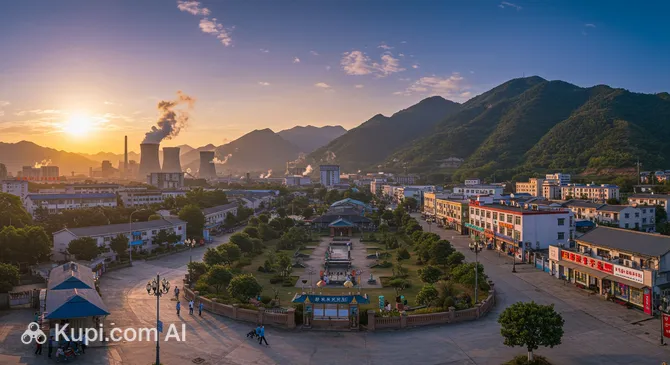
Located in the heart of Jilin Province, Huadian is a typical industrial and residential hub of northeastern China. This county-level city doesn't strive for the top spots in tourist rankings, instead attracting visitors with its sincerity and steady pace of daily life. Here, you can feel the true spirit of the Dongbei region, where industrial power coexists with vast forest landscapes.
Huadian. Illustration.
Source: Kupi.com AI
Geographically, the city is situated in a hilly area, which has largely shaped its development. With a population of about 455,000 people, Huadian is an important administrative center. The history of this region is closely tied to the development of natural resources and forestry, which is still reflected in the district's appearance and economy.
While the city is not brimming with world-famous landmarks, its uniqueness lies in the details: cozy parks, lively local markets, and the hospitality of its residents. Huadian is an excellent choice for those who want to see "off-the-beaten-path" China and get an unfiltered look at life in Jilin Province. We invite you to take this small but deep dive into the life of the Middle Kingdom's northeast.
Weather Overview
The climate in Huadian is distinctly continental, typical of the northeastern regions of China. Travelers should prepare for significant seasonal temperature fluctuations: harsh, snowy winters and fairly warm, sometimes humid summers await you here.
The winter period in the county is long, with average temperatures in January around -13.6°C, while nighttime frosts can reach -20°C and below. Snow cover usually lasts for 4–5 months. Summer months, by contrast, are pleasantly warm: in July, the average temperature is about 23.6°C, and during daytime hours, the air can heat up to +30°C. Peak precipitation occurs in July and August, which should be considered when planning walks.
When choosing a time for your trip, remember that the transition seasons—spring and autumn—are quite short here. If you want a more detailed weather forecast for the city, we recommend checking the data just before departure, as the continental climate sometimes brings surprises in the form of sudden cold snaps or prolonged rains.
Average monthly temperature
Average monthly precipitation
Interesting Facts
Administrative Status: Despite its size, Huadian is officially a county-level city within the prefecture-level city of Jilin.
Corporate Namesake: The city's name is identical to the giant state-owned energy company China Huadian Corporation, though there is no direct connection between the city and the corporation.
Forest Wealth: The city is surrounded by dense forests, which historically made forestry one of the key sectors of the regional economy alongside industry.
Compactness: The city's population of nearly half a million is concentrated in a fairly compact urban zone, creating high building density typical of Chinese county centers.
Geographic Remoteness: The coordinates of the city center (42°58′ N) confirm its position deep within Northeast China, far from the major coastal metropolises.
How to Get There
The transport accessibility of Huadian is determined by its location in Jilin Province. The city is not a major transport hub, so travelers most often use it as a transit point or travel here from nearby administrative centers. It is best to plan your route through the region's major cities, such as Jilin or Changchun.
There is no direct air connection to the city, as Huadian does not have its own airport. The nearest international airports are located in Changchun (Longjia Airport) and Jilin. From there, it is most convenient to reach Huadian by intercity buses or transfer. The travel time by car from Jilin is about 2–3 hours, and from Changchun, it is around 4–5 hours.
Rail service is another reliable way to reach this region. Although high-speed lines do not yet run directly to Huadian itself, you can take trains to the nearest junction stations in neighboring counties and then transfer to local transport. Regular bus routes connect Huadian with the Jilin bus station, ensuring a steady flow of passengers throughout the day.
Huadian is primarily an industrial and residential center, so you won't find high-profile historical monuments of national significance here. The main points of interest are concentrated in the heart of the city, where daily life is in full swing. The Central Square is the main meeting and walking spot, surrounded by major administrative buildings and shopping areas.
For the curious traveler, local markets and shopping centers can be quite interesting. These are not just places for shopping, but true centers of social life where you can observe the local color and purchase authentic regional goods. Huadian's urban architecture reflects the practical approach to construction characteristic of many county-level cities in northeastern China.
Despite the lack of major museums, the city itself serves as a kind of exhibit, showcasing the life of modern working-class China. Many view Huadian as a convenient transit point on the way to larger cultural centers of the province, such as Jilin City, enjoying the views of the hilly forest landscapes surrounding the county along the way.
Local Cuisine
Huadian's culinary traditions are inextricably linked to the cuisine of Northeast China (Dongbei), which is famous for being hearty and simple. The main emphasis here is on meat dishes, an abundance of vegetables, and various pickles. One of the signature dishes that you must try is Guobaorou—crispy pork in a sweet and sour sauce, which has become a hallmark of the region.
Thick soups with sauerkraut and pork are also popular, as are various jiaozi dumplings with a wide variety of fillings. Due to the proximity to forests, dishes made with wild mushrooms and other forest treasures are often found on local menus. Meals are usually accompanied by green tea or local beer, which is valued here for its light and refreshing taste.
The city's gastronomic scene is mainly represented by cozy family restaurants and street stalls in markets. It is customary here to eat simply and without much ceremony. The most authentic flavors can be found at the central market, where food is prepared right in front of you. This is an excellent opportunity to experience the true taste of Jilin Province at very affordable prices.
Travel Tips
Planning a trip to an authentic city like Huadian requires a special approach to ensure your journey is as comfortable and interesting as possible. We have prepared several tips to help you adapt more quickly to the local pace of life.
Clothing and Essentials: The climate in the region is sharply continental. Winters are very cold and long, so be sure to bring high-quality thermal underwear and down jackets. In summer, light clothing and comfortable shoes for walking in the hilly terrain will come in handy.
Transport: The best way to get around the city is by taxi or on foot in the center. Install the Didi app to call a taxi; this will significantly simplify communication with drivers.
Finances: The main currency is the Chinese yuan. International cards are rarely accepted, so always have cash or a set-up WeChat Pay/Alipay wallet with you.
Health and Safety: The city is very safe, and the crime rate is extremely low. Pharmacies can be found in the center, but it is better to bring basic medicines with you. During the cold season, use skin moisturizers due to the dry air.
Communication: English is practically non-existent here. Be sure to download an offline translator and have a card with the name of your hotel in Chinese.
Local Etiquette: Residents of Huadian are friendly but may show curiosity toward foreigners. Be polite; a simple smile and a nod are universal ways of greeting.
What to Avoid: You should not head into industrial zones on the outskirts of the city after dark, as there may be poor lighting and a lack of sidewalks.
Registration: Remember that when staying outside of major hotels, foreigners must register with the local police station within 24 hours.
May your introduction to Huadian be a pleasant discovery and provide a unique experience of immersion into the real life of Northeast China. Safe travels!
Entertainment & Nightlife
Entertainment in Huadian is predominantly quiet and local, reflecting the preferences of the residents. There is practically no traditional nightlife with an abundance of clubs and bars here. The main evening leisure activities for locals remain karaoke halls (KTV), which are very popular throughout the region, as well as visiting evening markets where people grab a snack and socialize in an informal setting.
During the day, residents and visitors prefer to spend time in small city parks or shopping centers. The crowd here is simple and friendly, and the atmosphere in local establishments is devoid of pretension or strict dress codes. If you are looking for more vibrant experiences, concert venues, or modern cinemas, you should plan a trip to the province's administrative center, Jilin City, which can be reached in a couple of hours.
For evening walks, it is best to stick to the central well-lit streets. Overall, Huadian is very safe after dark, and calling a taxi via the Didi mobile app is easy even late at night. This place is ideal for those who value peace and the chance to take a break from the noise of megacities in the atmosphere of an authentic Chinese county.
Parks & Museums
Huadian's green spaces are represented by small but cozy municipal parks, located mainly in the central part of the city. They serve as a place of rest for residents of all ages: here you can see morning Qigong exercises, elderly people playing chess, and families out for a walk. The compactness of the city parks is more than compensated for by the forested hills surrounding the county, which provide the city with fresh air.
There are currently no specialized museums or large art galleries in Huadian. The cultural life of the city is concentrated in cultural centers and open-air venues during festivals. Nevertheless, a walk through the central districts provides a better understanding of the history of this industrial region's development than any exhibit. For fans of large-scale museum collections, it is recommended to set aside a day for a trip to Jilin City, where larger historical and art collections are presented.
The lack of major tourist sites makes visiting local parks a particularly valuable experience—here you will encounter regular life in the Chinese provinces rather than crowds of tourists. The natural landscapes around the city are great for light walks and picnics, allowing you to enjoy peace and quiet away from the industrial zones.
Getting Around
The public transport system in Huadian is simple and functional, fully meeting the needs of a compact county center. The backbone of transport is municipal buses and route taxis, which connect the central districts with the outskirts and industrial zones. Service intervals during the day usually do not exceed 10–20 minutes, making travel around the city quite convenient.
Fares are paid in cash upon entry or through popular Chinese mobile services. The cost of a bus ride is minimal, amounting to just a few yuan. There are no subways or trams in the city, but thanks to the lack of serious traffic jams, ground transport handles its tasks efficiently. During peak hours, buses can be overcrowded, so it is worth planning your trips in advance.
An alternative to public transport is taxis, which can be easily hailed on the street or called via the Didi app. Taxi rides within the city are inexpensive and are the fastest way for a tourist to get around. In the warm season, electric bikes and scooters are popular and can be found at every turn, adding a special flavor to the city's traffic.
Accommodation
The choice of accommodation in Huadian is primarily geared toward business travelers and transit tourists, so luxury five-star hotels should not be expected. The majority of the hotel stock consists of budget 2–3 star hotels, guesthouses, and short-term rental apartments. Most accommodation options are concentrated near the railway station and the bus terminal, which is convenient for those arriving in the city for a short stay.
Accommodation prices in the city remain very affordable, ranging on average from 100 to 300 yuan per night. This makes Huadian an accessible destination for budget travelers. When looking for a place to stay, it is recommended to pay attention to reviews regarding cleanliness and the availability of necessary amenities, as service in provincial hotels may differ from standard international expectations.
It is better to book accommodation in advance, especially if your trip coincides with Chinese public holidays when demand for domestic travel spikes. For searching and booking, you can use both international services and local Chinese apps, which often offer a wider range of options in smaller counties like this.
Nearby Cities
Huadian serves as a convenient starting point for exploring the lesser-known but interesting corners of Jilin Province. Proximity to major transport arteries allows for easy planning of day trips to neighboring cities, each of which has its own unique character.
Just 97 kilometers away is Jilin (Jilin City), the province's second-largest city. It is famous for its picturesque embankments along the Songhua River and the unique natural phenomenon of "rime on trees" during the winter. For those interested in the history and modern life of small Chinese towns, Meihekou and Jiaohe, which are also about 100 kilometers away, are excellent destinations.
Exploring the surroundings of Huadian will allow you to better understand the diversity of China's northeastern region. Whether it's a trip to the lively Longtan or a visit to the more peaceful Yunshan, each of these destinations will add new colors to your journey through Jilin Province.
Shopping & Souvenirs
Shopping in Huadian is primarily about getting acquainted with local life and daily goods. You won't find boutiques of global brands here, but you can immerse yourself in the atmosphere of noisy and colorful Chinese markets. The main commercial activity is concentrated around the central square and the adjacent streets, where small shopping centers and specialized stores are located.
The main places for shopping are the central markets, which offer a huge selection of fresh produce, clothing, and household goods. This is the ideal place to purchase local delicacies. From Huadian, it is worth bringing back gifts from the forest: forest honey, dried mushrooms, and local tea. Prices here are significantly lower than in major metropolises, and the quality of products is often higher due to the proximity to ecologically clean areas.
Shops usually operate from early morning until 8–9 PM. The main payment methods in the city are mobile apps like WeChat Pay and Alipay, but it is always useful to have cash yuan on hand in small market stalls. The Tax-Free system is usually not available in such small towns, but the low price levels more than compensate for the lack of a tax refund.