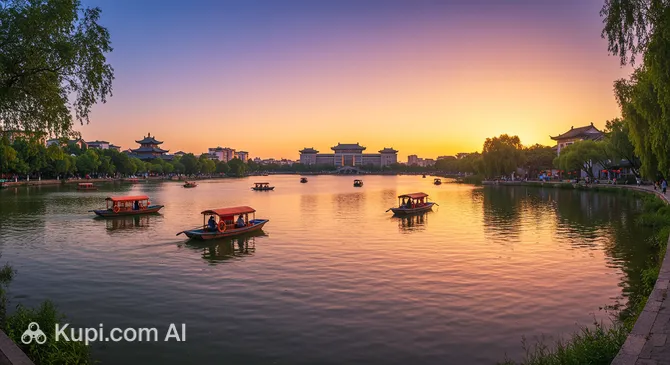
Suqian is an amazing fusion of antiquity and modernity located in the northern part of Jiangsu Province, China. A city with a history spanning over 2,500 years, it is situated on the shores of the picturesque Hongze Lake and served as a vital hub on the legendary Grand Canal for centuries. Today, it is a dynamically developing center with a population of about 5 million, while retaining the charm of an old river port.
Suqian. Illustration.
Source: Kupi.com AI
The city's atmosphere is inextricably linked to the name of the great general Xiang Yu, who was born here in the 3rd century BC. Visitors are drawn by the rich historical heritage: from ancient temples and memorial complexes to traces of the Tang and Ming dynasties. Suqian is also known as the birthplace of the famous Chinese spirit, baijiu, the production of which flourished thanks to the fertile land and the region's purest water resources.
A journey to Suqian is an opportunity to immerse yourself in the authentic culture of the Middle Kingdom, stroll through gardens and parks, and experience the scale of grand engineering achievements of the past. Whether you are an archaeology enthusiast, a gourmet, or a nature lover, everyone will find something inspiring here.
Weather Overview
Suqian is characterized by a moderate continental climate with distinct seasonality, influenced by the proximity of Hongze Lake. Spring and autumn are considered the most favorable periods for a visit: during this time, comfortable temperatures from +15°C to +25°C are established, and nature delights with bright blooms or golden foliage. These are ideal conditions for long walks by the canals and exploring historical monuments.
Summer in the region is hot and humid, with average temperatures around +28°C, but in July and August, the thermometer often rises to +35°C, accompanied by heavy rainfall. Winter is quite cold and dry, with temperatures dropping to -2°C...-5°C and piercing winds. To better prepare for your trip, we recommend studying the detailed city climate in advance.
Average monthly temperature
Average monthly precipitation
Interesting Facts
Suqian is a city hiding many amazing secrets that can surprise even the most seasoned traveler.
Birthplace of a Legend: The city is the birthplace of Xiang Yu, one of the most powerful and romanticized military leaders in the history of Ancient China.
Terracotta Army: It houses its own Museum of Terracotta Warriors of the Han Dynasty, which contains thousands of detailed 2nd-century BC figures discovered in princely tombs.
Artery of the Empire: Suqian is strategically located on the Grand Canal — the oldest and longest artificial waterway in the world, which contributed to the city's prosperity for centuries.
Spirit Capital: Suqian is widely known as a center for the production of baijiu — a traditional Chinese strong alcohol famous for its exceptional purity.
Rock Mysteries: Mount Guishan contains unique rock-cut princely tombs, which are complex architectural structures carved directly into the stone.
How to Get There
The transport accessibility of Suqian makes it a convenient destination for domestic and international tourists. The main aviation hub nearby is Nanjing Airport (located about 200 km away), from where the city can be quickly reached by high-speed train in just a couple of hours. There is also the local Suqian Shaoyang Airport, which accepts flights from China's major metropolises, such as Beijing and Shanghai.
Railway connection is the most popular and comfortable way to reach the city. Thanks to modern tracks, the journey from Shanghai takes about 3–4 hours, and from Beijing — from 4 to 5 hours. High-speed trains arrive at the central station, from where it is easy to reach any point in the city. More detailed information on routes can be found on the how to get to Suqian page.
Station
Passenger traffic
Distance
Huai'an East Railway Station
3
95 km
Xuzhou railway station
9
105 km
Lianyungang railway station
6
108 km
Linyi Railway Station
3
119 km
Yancheng Railway Station
3
188 km
For those who prefer a car journey, the G2 and G3 expressways pass through the city. Bus service is also well-developed: local bus stations receive regular bus services from neighboring provinces and major cities in East China. Although the Grand Canal is still used for transport, it is currently used less frequently for tourist passenger travel than railways.
Main Attractions
One of the most majestic locations in Suqian is the Xiang Yu Native Land memorial complex. This large-scale ensemble with traditional temples, museums, and gardens immerses visitors in the era of the fall of the Qin Dynasty and tells the dramatic story of the great hero whose exploits still inspire the people of the Middle Kingdom.
No less impressive is the Dragon King Temple (Longwangmiao), built in 1684 under Emperor Kangxi. This palace complex, occupying a significant area, served as a place for emperors to pray for protection against floods. Its glazed tiles and symmetrical layout are considered a benchmark of Qing period architecture and attract connoisseurs of ancient building craft.
Archaeology lovers should visit the Terracotta Warriors Museum and the tombs at Mount Guishan. The unique rock-cut tombs of the Han Dynasty princes and the thousands of small but detailed figures of warriors and servants found here allow you to touch the life and culture of antiquity. Walks through the old streets of the city will also reveal views of the traces of the Grand Canal and residences from the Qing Dynasty era.
Local Cuisine
A gastronomic journey to Suqian is unimaginable without an introduction to the local baijiu. This strong sorghum spirit has been produced here for centuries and is considered one of the benchmarks in China due to its crystal purity and rich flavor. In local restaurants, baijiu is often served as an accompaniment to a formal dinner, emphasizing the status of the guest.
The region's cuisine, which follows the traditions of Jiangsu Province, is based on fresh products from Lake Hongze and the Grand Canal. Be sure to try dishes made from lake fish, tender shrimp, roasted eel, and fragrant seaweed soups. Local chefs masterfully combine the natural taste of ingredients with light sauces, creating harmonious and healthy dishes.
Special attention should be paid to the street food at the markets by the river and in the Confucius Temple area. Here you can find authentic rice cakes, dumplings with various fillings, and traditional sweets. Restaurants in the historical quarters offer not only delicious food but also the opportunity to enjoy a meal in interiors that recreate the atmosphere of old China.
Travel Tips
To ensure your introduction to Suqian goes as smoothly as possible and brings only pleasant impressions, we have prepared a set of practical tips.
Clothing and Essentials: Choose your wardrobe according to the season (light cotton for humid summers, thermal underwear for cold winters). Be sure to take comfortable shoes for walking through extensive memorial complexes and paved streets.
Transport: Within the city, it is most convenient to get around by taxi via the Didi app. For buses, a transport card or small cash may be useful.
Finance: The official currency is the yuan. Large hotels accept cards, but for small purchases and food at markets, it is better to have Alipay or WeChat Pay payment systems set up.
Communication: English is not widely spoken. Download an offline translator and carry a hotel card with the address in Chinese.
Etiquette: When visiting temples, observe silence and do not photograph statues without explicit permission. Respect local traditions and greet people politely.
Connectivity: It is better to purchase a local SIM card immediately upon arrival in China for access to maps and translators. Wi-Fi is available in most public places.
What to Avoid: Do not plan important travel during rush hours and do not overindulge in baijiu, as this drink is much stronger than it might seem at first glance.
Museums: Study the history of the Han Dynasty in advance, as descriptions in local museums are often presented only in Chinese.
May these tips help you feel the true spirit of the city and enjoy every moment of your adventure in Suqian!
Entertainment & Nightlife
Entertainment in Suqian is primarily cultural and tranquil. Life after sunset concentrates in the historical quarters and along the embankments of the Grand Canal. In the evening, the illumination lights up, creating a fairytale atmosphere for boat trips or a leisurely dinner at waterside restaurants.
For lovers of traditional art, the Liuqin opera performances, which often take place at venues near the Dragon King Temple during festivals, will be a real find. This bright and emotional spectacle allows for a better understanding of the region's soul. During the day, it is worth visiting local exhibition halls and strolling through the gardens of the Xiang Yu Memorial, where history comes to life in landscape design.
Although the city does not have an abundance of noisy nightclubs, there are many cozy tea houses and small bars where you can try the famous local baijiu in a peaceful setting. Night markets offer not only delicious street food but also the opportunity to enjoy live music under the open sky. To return safely to your hotel at night, it is best to use an official taxi, which is easy to call via a mobile app.
Parks & Museums
Suqian is rich in green areas and cultural treasures. The Xiang Yu Memorial Complex is not just a museum but a huge landscape park where the architecture of ancient pavilions and temples harmoniously combines with shady alleys. A walk here allows you not only to learn the history of the legendary hero but also to enjoy the silence in traditional gardens.
The city's natural beauty unfolds on the shores of Lake Hongze and along the Grand Canal. Coastal parks offer picturesque trails for walking and cycling, while modern promenades connect historical monuments into a single recreation zone. For relaxation lovers, the area around the Dragon King Temple, where ancient trees have been preserved and an atmosphere of tranquility reigns, is ideal.
The main cultural attraction is rightfully considered the Museum of Terracotta Warriors of the Han Dynasty. The exhibition showcases thousands of ancient figures found in princely tombs of the 2nd century BC, striking the imagination with the scale of archaeological finds. It is also worth paying attention to the tombs on Mount Guishan, which represent a unique combination of natural landscape and ancient engineering.
Getting Around
The transport system of Suqian is focused on the convenience of residents and guests. The backbone of public transport consists of modern bus routes that connect the center with the outskirts and key attractions, such as the Dragon Temple. Fares are low, and routes cover all important tourist locations, making buses an affordable way to get around.
Taxis in the city are accessible and popular. It is recommended to use the Didi app, which allows you to see the trip cost in advance and avoid translation difficulties. A trip around the city usually starts from 10 yuan. Payment is most often made via mobile app QR codes, which have become standard in China, but cash yuan are also accepted by drivers.
Suqian is actively developing modern modes of transport, including high-speed trams. For strolls along the Grand Canal embankments and in historical zones, bicycles are ideal and can be rented through numerous rental services. Walking routes through the city center are also well-thought-out and allow for a detailed study of the architecture without any rush.
Accommodation
For those planning a visit to Suqian, the most convenient area to stay in is the city center, near the Xiang Yu Memorial or the railway station. High-quality hotels of well-known chains, including Holiday Inn, as well as comfortable 4-star local hotels are concentrated here, many of which offer rooms with panoramic views of the canal.
Travelers looking for more budget-friendly options can find cozy guesthouses in the historical quarter. This is a great way to immerse yourself in the local flavor and be within walking distance of the main museums. The average cost of staying in a comfortable room in the center starts from 300 yuan per night. For those who prefer peace and nature, accommodation options are available near Lake Hongze.
During the peak tourist season and during cultural festivals, it is recommended to book accommodation in advance through international services or popular Chinese aggregators. Pay attention to the availability of English-speaking staff, as knowledge of foreign languages can be limited in smaller hotels.
Nearby Cities
Suqian serves as an excellent starting point for exploring the northern part of Jiangsu Province. Thanks to the developed network of high-speed railways, it is easy to go on a short trip to neighboring areas to see even more facets of Chinese culture and nature.
In just one to two hours, you can reach Nanjing — a majestic ancient capital with its historical monuments. Also interesting are trips to neighboring Siyang, famous for its parks, or to the industrial and cultural center of Pizhou. The nearby city of Shuyangzha also offers its own unique attractions available for a day visit.
The region around Suqian is rich in picturesque lakes and historical canals, which makes trips to cities like Mingguang a pleasant addition to the main route. Exploring the surroundings will allow you to feel the rhythm of life in East China more deeply and discover less known but charming tourist locations.
Shopping & Souvenirs
Shopping in Suqian is primarily an opportunity to purchase unique goods with a rich history. The main souvenir is certainly the famous locally produced baijiu, which is valued throughout the country. In specialized stores, you can find collectible items in beautiful packaging, as well as traditional ceramics and silk products.
For authentic purchases and souvenirs, it is best to head to the historical quarters near the Confucius Temple and the markets by the Grand Canal. Folk crafts are sold here, including textiles and miniatures dedicated to Xiang Yu. A walk through the shopping rows is not only a search for goods but also an immersion into the atmosphere of traditional Chinese trade.
Modern shopping centers are located mainly in the central part of the city. They feature popular Chinese and international clothing and electronics brands. Most stores are open from 10:00 to 21:00 or 22:00, and payment is most often made through popular mobile apps, although credit cards are accepted in large malls.